Are headhunters worth it for early-stage startups?
Jan 19, 2026

Short answer: Yes, but only in specific situations.
Early-stage startups often face tight budgets, limited resources, and time constraints when hiring. Headhunters can save time and connect you with top talent, especially for senior, niche, or time-sensitive roles. However, their fees - usually 20%-30% of a hire's first-year salary - can strain a startup's finances. Alternatives like in-house recruiters, employee referrals, or recruitment tools may be more cost-effective for larger hiring needs.
When to consider headhunters:
Filling executive or specialized roles.
Scaling quickly after funding.
Handling confidential hires.
Drawbacks to watch for:
High costs (e.g., $30K-$45K for a $150K role).
Potential mismatches if recruiters don’t understand your company.
Risk of underperformance from agency hires (41% fail within 6 months).
Key takeaway: Use headhunters for critical roles or when internal resources are maxed out, but for long-term hiring, invest in building internal recruitment processes or leveraging tools like LinkedIn and GitHub.
Executive Hiring Advice from the Founder of Tech’s Top Recruiting Firm

Common Hiring Challenges for Early-Stage Startups
Early-stage startups often grapple with three major recruitment hurdles: tight budgets, limited founder availability, and the struggle to establish a strong brand identity.
Limited Resources and Budget
Startups typically operate on lean budgets, and hiring can quickly become a costly endeavor. Traditional headhunters charge 20%–30% of a candidate's first-year salary as a placement fee, and a poor hiring decision can cost up to twice the employee's annual salary when you factor in lost productivity, team morale issues, and the time it takes to find a replacement. For example, hiring ten employees - five entry-level roles at $50,000 each and five managerial positions at $100,000 - could rack up $150,000 or more in fees.
Hiring an in-house recruiter might seem like a cost-saving solution, but it comes with its own price tag, exceeding $70,000 annually when you include salary, benefits, and overhead. These financial demands can stretch a startup’s resources thin.
And it’s not just about money - recruitment also eats up a lot of time, which is another resource founders can’t afford to waste.
Time Constraints and Founder Bandwidth
Recruiting takes up more than 10 hours a week for tasks like sourcing candidates, screening resumes, and scheduling interviews. That’s time founders could otherwise spend on critical activities like building the product, securing funding, or connecting with customers. The Betts Team at Betts Recruiting captured this challenge perfectly:
"Every hour spent recruiting is an hour not spent on product, fundraising, or customers. And that can stall growth."
To fill a single technical role, founders often need to reach out to 50 to 100 candidates, with response rates hovering around 30% at best. Hiring two engineers could mean coordinating 60 to 150 interviews, all while managing the day-to-day demands of running a startup. It’s a grueling process that can overwhelm even the most organized founders.
And then there’s the challenge of convincing top talent to join a company that’s still building its reputation.
Limited Brand Recognition
Competing with well-known companies like Uber, Slack, or Stripe for talent is no small feat. Around 70% of job seekers are drawn to these established "rocket ship" brands because they offer a sense of stability and prestige, making the decision easier to explain to friends and family. Tammy Han from First Round’s Talent Team put it plainly:
"It's easier to join the winners than to pick them."
For early-stage startups, the lack of a recognizable name often translates to being perceived as risky and unproven. Candidates may hesitate to join, favoring the perks and security of established Silicon Valley companies. Without a strong brand to rely on, founders must rely heavily on selling their vision and passion - a completely different approach compared to the recruitment strategies of larger companies.
When Headhunters Add Value to Startups
Startups often face tight budgets and urgent hiring needs, making it essential to determine the right moments to involve headhunters. While there are challenges to outsourcing recruitment, headhunters can offer distinct advantages in specific scenarios. The key is understanding when their expertise is worth the investment versus when it’s better to handle hiring internally.
Situations Where Headhunters Make Sense
Headhunters shine when your internal resources are maxed out. For example, if you’re trying to fill executive positions like VP of Engineering, VP of Marketing, or VP of Sales but have already exhausted your board’s network, headhunters can step in. They’re also invaluable for niche roles, such as AI ethicists, quantum computing engineers, or manufacturing automation specialists. These professionals often belong to the 70% to 80% of passive talent who aren’t actively job hunting. Headhunters specialize in reaching this group and can fill such roles about 30% faster than internal teams.
Another scenario is during rapid scaling after securing funding. For instance, after closing a Seed or Series A round, you might need to build an entire team in a matter of weeks. Whether it’s a technical founder assembling their first sales or customer success team, or a company ramping up across multiple departments, headhunters can help meet these tight timelines.
They’re also crucial for confidential searches. If you need to discreetly replace an underperforming executive, external recruiters can manage the search while maintaining your company’s reputation.
Ultimately, deciding to hire a headhunter boils down to opportunity cost. If the time you’d spend on recruiting would be better spent on product development or fundraising, it may be worth paying the recruitment fee. These scenarios illustrate the strategic edge that headhunters can provide.
Benefits of Using Headhunters
One major benefit is speed. For specialized roles, headhunters can often deliver qualified candidates 2 to 4 weeks faster than internal efforts. For example, in December 2025, Abett was able to fill a niche data role within this timeframe by leveraging targeted sourcing to secure a passive candidate who wasn’t actively job hunting.
Another advantage is access to talent pools that startups might not reach on their own. While internal teams typically rely on job boards and existing networks, recruiters tap into specialized communities on platforms like GitHub or Slack and stay updated on salary expectations, equity norms, and benefits trends. For instance, AI startup Shaped filled four crucial positions - including Solutions Engineer and Account Executive - within four months of raising an $8 million Series A round. This allowed the founders to focus on fundraising and product development instead of recruitment.
Additionally, many agencies offer a 60- to 180-day replacement guarantee. This reduces the risk of a bad hire, as the recruiter will provide a replacement if the initial hire doesn’t work out.
Drawbacks and Risks to Consider
Despite their advantages, headhunters come with some significant risks. Cost is the most obvious concern. Contingency fees generally range from 15% to 30% of the new hire’s first-year salary. For example, hiring an engineer with a $150,000 salary could cost between $22,500 and $45,000 in fees. For executive roles, retained search fees can exceed $100,000.
Quality can also be an issue. According to industry data, 41% of hires made through agencies underperform in their first six months. As Maryna Sivaieva from Pear VC points out:
"The most effective founders don't outsource critical work... They seek help strategically; finding ways to extend their time, not to hand off responsibilities."
Outsourcing recruitment can also create bottlenecks. You lose direct control over the candidate experience and messaging, which can lead to mismatches if the recruiter doesn’t fully understand your company’s culture. Additionally, candidate ownership clauses - where agencies retain rights to a candidate for 6 to 12 months - can lead to disputes if that candidate reappears through another channel.
Before committing to a headhunter, it’s smart to do your homework. Ask for sample resumes and speak with past clients to assess their track record and approach.
Cost-Benefit Analysis: Headhunter Investment for Startups
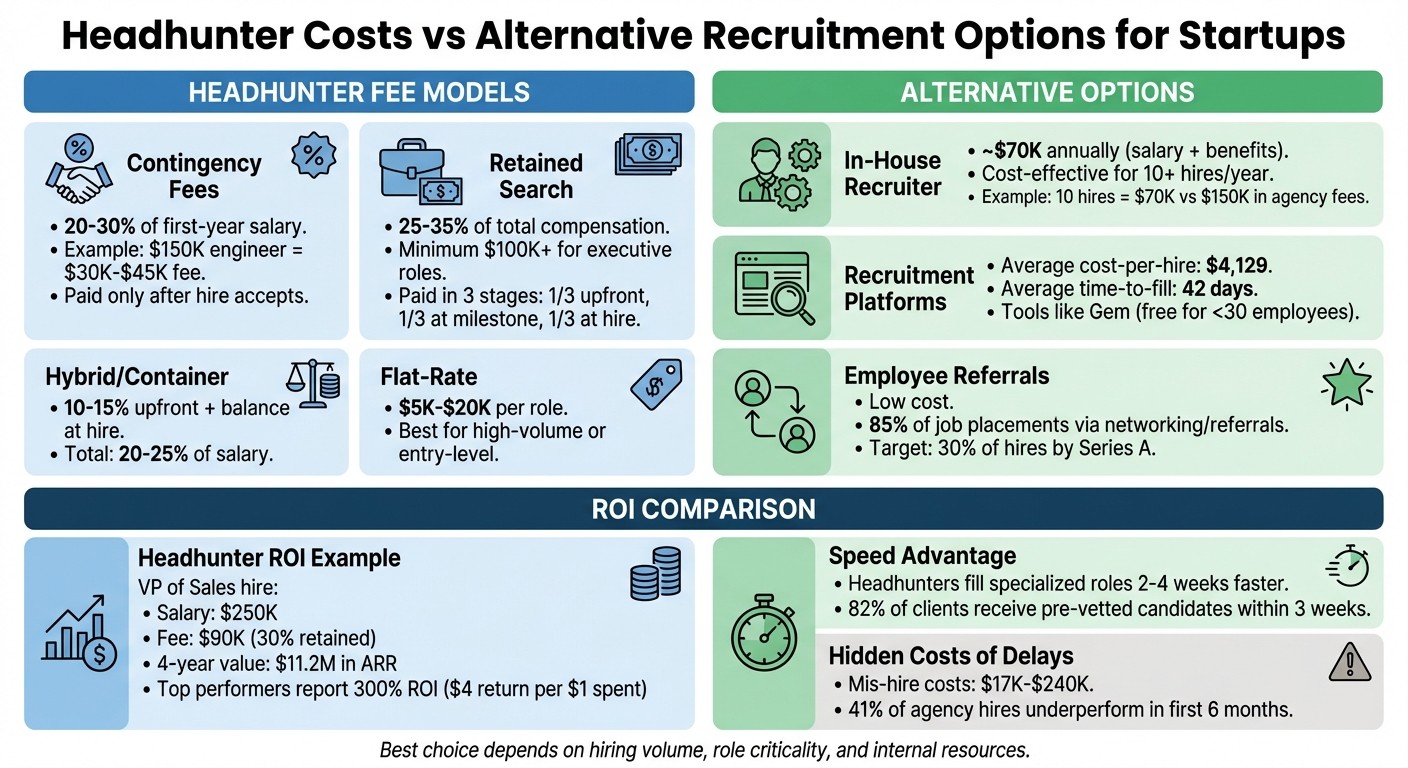
Headhunter Costs vs Alternative Recruitment Options for Startups
How Headhunter Fees Work
Headhunters typically operate under three main payment models:
Contingency fees: These range from 20% to 30% of the new hire's first-year salary and are paid only after a candidate accepts your offer. For instance, hiring a senior engineer with a $150,000 salary could cost you between $30,000 and $45,000 in fees.
Retained search fees: This model is common for executive roles. Fees usually fall between 25% and 35% of the total cash compensation and are paid in three stages: one-third upfront, one-third at a key milestone (like presenting finalists), and the final third upon hiring. These searches often come with minimum fees starting at $100,000, and larger firms generally avoid roles with salaries below $300,000.
Hybrid or "container" models: These involve a smaller upfront fee, typically 10% to 15%, with the remaining balance - bringing the total to about 20% to 25% - paid once the hire is made. This structure balances upfront commitment with results-driven payment.
Some agencies also offer flat-rate pricing, ranging from $5,000 to $20,000 per role, particularly for high-volume or entry-level positions. In some cases, startups with limited cash flow may negotiate to pay part of the fee in equity or stock options, which usually vest over the candidate's guarantee period.
Understanding these fee structures is essential for weighing the potential return on investment (ROI) of using headhunters.
Comparing Costs Against Benefits
To assess whether headhunter fees are worth it, consider them as micro-investments in talent acquisition. As Adam Gellert puts it:
"Recruiting fees are micro-investment rounds earmarked for people. Investors pour money into your cap table expecting 5-10× returns. Why not judge headhunter spend by the same yardstick?"
Top-performing companies report ROI as high as 300%, translating to roughly $4 in value for every $1 spent. Take this example: hiring a VP of Sales with a $250,000 salary and a $4 million annual recurring revenue target. If they achieve 70% of their quota over four years, that’s about $11.2 million in lifetime value. In this case, a $90,000 headhunter fee (based on a 30% retained model) delivers a substantial return.
Beyond ROI, headhunters can save startups valuable time. They often fill specialized roles 2 to 4 weeks faster than internal teams. About 82% of clients report receiving pre-vetted candidates for niche tech roles within three weeks. Additionally, consider the "hidden costs" of hiring delays or mistakes - leadership time spent interviewing, vacancy-related losses, and mis-hire expenses can range from $17,000 to $240,000.
Other Recruitment Options and Their Costs
For startups, headhunters aren't the only option. Depending on your hiring needs, there are other approaches to consider:
In-house recruiters: If you're planning to make 10 or more hires annually, an in-house recruiter might be a more cost-effective solution. With an average total cost of around $70,000 (including salary and benefits), this approach can save money compared to paying $150,000 in agency fees for 10 hires at a 20% rate.
Employee referral programs: These are a low-cost alternative, and networking or referrals account for about 85% of job placements.
Recruitment platforms: Tools for sourcing and screening candidates can streamline the process. In the U.S., the average cost-per-hire is $4,129, and filling an open position typically takes about 42 days. While these platforms can cut costs and time, leadership involvement is still crucial for closing top candidates.
Ultimately, the right recruitment strategy depends on your hiring goals. For a few high-priority roles where speed and quality are critical, headhunters may provide the best value. However, if you're scaling your team significantly over the next year, building internal recruitment capabilities or leveraging technology might offer better long-term savings.
Other Recruitment Approaches for Early-Stage Startups
Using Recruitment Technology and Platforms
For startups working with limited resources, technology can be a game-changer when it comes to finding top talent. Tools like Gem simplify sourcing, outreach, and tracking. They even offer startups under 30 employees free access, with a 50% discount for teams of 30 to 100 employees during their first year.
Automation tools also save time and effort. For instance, the Hireflow Chrome extension makes it easy to add LinkedIn candidates to email campaigns with just one click, streamlining your outreach. If you're looking for extra support, freelance sourcers on platforms like Upwork can handle high-volume outreach. Beyond LinkedIn, some of the best talent can be found on niche platforms like GitHub (for engineers), Discord communities, X (formerly Twitter), and even university clubs.
For startups seeking speed, Caddie AI connects you with expert headhunters who can deliver shortlisted candidates in under 24 hours, with an average hiring time of less than 21 days. Payment is only required when you make a hire.
On top of leveraging these tools, investing in a strong employer brand will further boost your ability to attract exceptional talent.
Building Your Employer Brand
A compelling employer brand can help you recruit effectively, even with a tight budget. In the early days, the personal brand of your founders plays a huge role. Founders should actively share their vision and the unique challenges their company is tackling through blogs and social media.
As Workable puts it:
"Smart people want to solve interesting problems. They're not looking for a job, they're looking for a mission."
This is crucial because most new hires who fail within their first 18 months don't do so due to technical skill gaps. Instead, the issues often stem from a lack of motivation, temperament, or openness to feedback.
Highlight your team and company culture through employee spotlights, videos, and meetups. Use your career page to showcase culture videos, FAQs, employee testimonials, and clear descriptions of benefits. Transparency is key - be upfront about compensation and any risks involved, which will attract candidates who value growth and impact over just a paycheck.
Additionally, diversity and inclusion matter to candidates; 66% actively look for companies that prioritize these values. When combined with efficient processes, these efforts can create a well-rounded hiring strategy for your startup.
Creating Internal Hiring Processes
Developing a scalable internal hiring process early on gives you more control and helps cut costs in the long run. Founders should personally hire the first five to twenty employees to establish the company culture and set a high standard for talent.
Start by crafting a detailed sourcing document for each role. This should include LinkedIn indicators like specific job titles, locations, and years of experience, as well as a list of target companies for sourcing candidates. Focus first on your first-degree network (former colleagues) and second-degree connections (introductions from investors or advisors) before turning to cold outreach. By Series A, aim for about 30% of new hires to come from internal referrals.
For interviews, implement a structured five-step process: a founder phone screen, skills evaluation, work-style interview, work trial, and reference checks. Use a clear scoring system - either "Hire/No Hire" or a numeric scale (1–5) - with no neutral options. This approach ensures faster decisions and better candidate conversion.
Examples from successful startups highlight the value of these strategies. In 2014, Coinbase, with just seven employees, worked with recruiter Aurora Petracca to create effective outreach. This allowed the founders to focus on phone screens, helping the company grow from 7 to 700 employees. Similarly, in 2011, Airbnb brought on a contract recruiter when their team was just 18, enabling them to scale from 50 to 900 employees without compromising on talent quality.
These examples show that with the right tools, branding, and processes, even early-stage startups can build strong teams.
Conclusion: Choosing the Right Hiring Approach
Key Takeaways
Headhunters are often the go-to solution for filling mission-critical roles like CTO, CFO, or VP of Engineering - positions where delays or bad hires can have a huge impact. For early-stage startups, every hiring decision carries weight due to limited resources and tight timelines. However, the cost of headhunters - ranging from 15%-30% of the first-year salary or $50,000-$100,000+ for executive roles - requires careful consideration, especially for startups working within strict budgets. On the flip side, leaving key roles unfilled can lead to delayed launches, missed opportunities, and burnt-out teams.
Headhunters are particularly useful when your personal network has been exhausted, you’re spending more than 10 hours a week searching for candidates instead of focusing on core business tasks, or when you need to scale quickly after securing funding.
That said, there are alternative approaches that can work well for many startups. Recruitment platforms, a strong employer brand built through founder-driven content, and well-organized internal hiring processes can yield great results without the steep costs. As Aurora Petracca, a Startup Advisor with experience at Airbnb and Coinbase, explains:
"A recruiter should be among your first 10 hires... investing in recruiting talent at this early stage is of fundamental importance".
Ultimately, your hiring strategy should align with your stage of growth, available resources, and immediate business priorities.
Decision Framework for Startup Founders
To decide whether to engage a headhunter, consider these criteria. Hiring a headhunter might make sense if three or more of the following apply:
You’re recruiting for a senior or highly specialized role.
Your network and job boards are no longer yielding strong candidates.
You need to fill the position within six months.
Your internal team is stretched too thin to manage the process.
A poor hire would cause significant setbacks for your company.
Before committing, weigh the costs. If you’re hiring more than 10 roles a year, bringing on an in-house recruiter (at about $70,000 annually) is generally more cost-effective than repeatedly paying agency fees. For smaller hiring volumes or niche roles, external recruiters might still be the better option. You can also negotiate performance-based fees and include replacement guarantees in your contracts to protect against early departures (typically within 60 to 180 days).
The job market today is heavily candidate-driven. In fact, 86% of recruiters and 62% of employers acknowledge this reality. Whether you opt for headhunters, build an internal recruitment team, or leverage tools like Caddie AI - which connects you with expert headhunters who can deliver shortlists in under 24 hours and only charge when you hire - the ultimate goal remains the same: securing the right talent to fuel your company’s growth.
FAQs
When is it a good idea for an early-stage startup to hire a headhunter?
When early-stage startups find their hiring efforts slowing down progress or stretching internal resources too thin, it might be time to bring in a headhunter. This can be particularly helpful when:
Traditional methods like job boards, personal networks, and referrals haven’t worked.
The role is senior or highly specialized - think CTO, CFO, or VP of Engineering - where a poor hire or prolonged vacancy could be a serious setback.
Founders and team members are already juggling critical tasks like fundraising, product development, or managing customers, leaving little bandwidth for an in-depth hiring process.
Headhunters are also great for connecting you with top-tier candidates who aren’t actively looking for new opportunities. If a key role is central to your growth strategy and you lack the time or expertise to conduct an executive-level search, a headhunter can help you find the right person more efficiently. Of course, you’ll need to weigh the recruiter’s fee - typically 15–20% of the first-year salary - against the potential costs of making a bad hire or leaving the position vacant for too long.
What are the risks of using a headhunter for early-stage startups?
Using a headhunter for hiring can pose some notable challenges for early-stage startups.
First, the cost can be a significant hurdle. Headhunters typically charge fees ranging from 20% to 30% of a new hire’s first-year salary. For senior-level positions, this could easily exceed $100,000 - a steep expense for startups operating on tight budgets.
Second, headhunters may focus on speed or rely heavily on their existing network, which doesn’t always guarantee candidates who fit your company’s values or can thrive in a fast-moving startup environment. A mismatch like this can disrupt team dynamics and slow progress.
Third, outsourcing the recruitment process means you’re less involved in evaluating candidates directly. This can make it harder to gauge their motivations and may limit your ability to develop internal hiring expertise. For startups, where founders often play a hands-on role in building their teams, this reliance on external help could create long-term challenges.
Carefully consider these factors to determine whether working with a headhunter aligns with your hiring needs and financial resources.
How can early-stage startups afford headhunters without breaking their budget?
Startups can keep headhunter costs in check by reserving their services for high-impact roles, like a CTO or VP of Sales. These are positions where the value of the hire clearly outweighs the expense. For instance, with a typical 20% fee on a $150,000 salary, you’re looking at $30,000. By focusing on critical roles, you ensure that this investment delivers a worthwhile return.
To manage expenses further, consider negotiating flexible payment terms. Many headhunters offer contingency-based models, meaning you only pay if a hire is made. Others might cap their fees or even agree to accept partial equity, which spreads the cost over time. Setting clear payment milestones can also help. For example, you could arrange to make partial payments when a shortlist is delivered and pay the remaining balance after the hire completes their first 90 days. This approach minimizes surprises and keeps costs predictable.
Finally, always measure the return on investment for each hire. Say a senior engineer is expected to generate $500,000 in annual recurring revenue (ARR). In that case, a $30,000 fee seems like a smart tradeoff. By targeting high-value roles, negotiating terms, and tracking the impact of each hire, startups can leverage headhunters effectively without overstretching their budgets.