Best Countries to Hire Software Engineers in 2025
Dec 15, 2025
Looking for software engineers in 2025? Here's the deal: Hiring in the U.S. is tough due to high salaries and competition. Companies are now hiring globally to save costs (up to 53%) and fill talent gaps in fields like AI and cybersecurity. But where should you look?
Here’s a quick rundown of the top 5 countries for hiring software engineers, based on talent pool, costs, time zones, English skills, and hiring ease:
India: Largest talent pool (5.2M engineers), low rates ($15–$35/hour), but time zone differences can be tricky.
Canada: Nearshore option with strong English skills, competitive salaries ($59K–$112K/year), and easy collaboration.
Mexico: Affordable ($25–$45/hour), shared time zones with the U.S., but security protocols may need extra attention.
Poland: Skilled engineers with strong Java expertise, slightly higher rates ($35–$60/hour), and solid English proficiency.
Vietnam: Very affordable ($10–$18/hour), growing tech scene, but significant time zone challenges and varying English fluency.
Quick Comparison
Country | Talent Pool Size | Average Hourly Rates | Time Zone Overlap | English Proficiency | Ease of Hiring |
|---|---|---|---|---|---|
India | 5.2M engineers | $15–$35/hour | Limited | Moderate | Established ecosystem |
Canada | 1M+ tech workers | $59K–$112K/year | Excellent | High | Nearshore advantage |
Mexico | 225K+ developers | $25–$45/hour | Excellent | Good | Close to U.S. |
Poland | 430K developers | $35–$60/hour | Limited | High | Strong legal frameworks |
Vietnam | 500K developers | $10–$18/hour | Limited | Moderate | Growing market |
Bottom line: India and Vietnam are cost-efficient for scaling, while Canada and Mexico offer easier collaboration. Poland is ideal for specialized roles despite higher costs. Choose based on your priorities - cost, time zones, or expertise.
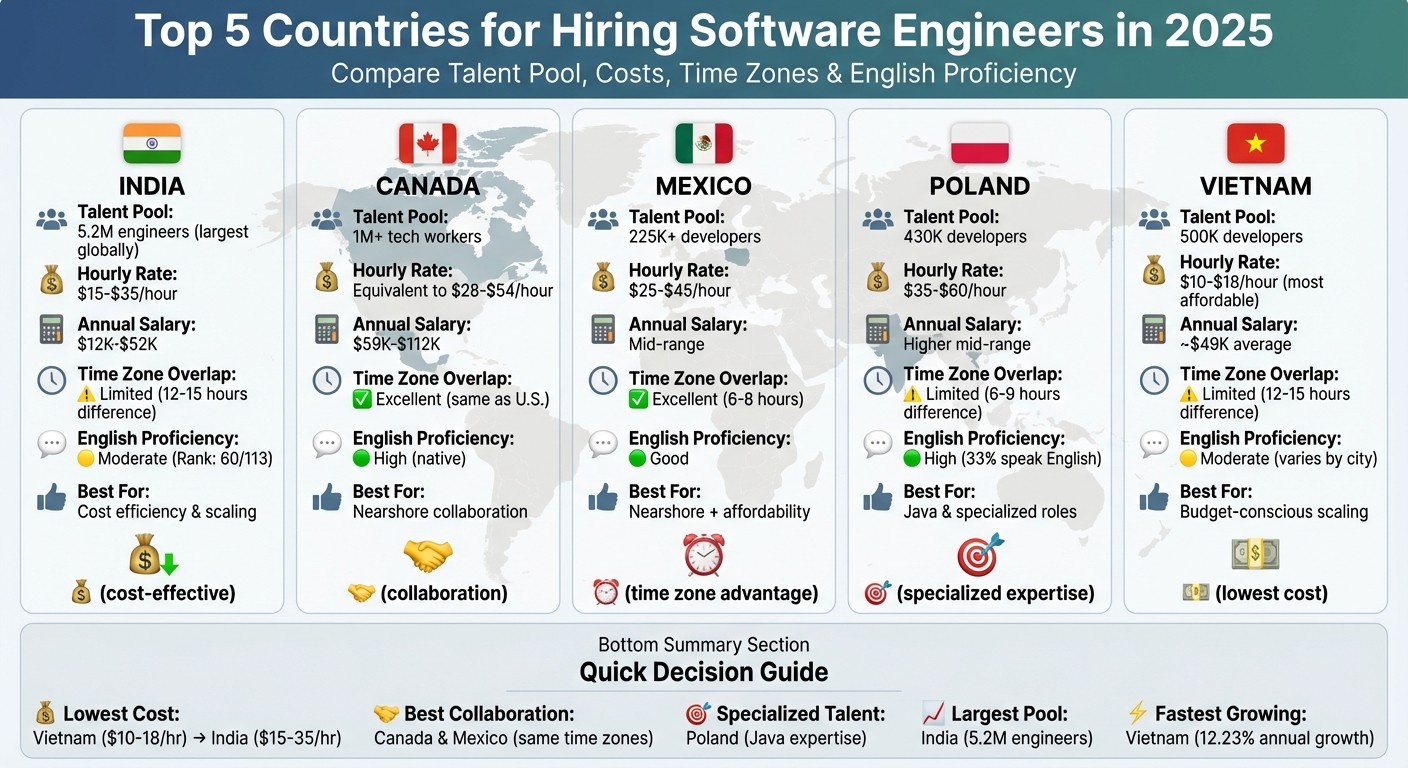
Top 5 Countries to Hire Software Engineers in 2025: Cost and Talent Comparison
1. India
Talent Pool Size
India stands out as a major hub for tech talent, offering a vast pool of 5.2 million software engineers and an IT outsourcing market valued at $11.04 billion in 2024. Key cities like Bengaluru, Hyderabad, and Pune serve as thriving technology centers, with expertise in popular programming languages such as Python, Java, C#, and JavaScript. A unique aspect of India's talent pipeline is that 18% of its developers are students - far surpassing the percentages in the U.S. (6%), Germany (11%), and the U.K. (5%). This ensures a steady flow of new professionals entering the industry.
Compensation in USD
India offers a cost-effective solution for companies aiming to scale their engineering teams. Hourly rates for software developers range from $15 to $35, while specialized roles like solution architects typically charge between $30 and $50 per hour. For full-time positions, the average annual salary for an AI software engineer is $12,000, and engineering managers earn around $52,000. To put this into perspective, an engineering manager in India earns roughly 25% of what their U.S. counterpart makes ($200,000) and about 44% of what a German manager earns ($118,000).
Time Zone Overlap
India’s time zone difference with the U.S. East Coast can be a challenge, often requiring teams to schedule meetings outside standard business hours. This is a noticeable drawback compared to countries in Latin America, such as Brazil and Argentina, which align more naturally with North American work schedules.
English Proficiency
India ranks 60th out of 113 countries on the EF English Proficiency Index, placing it in the moderate category. While many Indian developers are proficient in English and communicate effectively, there are regional and experience-based variations. It's important for companies to evaluate communication skills to ensure seamless collaboration.
Ease of Hiring
India’s well-established outsourcing ecosystem, supported by clear legal frameworks and numerous staffing agencies, makes the hiring process relatively straightforward. However, challenges like varying talent quality and time zone differences remain. These factors highlight both the opportunities and considerations when comparing India to other emerging tech hubs around the world.
2. Canada
Canada stands out as an attractive option for companies seeking global talent, thanks to its close proximity to the U.S. and alignment with American business hours.
Talent Pool Size
Canada's tech workforce has grown significantly, reaching over 1 million professionals by 2024. Among these, software engineers make up more than 35% of all tech roles. The demand for software engineers is expected to rise by 20% over the next five years, demonstrating the country's thriving tech market. Currently, there are 80,500 open developer positions nationwide. Major tech hubs like Toronto, Vancouver, and Montreal further enhance Canada's appeal, offering a rich pool of skilled professionals and a strong foundation for growth.
Compensation in USD
Salaries for Canadian software engineers are competitive when converted to U.S. dollars. On average, software engineers earn about $73,000 annually. Junior engineers typically make around $51,183 per year, while senior engineers average $73,184. Overall, developer salaries range from $59,000 to $112,248, providing flexibility for companies hiring across experience levels.
Time Zone Overlap
One of Canada’s key advantages is its shared time zones with the U.S., which ensures smooth collaboration and efficient workflows. Teams can easily schedule stand-ups, meetings, and pair programming sessions without the challenges posed by significant time differences.
English Proficiency
As one of Canada’s official languages, English is widely spoken, ensuring seamless communication between Canadian developers and U.S. teams. This fluency supports clear documentation, effective code reviews, and productive client interactions, reducing the risk of language-related issues.
Ease of Hiring
Canada's close geographical and cultural ties to the U.S. make it easier for American companies to hire and collaborate with Canadian talent. With the Canadian job market projected to grow by 5.6% in 2025, businesses have ample opportunities to access this well-established and expanding talent pool.
3. Mexico
Mexico has become a go-to destination for U.S. companies looking to build tech teams closer to home. Its location and shared time zones make collaboration easier, while its workforce offers a range of benefits for outsourcing software development.
Talent Pool Size
While exact numbers for Mexico's tech workforce aren't readily available, the country is well-regarded as a hub for skilled tech professionals. It stands out as a priority market, even though more detailed data exists for places like Canada and Vietnam.
Compensation in USD
When it comes to cost, Mexican software engineers provide a budget-friendly option. Their median salaries fall between Canada ($61,360) and Poland ($30,080), making Mexico an attractive choice for companies balancing cost and quality.
Time Zone Overlap
Mexico's time zones align closely with those in the U.S., offering 6–8 hours of overlap. Many developers work on Central Standard Time, which allows for real-time collaboration and smoother workflows without the hassle of late-night meetings.
English Proficiency
Mexican engineers generally have solid English skills, sufficient for handling technical discussions and documentation. That said, proficiency may vary, and some differences might be noticeable compared to countries where English is the native language.
Ease of Hiring
Being so close to the U.S., Mexico makes team integration and scheduling much simpler. Plus, the abolition of daylight saving time in October 2022 (except for certain northern border areas) has brought more consistent scheduling year-round, reducing potential disruptions.
4. Poland
Located in the center of Europe, Poland provides a prime location for U.S. companies seeking accessible global talent. Over the years, the country has built a strong reputation as one of Europe’s leading hubs for software development outsourcing. With a tech-savvy workforce and a solid education system, Poland offers a compelling option for businesses aiming to hire skilled engineers while keeping expenses manageable. This combination of talent and affordability underscores Poland's appeal in the global market.
Talent Pool Size
Polish universities churn out thousands of developers every year, steadily growing the country’s tech talent pool. By December 2025, Poland had over 120,000 job openings in high-paying professions. Polish developers are internationally recognized for their programming expertise and algorithmic skills. They are also well-regarded for their professionalism and adherence to Agile methodologies. However, the competition for top-tier talent is intense, with both local and global companies actively seeking to hire these skilled professionals.
Compensation in USD
Poland strikes a great balance between cost and quality, making it a standout outsourcing destination. While hiring Polish engineers might be slightly pricier than in some other Eastern European countries, their rates are still a fraction of what companies would pay in Western Europe or North America. In 2024, the Polish IT services market hit $9.45 billion, with $3.49 billion coming from outsourcing alone. Polish engineers offer competitive rates that align with their advanced technical abilities, making them a cost-effective choice for U.S. businesses.
5. Vietnam
Vietnam has positioned itself as a standout tech hub in Southeast Asia, offering a blend of affordability and growing technical expertise. With over 500,000 developers employed in its software industry, the country benefits from consistent government investment in education. Let’s take a closer look at Vietnam’s talent pool, compensation levels, time zone differences, and English proficiency.
Talent Pool Size
Vietnam’s developer community is growing at an impressive pace, fueled by a thriving local startup scene that nurtures engineers with strong problem-solving abilities and up-to-date industry skills. The country is also seeing a rise in specialists in areas like AI and machine learning, making it an attractive destination for companies looking to explore advanced technologies. That said, the availability of highly experienced professionals in niche fields such as blockchain and cloud architecture remains somewhat limited.
Compensation in USD
Vietnamese developers are known for offering some of the most competitive rates worldwide. The average annual salary for a developer stands at $48,994, which is significantly lower than typical U.S. salaries. Hourly rates vary by role: software developers charge $20 to $35, solution architects range from $30 to $45, and UX/UI designers typically bill $18 to $30. Vietnam’s IT outsourcing market is also on a strong growth trajectory, valued at $694.80 million in 2024 and projected to reach $1.23 billion by 2029, with an annual growth rate of 12.23%.
Time Zone Overlap
Vietnam operates on Indochina Time (ICT), which is 12 to 15 hours ahead of most U.S. time zones. This significant time difference leaves little room for real-time collaboration during standard U.S. business hours. To navigate this challenge, companies often rely on asynchronous workflows or adjust meeting schedules to bridge the gap.
English Proficiency
English skills among Vietnamese developers can vary widely. While most engineers are proficient in technical English for tasks like documentation, conversational fluency tends to differ. Developers based in major cities like Ho Chi Minh City and Hanoi generally have better English proficiency, thanks to greater exposure to international projects. Assessing language skills during the hiring process is a smart step to ensure effective communication.
Pros and Cons
Here's a quick comparison of the strengths and challenges of each country, based on the insights provided earlier:
Country | Key Advantages | Key Disadvantages |
|---|---|---|
India | - Largest IT workforce globally, capturing 55% of the outsourcing market. | - Quality can vary significantly across vendors. |
Canada | - Over 1 million tech workers, with 20% growth projected. | - Higher costs, with annual compensation ranging from CAD 65,000 to CAD 180,000. |
Mexico | - More than 225,000 developers. | - Security protocols may need additional verification. |
Poland | - Over 430,000 developers, contributing 8% of GDP. | - Hourly rates are higher, ranging from $35–60/hr. |
Vietnam | - Very affordable pricing at $10–18/hr. | - Smaller talent pool for emerging technologies. |
When deciding, it all comes down to your priorities. If you're looking for cost efficiency and scalability, India and Vietnam are excellent options. For smoother collaboration and time zone alignment, Canada and Mexico are ideal nearshore choices. And if you're after technical excellence - especially in areas like Java development - Poland stands out, even with its higher price tag.
This table provides a snapshot to help you align your hiring needs with the unique advantages of each market.
Conclusion
Your hiring priorities determine the best market to tap into. If you're looking to scale quickly while keeping costs low, emerging markets like India and Vietnam are excellent options. For businesses that need overlapping work hours to ensure smooth communication, nearshore locations such as Canada and Mexico are ideal. And when it comes to specialized roles, like AI engineering, established tech hubs like Poland offer access to top-tier expertise, though at a higher price point.
Managing global hiring - covering vetting, payroll, and labor compliance - can be a challenging process. That’s where Caddie AI steps in. By connecting you with expert headhunters and leveraging smart AI-powered matching, Caddie AI helps you secure top talent in under 24 hours. Their streamlined approach reduces hiring times to under 21 days while cutting costs by as much as 60%.
As more U.S. companies explore international hiring to fill talent gaps and optimize budgets, partnering with a smart hiring solution can make all the difference. With the right strategy and support, you'll be able to build a tech team that drives forward-thinking innovation.
FAQs
What challenges might businesses face when hiring software engineers from India and Vietnam?
Hiring software engineers from India and Vietnam comes with its own set of challenges. One of the most noticeable hurdles is the intense competition for highly skilled professionals. Both countries are renowned as tech outsourcing powerhouses, which means securing top-tier talent can take longer than expected.
Another difficulty lies in the wide range of skill levels among candidates. This often means investing extra time in evaluating technical expertise to find the right fit. On top of that, time zone differences can sometimes make real-time collaboration with U.S.-based teams tricky. Careful scheduling and planning are essential to maintain smooth communication and ensure workflows remain on track.
How do time zone differences impact working with software engineers in other countries?
Time zone differences can throw a wrench into smooth collaboration with software engineers across the globe. When work hours barely overlap, communication slows down, decisions take longer, and solving problems in real time becomes tricky. All of this can lead to delays in project timelines and disrupt the overall workflow.
To tackle these hurdles, many companies adopt strategies like flexible work hours, using asynchronous communication tools, and setting up overlapping periods for essential meetings. Handling time zone challenges well is crucial for keeping collaboration seamless, productivity high, and global tech teams connected.
Why is Poland a top choice for hiring specialized software engineers, even with higher costs?
Poland has become a go-to destination for hiring specialized software engineers, thanks to its deep pool of highly skilled professionals and advanced technical knowledge. While the cost of hiring here might be higher than in some other regions, the expertise offered often makes it worth the investment - especially for complex or highly specific projects.
Beyond talent, Poland's thriving tech scene, central location in Europe, and strong infrastructure make it an excellent choice for smooth collaboration across various markets. These factors position Poland as a dependable and appealing option for businesses in need of top-level expertise in specialized roles.