How to Build a Remote-First Team That Actually Works
Dec 20, 2025

Building a remote-first team requires thoughtful systems and clear communication. A remote-first model eliminates the need for a central office, prioritizing tools and processes that enable seamless collaboration across time zones. Here's how you can make it work:
Document Everything: Create a centralized handbook (using tools like Notion) to outline workflows, decision-making processes, and communication standards. This minimizes confusion and reduces unnecessary meetings.
Define Roles Clearly: Assign a Directly Responsible Individual (DRI) for every project and use scorecards to measure performance based on results, not hours worked.
Choose the Right Tools: Use platforms like Slack, Asana, and Zoom to support both asynchronous and real-time collaboration. Prioritize security with tools like Okta and MFA.
Hire Globally: Look for self-motivated candidates with strong written communication skills. Use platforms like Caddie AI to streamline hiring and ensure compliance with local labor laws through services like Deel.
Onboard Effectively: Develop a 30-60-90 day onboarding plan, provide clear offer letters, and assign onboarding buddies to help new hires integrate smoothly.
Focus on Results: Measure success with OKRs or SMART goals, not activity metrics. Use project management tools to track progress and align individual contributions with team goals.
Build Connection: Encourage informal communication through virtual coffee chats, team-building activities, and occasional in-person meetups.
Protect Work-Life Balance: Set clear boundaries for work hours, limit meetings, and offer wellness support to prevent burnout.
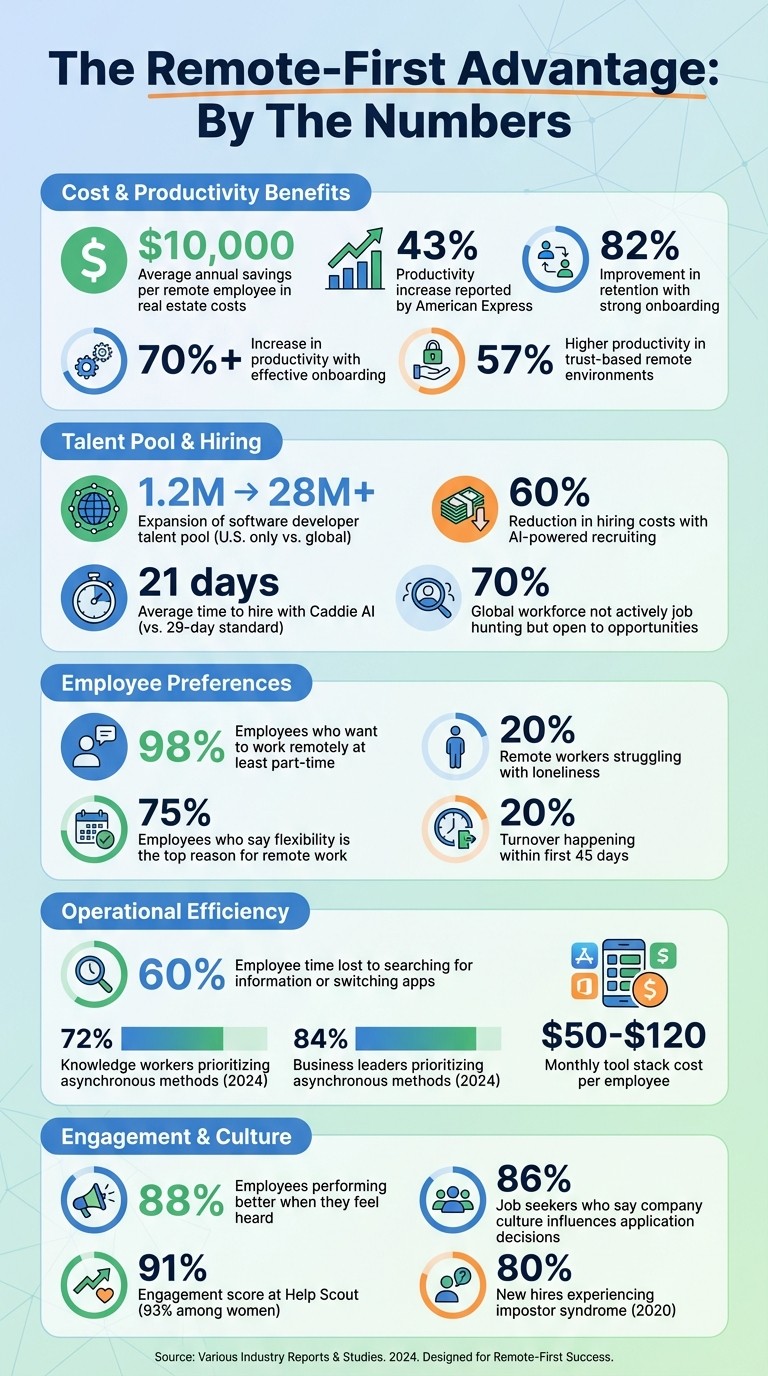
Remote-First Team Benefits: Cost Savings, Productivity Gains, and Global Talent Statistics
How to Build a Remote Team that Actually Works

Creating Your Remote-First Operating System
Building a remote-first operating system is like laying the groundwork for a distributed team to thrive. It’s the system that keeps everyone on the same page, even without a shared office space. By integrating essential workflows, defining roles, and using the right tools, you create a structure that ensures smooth collaboration and clarity, no matter where your team members are.
The aim is to replace the in-person cues of traditional offices with systems that work seamlessly across time zones. When done right, everyone knows their responsibilities, communication flows efficiently, and no information gets lost in the shuffle. Here's how to get started by documenting processes and clarifying roles.
Document Your Workflows and Communication Standards
Think of documentation as the backbone of your remote team. Every major decision, process, and workflow should be written down, with a clear owner and a timestamp. This isn’t about adding red tape - it’s about reducing confusion and giving new team members a head start.
Create a centralized, searchable handbook using tools like Notion or Confluence. This handbook should include your company’s values, processes, meeting norms, and security policies. That way, whenever someone asks, “How do we handle X?” the answer is just, “Check the handbook, section Y.”
"Clarity is kindness. Every material decision, plan, and process has an owner, a page, and a date." - Beancount.io
To minimize unnecessary meetings, set up an escalation ladder for communication. Start with a documented solution, then move to a thread or comments, followed by a quick 15-minute huddle if needed. Only escalate to a full meeting as a last resort. Define clear response times - for example, 15 minutes for urgent issues, 4 business hours for routine questions, and 1 business day for cross-departmental matters. This helps create predictability and reduces the time spent on “work about work.” In fact, studies suggest that 60% of an employee’s time can be lost to tasks like searching for information or switching between apps.
Define Roles and Performance Metrics
Once your processes are documented, the next step is ensuring accountability. Every project should have a Directly Responsible Individual (DRI) - a single person who owns the project, makes decisions, and is responsible for its outcomes. This eliminates confusion about who’s in charge.
Use role scorecards to outline expectations. These scorecards should detail key outcomes, areas of responsibility, collaboration standards, and quality benchmarks. The focus should always be on results, not hours worked. For example, track projects completed, sales closed, or features launched.
To provide context for decisions, use Architecture Decision Records (ADRs). These records capture the reasoning behind key choices, the options considered, and the final decision, making it easier for future team members to understand past actions.
Choose Your Remote Work Tools
The tools you choose can make or break your remote-first system. Look for a stack that supports asynchronous work while allowing for real-time collaboration when necessary. On average, a solid tool stack might cost between $50–$120 per employee per month.
Here’s a typical setup:
Documentation tools: Notion, Confluence, or Google Docs.
Project tracking tools: Asana, Linear, Trello (around $5/user/month for the Standard plan), or Jira.
Communication tools: Slack (around $6.67/user/month for the Pro plan) or Microsoft Teams.
Video conferencing tools: Zoom or Google Meet, which integrates well with Workspace tools and allows 60-minute meetings.
Don’t forget to prioritize security. Use Single Sign-On (SSO), Multi-Factor Authentication (MFA), and Mobile Device Management (MDM) tools like Okta or Kandji to protect your team’s digital environment.
To balance collaboration and focus, establish core overlap hours - 2–3 hours each day (e.g., 11:00 AM to 3:00 PM EST) when everyone is online for synchronous work. The rest of the day should be dedicated to deep, uninterrupted tasks.
Hiring and Onboarding Global Talent
Expanding your hiring efforts to a global scale opens up a world of possibilities. For instance, when recruiting software developers, looking beyond the U.S. increases your talent pool from 1.2 million to over 28 million candidates. But tapping into this broader market requires a well-thought-out approach.
The secret lies in creating a process that identifies candidates ready for remote work, moves efficiently, and ensures compliance with international regulations. This strategy not only speeds up hiring but also reduces costs and strengthens your team. It’s the foundation for finding the right remote talent.
Identify the Right Skills for Remote Work
Thriving in a remote work environment isn’t for everyone. Before drafting your job description, pinpoint the qualities that lead to success in distributed teams. Look for candidates who are self-motivated, excellent at written communication (essential for asynchronous work), and capable of managing priorities independently.
During interviews, behavioral questions can help you gauge these traits. For example, ask candidates to share how they’ve managed projects with limited information or balanced competing deadlines. At Zapier, which reviews over 1,000 remote applications weekly, the team uses standardized rubrics to evaluate empathy, technical skills, and attention to detail during video interviews. This structured approach minimizes bias and ensures fair assessments.
"If you don't understand the work, it's really hard to evaluate someone's abilities. Before we hired our first customer service person, I did just about all the customer service for two years." – Jason Fried, Co-founder, Basecamp
To attract global talent, optimize your job postings for visibility. Use location-independent settings and include "remote" keywords to make it clear the role isn’t tied to a specific place. Post on platforms such as We Work Remotely, Stack Overflow, and FlexJobs to reach active job seekers. Additionally, consider passive sourcing through LinkedIn Recruiter, as 70% of the global workforce isn’t actively job hunting but may be open to the right opportunity.
For technical roles, consider using work sample tests that reflect actual job tasks. For example, Zapier asks engineering candidates to complete a 2–3 hour project on their Developer Platform. This task assesses collaboration and problem-solving skills in a way that’s more relevant - and respectful of candidates’ time - than traditional whiteboard interviews.
Once you’ve outlined the skills you’re looking for, streamline your recruitment process with the help of advanced tools.
Use Caddie AI to Find Global Tech Talent

Traditional recruiting can take months, but Caddie AI accelerates the process by connecting you with expert headhunters in major tech hubs who work on your role simultaneously. These recruiters compete to find the best candidates, and you only pay when you make a hire.
Caddie AI uses AI matching to pre-qualify candidates, ensuring consistency from evaluation to hire. The platform delivers AI-matched candidate shortlists within 24 hours, and the average time to hire is just 21 days - significantly faster than the usual 29-day cycle. By leveraging a global network of specialized recruiters, Caddie AI cuts hiring costs by up to 60% while ensuring you only see qualified, vetted candidates.
This approach is particularly effective for fast-growing tech teams that need to fill multiple roles quickly without compromising on quality. The AI ensures candidates meet both technical and remote work requirements before they reach your inbox. Plus, Caddie AI partners with Deel for global payments, making it easy to transition from hiring to compliant onboarding, with a 20% discount on Deel services.
Once you’ve chosen your top candidates, focus on a seamless onboarding process to set them up for success.
Create Consistent Offer Letters and Onboarding Plans
After selecting a candidate, ensure your offer is structured in USD and clearly outlines compensation, benefits, and employment logistics. If you’re hiring in a country where you don’t have a legal entity, an Employer of Record (EOR) like Deel can handle payroll, taxes, and compliance with local labor laws. This allows you to hire in over 100 countries without the lengthy process of setting up a subsidiary.
It’s crucial to avoid misclassifying contractors as employees. If someone works set hours, uses company-provided equipment, and follows your processes, they may legally be considered an employee - even if their contract says otherwise. Misclassification risks include back-pay for benefits, tax penalties, and potential legal issues.
To help new hires integrate smoothly, develop a 30-60-90 day onboarding plan that covers organizational, technical, and social aspects. Before their first day, send hardware, company swag, and ensure all accounts are set up so they can hit the ground running. Strong onboarding can improve retention by 82% and increase productivity by over 70%. Assign an "onboarding buddy" to provide guidance and foster connections, as 20% of turnover happens within the first 45 days.
Rather than cramming all training into a single day, spread sessions across the first week to avoid overwhelming new hires. As Kelly Chuck from LinkedIn explained when transitioning to remote onboarding:
"We didn't want to transition everything into a full day virtually. We felt we could best do that with shorter bursts spread over a week."
This staggered approach minimizes Zoom fatigue and helps new employees retain information, setting them up for long-term success.
Managing Daily Operations and Performance
Once you’ve laid out clear workflows and defined roles, the next step is ensuring your remote operations run smoothly day-to-day. This means keeping everyone aligned, productive, and focused on results. To do this effectively, rethink how you handle meetings, embrace asynchronous work, and measure success based on outcomes rather than online activity.
Set Up Your Meeting Schedule and Communication Rules
Remote teams don’t need more meetings - they need smarter ones. Only schedule a meeting if it involves multiple people, requires real-time discussion, and can’t be handled through email or Slack. Otherwise, document key decisions for later reference.
When meetings are necessary, keep them purposeful and consistent. Daily standups should be short (15–20 minutes) and focus on removing obstacles rather than recapping status updates. Weekly team syncs can include a few minutes of casual conversation to replicate the informal interactions often missed in remote settings. This is especially helpful as 20% of remote workers report struggling with loneliness. Additionally, regular one-on-one check-ins allow managers to provide both personal and professional support - something that 88% of employees say helps them perform better when they feel heard.
To protect deep work time, set aside meeting-free blocks, like specific afternoons or mid-day windows.
"It's far better for everyone's concentration and sanity if you collaborate as though most things will get an answer eventually, but not necessarily right this second." – Jason Fried, Co-founder and CEO, Basecamp
Make meetings accessible for all team members by recording them and providing written summaries or transcriptions. This ensures that those in different time zones can stay informed without attending live sessions.
Implement Asynchronous Work Practices
Asynchronous communication is the backbone of effective remote teams. By late 2024, 72% of knowledge workers and 84% of business leaders were prioritizing asynchronous methods. Use real-time meetings sparingly, reserving them for complex, emotionally sensitive, or high-stakes discussions.
One standout example is GitLab, a fully remote company with over 1,500 employees across 65+ countries. GitLab’s comprehensive 2,000-page handbook enables employees to find the information they need without waiting for colleagues, eliminating delays. This highlights the importance of documenting conversations and processes to retain their value.
When communicating asynchronously, provide all necessary context, links, and background in your initial message. Assume the recipient may be in a different time zone and unavailable for immediate follow-up. For detailed explanations, tools like Loom can help you record short video updates that teammates can watch on their own schedule.
Break larger projects into smaller, manageable tasks, allowing team members to work independently without waiting for real-time approvals. Gumroad, led by CEO Sahil Lavingia, operates entirely without fixed working hours or real-time meetings. By relying on written documentation, employees can take extended breaks without disrupting progress.
Set clear response time expectations, such as replying to Slack messages within two hours or emails within 24 hours. Encourage team members to separate work chat apps from personal devices and use focus indicators when they’re engaged in deep work.
"Remote is much better for your mental health and sanity than other settings because it forces you to work asynchronously... It removes the burden of an endless string of messages you must respond to immediately." – Darren M., Head of Remote, GitLab
These asynchronous strategies naturally pave the way for a results-driven approach to performance measurement.
Measure Results Instead of Activity
One common mistake remote managers make is trying to replicate office-style oversight in a virtual environment. While studies show that productivity often improves with remote work, many leaders still rely on activity metrics such as online status or response times to gauge performance. This focus on “productivity theater” can be misleading and doesn’t necessarily reflect the quality of work being done.
Instead, shift the focus to outcomes by using SMART goals or OKRs. Define success clearly from the start, including deliverables, deadlines, and quality standards.
"For most roles at Automattic, what you're accountable for is a result. You could work 60 hours and not do a lot, or you could work 20 hours and do a ton. It's really about the result." – Matt Mullenweg, Founder, Automattic
Use project management tools like Jira, Trello, or GitHub to create a single source of truth where progress is visible to everyone. Sharing company-wide OKRs and project boards helps every team member see how their work aligns with broader goals.
Performance reviews should combine self-assessments, peer feedback, and managerial input to evaluate both tangible deliverables and soft skills like communication. Weekly one-on-ones can focus on coaching and career development rather than status updates, with individual growth goals tracked in a shared space like a Trello board. Create dedicated channels, such as a #kudos channel, for peer recognition so achievements are celebrated across the team.
During standups, ask questions like “What’s slowing you down?” instead of “What did you do today?” to shift the focus from monitoring activity to offering support. Research involving over 800,000 employee survey responses found that 57% of workers in trust-based environments reported being more productive.
"It's not about how they work. It's about the work they produce." – Lucy Suros, CEO, Articulate
Building Your Remote Team Culture
Once you've established efficient daily operations, the next step is creating a strong remote team culture. This isn't something that happens by chance - it takes deliberate effort to build trust, foster connection, and create a sense of belonging. Just like defining workflows and roles, shaping your team culture ensures everyone stays aligned and engaged. This involves documenting your values, encouraging informal communication, and making transparency a core principle.
One way to start is by giving employees flexibility in their work hours. Trust them to manage their schedules - whether that means running errands during the day or working at times that fit their lives - as long as they meet deadlines and deliver results. In fact, 75% of employees say flexibility is the top reason they pursue remote work. When employees feel trusted and empowered, their productivity can increase by as much as 57%.
"After 14 years as a fully remote company, we're convinced a distributed environment isn't just good for our employees. It's also one of the key reasons we've been so successful as a company." – Adam Schwartz, Founder and CEO, Articulate
Another critical component is making information accessible to everyone. Use tools like shared trackers, public meeting notes, and recorded calls to ensure no one feels excluded - especially team members in different time zones. This transparency reduces confusion and helps everyone feel like they belong.
Create Opportunities for Connection
Remote teams need structured ways to connect informally. For example, tools like "Meeting Roulette" can pair teammates for casual 15-minute virtual coffee chats. Informal communication channels also help build relationships beyond work tasks.
Toptal, a fully distributed company with over 4,000 team members across 100+ countries, assigns new hires a "TopPal" - a seasoned employee outside their department who serves as a guide during their first few weeks. This approach helps new employees settle in and combats impostor syndrome, which nearly 80% of new hires reported experiencing in 2020.
Help Scout, which managed 109 employees across 80+ cities in 2019, invested heavily in People Operations, maintaining a ratio of five dedicated staff members for their team. This commitment paid off, as their engagement survey showed a 91% engagement score, with 93% among women. Such investments build strong relationships, even across distances.
You can also use the first few minutes of meetings for personal updates or icebreakers like "Two Truths and a Lie" or "Meme Chats" to foster camaraderie. Recognize both U.S. and international holidays, and encourage team members to share their traditions. Sending welcome packages - such as branded stationery or coffee gift cards - can create an immediate sense of connection.
Even though daily work happens remotely, plan occasional in-person events like semi-annual retreats or quarterly leadership off-sites. These face-to-face gatherings strengthen bonds that carry over into virtual collaboration.
Protect Work-Life Balance
Remote work can blur the boundaries between personal and professional time, so it's essential to set clear guidelines. Establish core working hours (e.g., 11:00 AM to 3:00 PM) to protect focus time and limit non-critical communication outside these hours.
Consider designating one day a week as meeting-free to combat Zoom fatigue and allow for uninterrupted deep work. If your team spans multiple time zones, rotate meeting times to avoid consistently inconveniencing the same group.
Offer wellness support through Employee Assistance Programs (EAPs), mental health benefits, and stipends paid in USD. For international employees in areas with fluctuating currencies, USD stipends provide stability. Floating holidays are another way to let employees observe events that matter to them, whether they're local or religious.
"We still need human connection. It's more important than ever to find ways to connect with customers and one another - even if it's just via video, Asana, or Slack." – Dave King, Head of Marketing, Asana
Regular feedback is another key to keeping remote employees engaged. Workers who receive consistent feedback from their managers are three times more likely to feel engaged. Use one-on-one meetings not just for updates but to check in on stress levels, workloads, and career goals. Active listening and empathy go a long way in building meaningful connections, especially when you can't rely on in-person cues.
Continuously Improve Through Feedback
Your remote culture will naturally evolve as your team grows, so it's important to gather feedback regularly. Conduct team retrospectives - monthly or quarterly - to identify what’s working and what isn’t. Anonymous surveys can help gauge engagement, uncover challenges, and track progress over time.
Ask targeted questions: Are meetings happening too often? Do employees feel connected to their team? Is the workload manageable? Do they feel their contributions are valued? Since 86% of job seekers say company culture plays a significant role in their decision to apply for a job, understanding these dynamics can help you attract and retain talent.
Create dedicated spaces, like Slack channels (#feedback or #suggestions), where team members can share ideas in real time. Most importantly, act on the feedback you receive. When employees see their suggestions leading to real changes, they feel heard and appreciated. This commitment to improvement keeps your remote culture dynamic and aligned with your team's needs, seamlessly supporting the operational systems you've already put in place.
Conclusion
Creating a remote-first team isn’t something that happens by chance - it takes careful planning and thoughtful execution. It starts with documenting workflows, setting clear performance metrics, and selecting tools that make asynchronous communication seamless. Platforms like Caddie AI open doors to global talent, removing geographical barriers, while efficient onboarding ensures new hires integrate smoothly.
The benefits are hard to ignore. Companies save an average of $10,000 per year in real estate costs for each remote employee. Productivity also gets a boost - American Express reported a 43% increase in output. On top of that, flexibility is a major draw for employees, with 98% expressing a desire to work remotely at least part-time during their careers. Clearly, offering remote options isn’t just about saving money; it’s a competitive advantage for attracting and keeping top talent.
"Good teamwork is structured, not spontaneous, in remote-first environments." - Deel Founder's Guide
This quote highlights a key principle: remote-first success hinges on systems designed for measurable results. Focus on using clear OKRs and transparent dashboards to track progress based on outcomes, not hours worked. Tools like Slack, Notion, and Loom help bridge time zones and reduce the need for endless meetings, keeping teams connected without burnout. And let’s not forget - company culture doesn’t just “happen.” It takes deliberate effort, from regular feedback loops to meaningful rituals, to ensure it thrives in a remote setting.
FAQs
What tools are essential for building a productive remote-first team?
Building a thriving remote-first team starts with equipping yourself with the right tools to promote clear communication, smooth collaboration, and efficient workflows.
Communication platforms like Slack and Zoom are essential for keeping everyone connected. Whether it’s through instant messaging, video calls, or screen sharing, these tools help ensure team members stay aligned no matter where they’re located. For managing tasks and responsibilities, project management tools such as Trello provide a visual way to organize work, assign tasks, and monitor progress - critical for staying accountable across various time zones. On top of that, having a centralized knowledge base for processes, goals, and guidelines ensures that every team member can quickly find the information they need without unnecessary delays.
By integrating these tools, you create an environment that fosters transparency, teamwork, and productivity - cornerstones of any successful remote team.
How can I stay compliant when hiring remote workers from different countries?
To hire remote workers across the globe while staying compliant, the first step is understanding the labor laws in each country you plan to operate in. This includes key areas like how employees and contractors are classified, minimum wage standards, working hours, required benefits, and tax regulations. Many companies simplify this process by working with an Employer of Record (EOR) or establishing a local entity. These options allow businesses to manage payroll and legal obligations while retaining control over day-to-day operations.
It’s also essential to develop a clear remote work policy. This policy should cover expectations around data privacy, handling overtime, and leave policies. Before making an offer, confirm the worker’s legal right to work, verify their tax residency, and collect all necessary onboarding documents, such as contracts and tax forms. For freelancers, make sure contracts clearly outline the scope of work to avoid any issues with misclassification.
Keep a close eye on regulatory changes in the countries where you operate. Regularly updating contracts and maintaining thorough records will help ensure compliance with local laws. Using global HR platforms or working with compliance-focused services can make it easier to manage payroll, taxes, and benefits. These tools not only help you align with changing regulations but also protect both your business and your workforce.
How can we improve the onboarding process for remote employees?
To make remote onboarding smoother and more effective, start with a well-organized plan that maps out key milestones for the first few weeks. This plan should cover general onboarding sessions, training tailored to their role, and some time for the new hire to settle in before handling full responsibilities. Providing a detailed employee handbook is also essential - it should include company values, tools, and processes, serving as a go-to resource for any questions they might have.
Ensure new team members have a step-by-step checklist to guide them through essentials like setting up hardware, accessing the VPN, and getting familiar with communication tools. Pair them with a mentor or buddy who can answer questions, share advice, and help them feel connected through casual virtual chats. To make the experience more welcoming, personalize their onboarding by aligning tasks with their role and celebrating their start with a team introduction or a thoughtful welcome message. This helps create a sense of belonging right from the beginning.