What does a Chief Scientific Officer do and when should a startup hire one?
Jan 15, 2026

A Chief Scientific Officer (CSO) is a key executive responsible for leading research and development (R&D) in science-driven startups. They ensure scientific efforts align with business goals, manage regulatory compliance, secure intellectual property, and play a critical role in attracting investors. Startups should consider hiring a CSO when they need expert guidance to turn scientific research into market-ready products, especially during early stages or when facing complex regulatory challenges.
Key Points:
Role: Oversee R&D, connect science with business, ensure compliance, and manage risk.
When to Hire: Early-stage startups in biotech or life sciences, or when preparing for clinical trials and regulatory approvals.
Qualifications: Ph.D. in a relevant field, R&D leadership experience, regulatory expertise, and strong communication skills.
Salary Range: $320,000–$500,000 (2026 projection).
Hiring Tip: Tools like Caddie AI can simplify and speed up the hiring process.
A CSO can help your startup bridge the gap between scientific innovation and market demands, ensuring research efforts lead to viable products and long-term growth.
Understand the Role of the Chief Scientific Officer (4 Minutes)

What Does a Chief Scientific Officer Do?
A Chief Scientific Officer (CSO) blends scientific expertise with business strategy and risk management. Their role spans the entire journey of bringing scientific breakthroughs to market, from research labs to investor presentations. Here's a closer look at their key responsibilities and why they are crucial for your startup's success.
Managing Research and Development
The CSO plays a pivotal role in determining which research areas hold the most promise, deciding which projects receive funding, and allocating resources across R&D teams. This requires balancing scientific potential with commercial viability, a critical factor in ensuring startups avoid wasting time and money on projects that lack market potential.
Overseeing multidisciplinary teams of scientists, the CSO ensures that research meets high-quality standards while staying within budget. They manage clinical trial designs, guide experimental protocols, and make tough calls about whether to advance or terminate projects. As Helen Mango Ph.D., Professor of Geology and Chemistry at Castleton University, puts it:
"Chief Science Officers are responsible for leading the scientific operations of an organization. Their duties include developing scientific strategies, directing clinical trial designs, implementing research processes, and communicating the scientific vision to investors and senior management".
These decisions are foundational in turning research into competitive market advantages.
Connecting Science with Business Goals
A CSO bridges the gap between complex scientific concepts and business objectives. They translate technical breakthroughs into compelling narratives that resonate with investors, board members, and customers. This ability is especially important during fundraising, where investors need assurance that your science has a clear path to profitability.
CSOs also conduct market assessments to guide research efforts toward areas with strong commercial potential. This strategic insight shapes decisions on partnerships and acquisitions, ensuring that R&D aligns with market needs. As noted by Kingsley Gate:
"The CSO sets the scientific direction for the company, identifying promising research areas, prioritizing projects based on market needs and commercial viability, and strategically allocating resources to maximize the impact of R&D efforts".
By aligning research with business goals, the CSO ensures that innovation drives growth and positions the company for long-term success. Alongside these efforts, they also oversee regulatory compliance to safeguard operational integrity.
Handling Regulatory Compliance and Risk
Navigating complex regulatory landscapes, such as FDA approval processes, is a key challenge for science-focused startups. The CSO ensures that every experiment, clinical trial, and manufacturing process adheres to Good Manufacturing Practices (GMP) and ethical standards. They oversee safety protocols, quality control measures, and the documentation required for Institutional Review Board (IRB) approvals and regulatory audits.
Beyond compliance, the CSO actively manages risk. They evaluate project viability in the face of market uncertainties and develop contingency plans for setbacks. Collaborating with legal teams, they secure intellectual property through patents and trade secrets - a critical move for startups where IP often defines competitive advantage. Experienced CSOs know when to cut losses by ending projects early, preventing unnecessary financial drains on the company. This proactive approach to risk management bolsters the startup's credibility and keeps investors confident in its direction.
When Should You Hire a Chief Scientific Officer?
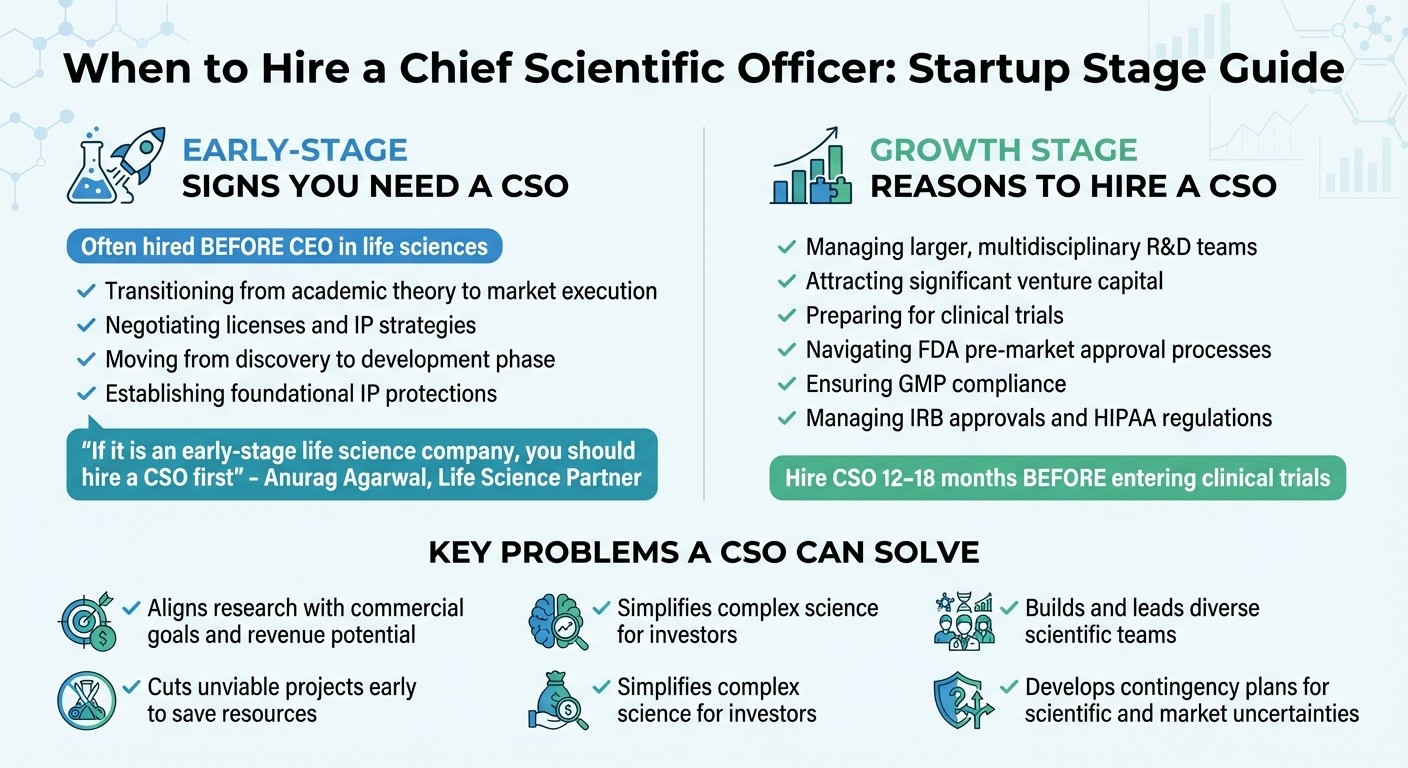
When to Hire a Chief Scientific Officer: Startup Stage Guide
Deciding when to bring a Chief Scientific Officer (CSO) on board can significantly impact your startup's progress. The timing largely depends on the stage of your company and the complexity of its scientific endeavors. Let’s explore the key indicators that suggest it’s time to hire a CSO.
Early-Stage Signs You Need a CSO
In life sciences and biotech startups, the CSO is often one of the first executive roles filled - sometimes even before hiring a CEO. Anurag Agarwal, Life Science Partner at Osage University Partners, emphasizes this point: "If it is an early-stage life science company, you should hire a CSO first". At this stage, a CSO is crucial for advancing research from academic theory to practical market execution. This includes tasks like negotiating licenses, shaping intellectual property (IP) strategies, and extending research efforts beyond the lab.
For deep-tech companies, the shift from discovery to development is a pivotal moment. This is when the pressure mounts to convert raw scientific breakthroughs into tangible, market-ready products while securing foundational IP protections.
Growth Stage Reasons to Hire a CSO
As your startup grows, the CSO’s responsibilities expand. They take on managing larger, multidisciplinary R&D teams and play a key role in attracting significant venture capital by crafting compelling scientific narratives.
Regulatory hurdles often serve as a clear signal to hire a CSO. When your company is preparing for clinical trials or navigating complex FDA pre-market approval processes, you need someone with the expertise to ensure compliance with Good Manufacturing Practices (GMP), manage Institutional Review Board (IRB) approvals, and handle HIPAA regulations. Agarwal also advises hiring a Chief Medical Officer (CMO) about 12 to 18 months before entering clinical trials, but this assumes that a CSO is already in place to guide the research strategy necessary for clinical readiness. These challenges highlight the CSO’s critical role in steering your company’s growth and regulatory strategy.
Problems a CSO Can Solve
A skilled CSO bridges the gap between scientific innovation and market demands. They ensure that research efforts align with commercial goals, focusing on projects with genuine revenue potential rather than purely academic pursuits. They also have the foresight to cut unviable projects early, saving your startup from wasting resources on dead-end ventures.
Another key strength of a CSO is their ability to simplify complex scientific ideas for investors, making it easier to secure funding. They excel at building and leading diverse teams of scientists and engineers, helping technical founders overcome operational challenges. Perhaps most importantly, they develop contingency plans to address both scientific and market uncertainties, reducing risks and safeguarding your startup’s future.
How to Hire the Right CSO
Required Qualifications and Skills
When searching for the right Chief Scientific Officer (CSO), focus on key qualifications like a relevant Ph.D. and leadership experience in R&D. A Ph.D. in fields such as Biology, Chemistry, or Molecular Biology, along with postdoctoral research, is often a must. Beyond academic credentials, look for candidates with 5–10 years of experience leading research and development teams, particularly those who can align scientific innovation with business objectives.
Regulatory knowledge is non-negotiable. A strong candidate will be well-versed in FDA regulations, GxP guidelines, and GMP standards, as well as ethical research practices. Financial management skills are also essential. Your CSO should be capable of evaluating the ROI of R&D projects, managing budgets effectively, and ideally, have experience securing venture capital or handling large research grants.
Communication skills are equally important. A CSO must be able to distill complex scientific data into clear, actionable insights for investors and board members. During interviews, ask candidates to explain a recent scientific breakthrough in simple terms. If they can't translate the technical into the understandable, they may not be the right fit.
Another crucial area to assess is intellectual property management. A top-tier candidate will have hands-on experience securing patents, trademarks, and trade secrets to protect your company's innovations. With these qualifications in mind, advanced recruitment tools can help simplify and speed up your hiring process.
Using Caddie AI to Find Your CSO

Hiring a CSO through traditional methods can take months, but Caddie AI offers a faster, more efficient alternative. The platform connects you with a network of expert headhunters specializing in executive scientific roles across major tech hubs. Instead of relying on a single recruiter, multiple experts collaborate to broaden your candidate pool.
Caddie AI leverages advanced AI-matching technology to screen candidates before they reach you, delivering a shortlist of qualified individuals within just 24 hours. On average, the platform reduces hiring time to under 21 days - much quicker than traditional executive search approaches. Plus, with its pay-on-success model, you only pay after making a successful hire, potentially cutting recruitment costs by up to 60%. As an added bonus, Caddie AI's partnership with Deel offers 20% off global payment solutions for your new executive hire.
Conclusion
Key Points for Startups
Bringing a Chief Scientific Officer (CSO) on board provides startups with a leader who can transform intricate research into practical, market-ready solutions while ensuring that research and development efforts align seamlessly with business objectives. When the time comes to hire, focus on candidates who possess the right blend of qualifications: advanced scientific credentials (often a Ph.D.), regulatory knowledge (such as FDA and GxP guidelines), and the financial expertise to handle research budgets effectively.
The timing of this hire is just as important as the role itself. A CSO becomes essential when your team encounters scientific challenges beyond their expertise or when regulatory complexities arise. Before diving into a full-time commitment, consider starting with a part-time technical advisor to evaluate your actual needs. Once you're ready, a streamlined recruitment process will ensure you find the right fit.
A CSO is instrumental in protecting intellectual property, guiding your company through regulatory requirements, and minimizing the risk of costly setbacks during later stages of development. However, this role represents a considerable investment, with experienced CSOs commanding annual salaries ranging from $125,000 to $326,000. It’s crucial to ensure this hire aligns with your startup's current growth phase and strategic priorities.
When you're ready to recruit, platforms like Caddie AI can simplify the process by providing qualified shortlists within 24 hours and reducing hiring timelines to less than 21 days. Their pay-on-success model can also lower recruitment costs by up to 60%, allowing you to focus on finding the right scientific leader without the delays and expenses of traditional hiring methods.
FAQs
What qualifications should a startup look for when hiring a Chief Scientific Officer (CSO)?
When you're looking to hire a Chief Scientific Officer (CSO), focus on candidates who bring both extensive scientific expertise and exceptional leadership abilities to the table. Ideally, they should hold a PhD or an advanced degree in a relevant discipline - whether that's biology, chemistry, engineering, or data science - and have a history of driving innovation, such as publishing impactful research or securing patents. It's also crucial that they have hands-on experience leading R&D initiatives and managing the entire product development process, from early-stage research to delivering market-ready solutions.
A strong candidate should have a clear strategic vision that bridges scientific objectives with the company's broader business goals. They need to be skilled at setting research priorities, effectively allocating resources, and forming partnerships with key players like academic institutions, biotech firms, or investors. Familiarity with regulatory frameworks, such as FDA compliance, and expertise in intellectual property protection are equally important. Beyond technical qualifications, outstanding communication and leadership skills are a must. The CSO will play a pivotal role in mentoring teams, presenting findings to stakeholders, and fostering collaboration across departments to drive progress and innovation.
What role does a Chief Scientific Officer play in managing regulatory challenges?
A Chief Scientific Officer (CSO) plays an essential role in guiding startups through the often tricky maze of regulatory requirements. They work closely with regulatory agencies like the FDA to ensure that research plans, clinical trials, and manufacturing processes meet the necessary standards. By addressing these regulatory needs early in the product development cycle, the CSO helps avoid expensive delays or the need to overhaul processes later.
Beyond regulatory navigation, the CSO is responsible for setting up strong quality systems, managing safety protocols, and leading the preparation of regulatory submissions. Their expertise not only ensures compliance but also fosters confidence among investors and partners. This forward-thinking strategy helps smooth the approval process, minimizes risks, and speeds up the path from groundbreaking ideas to market-ready products.
When is the right time for a startup to hire a Chief Scientific Officer?
Startups should think about bringing in a Chief Scientific Officer (CSO) as soon as they start shaping their product and outlining their scientific strategy. Having a CSO on board early can steer key research and development decisions, making sure the company's innovations stay aligned with its long-term objectives.
For startups rooted in science or technology, a CSO becomes especially important during growth phases that demand advanced R&D, intellectual property development, or navigating regulatory requirements. Timing the hire right allows the CSO to play a pivotal role in scaling the business and staying ahead of the competition.