10 Ways to Cut Tech Recruitment Costs by 50%
Dec 19, 2025

Recruiting tech talent is expensive, but you can slash costs by up to 50% with smarter strategies. Here's how:
Automate Resume Screening: AI tools cut manual screening time by 75% and reduce cost-per-hire by 30–60%.
Targeted Job Ads: Programmatic advertising lowers job board costs by 23% and boosts applicant quality by 33%.
Performance-Based Hiring: Pay only for successful hires, saving up to 45% on agency fees.
Hire Globally: Tap into international talent pools to reduce salaries by 30–70%.
Shorten Time-to-Fill: Use AI to cut vacancy costs, saving $307 per unfilled day for an $80,000 role.
Standardized Assessments: Avoid bad hires, which can cost 2–3x annual salary, using structured evaluations.
Efficient Interviews: Streamline interviews to save engineering time and reduce hiring delays.
Consolidate Tools: Combine recruitment platforms to save on redundant software costs.
Success-Fee Models: Eliminate upfront costs by paying agencies only for successful placements.
Data-Driven Insights: Track metrics like cost-per-hire and time-to-fill to optimize spending.
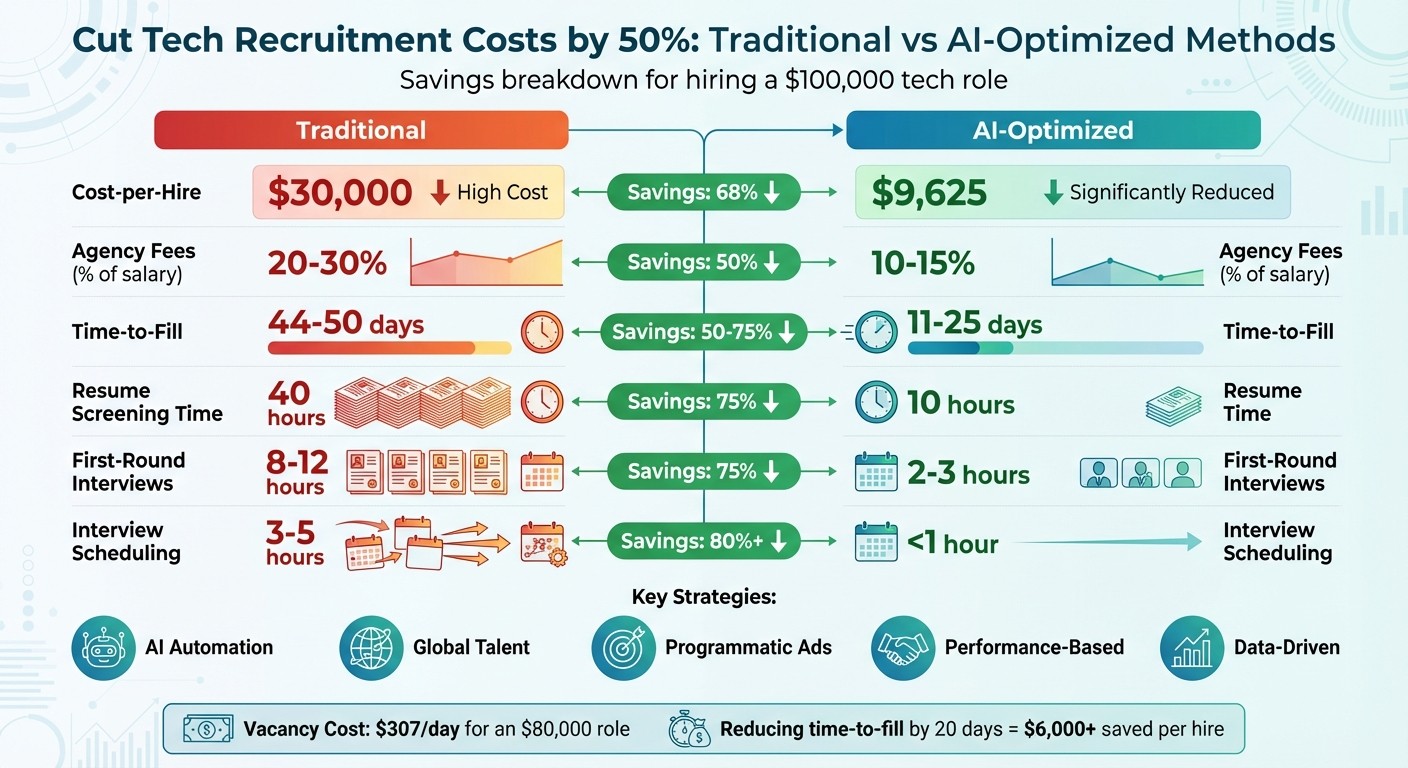
Traditional vs AI-Optimized Tech Recruitment: Cost and Time Savings Breakdown
Cost Per Hire: How to optimize recruitment costs & strategy
1. Automate Resume Screening and Candidate Sourcing with AI
Screening resumes manually eats up a staggering 40–60% of recruiters' time. But AI-powered tools can handle thousands of resumes in mere minutes - something that would take human recruiters weeks. Using Natural Language Processing (NLP), these tools go beyond simple keyword matching, analyzing the context behind candidates' skills and experience.
The financial impact is immediate. For example, in August 2024, Axelerant revamped its recruitment process with intelligent automation, led by Michael Cannon, Director of Intelligent Automation. The results? An 83% reduction in time-to-hire and a 15% drop in operational costs. Similarly, a mid-sized tech company slashed its initial screening time from 40 hours per position to just 10 hours in June 2025 - a 75% decrease in manual work. These examples highlight how AI dramatically boosts recruitment efficiency.
"Efficiency is doing things right; effectiveness is doing the right things. Automation frees recruiters from time-consuming tasks and enables them to focus on building meaningful relationships." – Michael Cannon, Director of Intelligent Automation, Axelerant
Here's another way to think about it: for an $80,000 job, every unfilled day costs about $307 in lost productivity. By cutting time-to-hire by 40–75%, AI-driven tools can reduce cost-per-hire by 30–60% and total hiring expenses by up to 68%.
Getting started is simple. Focus first on high-volume roles, connect AI tools to your Applicant Tracking System (ATS), and scale from there. Most companies see measurable results within 3–4 months. This streamlined process not only saves time and money but also sets the stage for broader improvements in tech recruitment.
2. Cut Job Advertising Costs with Programmatic Targeting
Posting jobs on traditional boards has become increasingly expensive. Since 2020, the costs associated with job boards have jumped by over 300%. Yet, many companies still rely on the outdated "spray and pray" method - posting on multiple platforms and hoping for results. Programmatic ad targeting offers a smarter alternative. Instead of paying for countless impressions that lead nowhere, you pay only for quality applications from candidates who are a good fit for your tech roles. This approach uses precise bidding and targeted placements to make the most of your budget.
Building on AI's role in resume screening, programmatic targeting takes your ad spend to the next level. These platforms use AI-driven real-time bidding to strategically place your job ads where top talent - like software engineers, data scientists, and DevOps professionals - spend their time. Think coding forums, tech blogs, or niche platforms. The system constantly monitors performance, reallocating your budget away from underperforming channels to maximize results. This strategy has been shown to lower cost-per-hire by 23% and improve applicant quality by 33%.
"Programmatic job advertising reduces wasted spend, improves applicant quality, and helps you scale your recruiting efforts with less manual oversight." – Jessica Miller-Merrell, Founder, Workology
The benefits don’t stop there. Setting up programmatic ads is 57% faster compared to managing traditional insertion orders, and AI-powered tools can reduce your time-to-hire by 30%. Faster hires mean lower vacancy costs, which can significantly impact your bottom line. A great way to start is by focusing on 3–5 key roles to establish a baseline, then gradually scaling the approach across all positions. Most platforms also integrate seamlessly with your ATS, making implementation even easier.
3. Switch to Performance-Based Hiring Marketplaces
Traditional recruitment agencies often charge steep fees - typically 15%–25% of a hire’s first-year salary. For a $120,000 engineer, this can mean paying up to $30,000, regardless of whether the candidate is a perfect fit. In contrast, performance-based hiring marketplaces only charge fees upon successful placement. This approach shifts the financial risk from the employer to the provider, offering not just cost savings but also an incentive for the provider to focus on quality hires.
Here’s a real-world example: By switching from a 25% traditional agency fee to an 18% performance-based model, one company saved around $84,000 annually on hiring 10 engineers. This adjustment not only reduced recruitment costs by 45% but also sped up the hiring process by 30%.
Speed matters - a lot. Unfilled tech positions can cost companies approximately $500 per day in lost productivity. Performance-based marketplaces often use AI-driven matching and pre-vetted candidate pools to fill roles faster. For instance, one unicorn startup hired 15 senior developers to prepare for its IPO, while another company managed to onboard 126 developers in just six months.
Some platforms make the setup process incredibly quick, allowing recruitment to begin in under 30 minutes and eliminating the hassle of juggling multiple agency contracts. For companies with high-volume hiring needs, flat-fee models are a game-changer. These plans often allow unlimited hires for a fixed monthly fee, typically about $3,000. For individual roles, flat fees might range from $1,000 to $3,000 for entry-level positions and $7,500 to $15,000 for senior roles, offering predictable costs and better budget management.
4. Hire Global Talent to Lower Compensation Costs
Hiring globally can dramatically reduce compensation expenses. For example, while a senior software engineer in the U.S. earns about $150,000 annually, similar talent in regions like Eastern Europe or Southeast Asia can cost between $50,000–$80,000. In Vietnam, the range is $30,000–$50,000, and in India, it can be as low as $11,000. These options provide access to skilled professionals without sacrificing quality.
Establishing a foreign entity, however, comes with upfront costs of $15,000–$50,000 and a timeline of 3–6 months. A more efficient alternative is using an Employer of Record (EOR), which handles legal complexities for $199–$699 per employee per month. This approach enables faster hiring and can cut total recruitment and compensation costs by 30%–60%.
"Keep extending your talent pipelines outside traditional tech hubs. The more you expand across borders, the better off you're going to be. I look at it now as a necessity to stay competitive and find great talent." - Dave Walters, CTO, Hired
To maintain quality, adopt skills-based hiring practices. Tools like standardized coding assessments (e.g., HackerRank) can help identify top candidates while avoiding the 30% first-year earnings cost of a bad hire. Interestingly, remote developers, when supported properly, can be 35%–40% more productive than their office-based counterparts.
Local recruitment often takes 2–3 months, but global hiring platforms can reduce this timeline to just 1–2 weeks. With 71% of U.S. employers facing challenges in finding skilled professionals domestically, international hiring is becoming essential. Additionally, a fully remote team of 50 employees could save $375,000–$750,000 annually in office rent alone.
Expanding your talent search globally doesn’t just lower compensation costs - it speeds up hiring and complements other strategies to address vacancy costs effectively.
5. Reduce Time-to-Fill to Lower Vacancy Costs
Leaving a tech position unfilled doesn’t just create headaches - it costs your company money. For a role with an $80,000 annual salary, each day it remains vacant translates to about $307 in lost productivity. That adds up quickly, making it essential to minimize the time it takes to fill open positions.
Leveraging AI to streamline your hiring process can significantly cut these vacancy-related expenses. For example, reducing the time-to-fill from 45 days to 25 days saves over $6,000 per hire in lost productivity alone. AI-powered hiring platforms can reduce the industry average of 44 days to just 11 days. Some companies using advanced staffing technology report an average of 21 days to hire, while specialized platforms for pre-vetted technical talent have achieved an impressive 7.6 days. When combined with efficient candidate sourcing, these time savings create a powerful cost-cutting strategy.
The urgency is clear: top tech candidates leave the job market in just 10 days, and 62% of candidates drop out if your hiring process takes longer than three weeks. Companies like Hilton have demonstrated what’s possible - by optimizing their Applicant Tracking System workflows, they reduced hiring time from six weeks to just five days. Similarly, Netflix cut its time-to-hire by 65% through proactive pipeline management, and Zappos streamlined its interview process from six rounds to three, achieving a 40% reduction in hiring time.
Dragging out the hiring process also comes with hidden costs. Extended vacancies can force reliance on staffing agencies, which charge 15–30% of the base salary. On the other hand, companies using AI in recruitment report a 27% reduction in cost-per-hire, all while maintaining quality. AI not only scales effortlessly across multiple roles but also improves employee retention. Faster hiring through better AI matching has been shown to boost employee tenure by 40%, potentially saving $30,000 in turnover costs for a $60,000 role. These results highlight how reducing time-to-fill isn’t just about speed - it’s a comprehensive approach to saving money and improving efficiency in tech recruitment.
6. Use Standardized Assessments to Prevent Costly Mis-Hires
Standardized technical assessments are a powerful tool for avoiding the steep expenses associated with bad hires. A poor hiring decision can cost far more than just the annual salary of the employee, making objective assessments essential for smarter hiring decisions. Shockingly, 57% of recent hires were found to be poor fits due to misalignment with the role or company culture. Standardized assessments can help identify these issues early on.
Shifting from subjective interviews to structured assessments significantly improves hiring accuracy. Instead of relying on gut feelings, tools like coding challenges and system design interviews ensure candidates have the skills to perform effectively from day one. Companies that adopt standardized hiring practices experience 40% lower new-hire turnover. Additionally, teams with strong hires report 14% higher productivity and 23% greater profitability. AI-enhanced assessment tools also streamline the process, cutting resume screening time by over 50% and reducing the overall time-to-hire by 30%.
"By standardizing the interview, you're not just being fair - you're building a repeatable, data-driven system. It makes comparing candidates an apples-to-apples affair and dramatically cuts the risk of making a bad hire." - Steve Nash, Async Interview
Modern recruitment software makes it easy to integrate standardized assessments into existing workflows. Platforms like SAP SuccessFactors, BambooHR, Lever, and Greenhouse seamlessly connect with these tools. Starting with high-volume roles can help gather data quickly, which can then be extended to specialized positions. AI-powered systems can manage thousands of candidates at once, far exceeding manual screening capabilities. Organizations that use skills-based hiring with standardized assessments report a 78% improvement in hiring quality, and recruiters are now 5 times more likely to focus on skills rather than educational background when searching for candidates.
The financial benefits are hard to ignore. Traditional recruitment agencies charge 15–30% of the base salary for their services, while AI-driven assessment platforms typically cost 10–15%. For a $100,000 hire, that translates to savings of $10,000 to $20,000 per position. Some platforms even offer subscription models, starting at just $99 to screen 2,000 resumes. Tiered pricing plans range from $250–$500/month for small businesses to $5,000–$15,000/month for larger enterprises. With lower mis-hire costs, faster hiring processes, and improved retention rates, standardized assessments are a smart and cost-effective solution for modern recruitment.
7. Streamline Interview Processes to Save Engineering Time
Efficient interviews are a game-changer when it comes to cutting recruitment costs, especially when paired with AI-driven resume screening. Inefficient interview processes can drain valuable engineering hours, with traditional methods costing around $500 per candidate. This includes five employees spending two hours each on interviews, while indirect costs - like time spent by managers and engineers - make up 60–70% of recruitment expenses. Streamlining interviews isn’t just about moving faster; it’s about safeguarding your technical team’s time and energy.
Structured interviews help eliminate unnecessary steps and reduce bias. By using standardized technical assessments and AI-powered tools, you can filter out unqualified candidates before engineers get involved. During the interview stage, AI tools for scheduling and pre-screening can reduce the burden on engineers, cutting candidate wait times from seven days to less than 24 hours. Companies that adopt AI-enhanced recruitment processes report a 27% drop in cost-per-hire and a 40–85% reduction in time-to-fill. For a role with an $80,000 salary, every day the position remains unfilled costs about $307 in lost productivity. Reducing the time-to-fill by 20 days translates to savings of over $6,000 per hire. These optimized processes work hand-in-hand with AI-driven screening to lower recruitment costs without sacrificing quality.
"It allows the recruiters to spend more time building relationships with that shortlist of qualified candidates rather than going through hundreds of resumes." - Prem Kumar, CEO and Co-founder, Humanly
Real-world examples highlight the benefits of automation. In August 2025, Sopra Steria slashed its hiring time by 60% by incorporating Skillate’s AI-powered matching engine into its applicant tracking system. This tool handled resume matching, pre-screening, and feedback collection, enabling the team to fill roles much faster. Similarly, Unilever introduced AI-powered video interviews and skills assessments in 2025, allowing them to evaluate both technical skills and soft skills at scale before advancing candidates to final-stage human interviews. These cases show how automation can free engineers from administrative tasks while maintaining the quality of hires.
Getting started is simpler than you might think. Use automated technical assessment platforms like CodeSignal or Criteria to screen candidates before engineers get involved. Deploy AI chatbots to manage interview scheduling and handle coordination across time zones. Generative AI can also summarize interview notes and highlight key takeaways for recruiters. Reserve engineering interviews for candidates who have already passed these objective pre-screening steps. This ensures that every minute engineers spend on interviews is focused, productive, and worthwhile, rather than wasted on unqualified candidates.
8. Consolidate Recruitment Tools and Automate Reporting
Tech companies often deal with an overwhelming number of recruitment tools. On average, organizations use over 125 SaaS apps, costing about $1,040 per employee annually, with 31% of that expense going to waste. On top of that, companies pay extra to manage scattered tools for tasks like sourcing, screening, scheduling, and reporting. By consolidating these functions into a single platform, you can cut down on multiple subscription fees and save time lost to manual data entry and switching between tools - potentially saving anywhere from $1 to $20 per user each month.
Streamlining your tools doesn’t just save money; it also speeds up critical recruitment processes. Take Boulevard as an example. In August 2025, they integrated Findem with Greenhouse, reducing the time from job posting to candidate flow by 35% - from nine days to just 5.8 days. They also cut the time from job opening to accepted offer by 30%, shrinking it from 55 days to 38 days. Similarly, Nutshell Consulting AB saw a 50% reduction in job publishing time after merging their systems into Recruit CRM, turning a half-day task into one that takes less than an hour.
"Efficiency is a mandate, not a nice-to-have. As a talent acquisition function, we're in the spotlight more than ever." - David Malloy, Findem
Automated reporting can revolutionize how you track hiring performance. Forget about manual data exports and custom spreadsheets - a centralized platform provides real-time dashboards that reveal which sourcing channels deliver the best candidates and identify bottlenecks in your process. For instance, General Motors automated interview scheduling, cutting coordination time from five days to just 29 minutes, saving an estimated $2 million annually in recruiter hours. With manual data work off the table, your team can focus on making smarter, more strategic hiring decisions. These reporting tools integrate seamlessly with a consolidated tech stack.
Start by auditing your current tools before renewal season to pinpoint underused or redundant software. Consolidating tools not only simplifies workflows but also boosts efficiency and lowers costs. To measure the return on investment (ROI), use this formula: (hours saved × hourly rate × 12) ÷ annual software cost. If the result exceeds one, the consolidation will pay for itself within a year. Choose a core applicant tracking system (ATS) that works smoothly with your existing calendar and email systems. Then, layer on specialized AI tools for tasks like sourcing or scheduling that sync automatically. Many platforms offer a 21–30 day trial period, giving you time to evaluate their impact before fully committing.
9. Use Success-Fee Models to Eliminate Upfront Costs
Success-fee models flip the script on traditional recruitment fees. Instead of paying upfront retainers or milestone-based fees regardless of the outcome, you only pay when a candidate is successfully hired and starts their role. This approach shifts the financial risk to the recruitment agency, helping you manage your budget more effectively and improving cash flow. It’s a smarter way to handle hiring costs while ensuring you only pay for results.
Typically, traditional agencies charge 15–30% of a candidate's first-year salary. For example, hiring a software developer with a $120,000 salary at a 25% fee would cost $30,000 per hire. Success-fee agreements, however, often include a 3- to 6-month guarantee period. If the hire leaves during this time, the agency is required to provide a replacement at no extra cost. This added layer of protection ensures you get value for your investment.
You can also negotiate milestone-based payments to further control costs. For instance, splitting the fee between the hire’s start date and a 90-day retention period can safeguard your budget while encouraging long-term retention.
"Standard agency contracts often demand upfront fees, regardless of hiring success. Instead, negotiate performance-based structures... ensuring value throughout the process rather than upfront." - Olha C., Unbench
Since success-fee models are the norm for external staffing, they allow you to work with multiple agencies simultaneously without upfront costs. This expands your reach to a broader talent pool without draining your budget. Combine this with automated sourcing tools and efficient hiring processes, and you can significantly reduce financial risk. To get the best deal, solicit competitive bids from multiple agencies and negotiate terms like milestone payments to ensure retention.
These models are particularly effective for tech recruitment, especially when hiring for specialized or senior-level roles where the talent pool is smaller. However, for high-volume hiring (three or more roles), costs can add up quickly since you pay per successful placement. AI-driven platforms offering success-fee models at rates of 10% to 15% of a candidate’s first-year salary can help reduce costs by as much as 60% to 70%. This makes them a great option for companies looking to scale their engineering teams without the burden of upfront expenses.
10. Optimize Hiring with Data-Driven Insights
Use data-driven metrics to take the guesswork out of recruitment and turn it into a precise science. For instance, cost-per-hire helps you track exactly where your budget is being spent by factoring in both internal and external expenses. Did you know that manually screening candidates can cost $720 in recruiter time before interviews even begin? With insights like this, you can decide where automation might save both time and money.
Another critical metric is time-to-fill, which highlights delays in your hiring process. Cutting this time by just 20 days can save thousands of dollars per hire. AI-powered tools can shrink the average time-to-fill from 44 days to just 11 days, offering significant savings when hiring for multiple roles.
Source effectiveness sheds light on which recruitment channels deliver the best candidates. With job board costs skyrocketing - up over 300% since 2020 - tracking performance is more important than ever. Use UTM parameters on job posting links to pinpoint where your top hires are coming from, and stop wasting money on platforms that don’t deliver. Internal hiring, for example, is 20% more cost-efficient than external sourcing, so start by tapping into your company’s existing talent pool. These insights pave the way for smarter, more targeted hiring strategies.
"2025 is about refining recruitment to reclaim time, cut costs, and elevate candidate experience." - Shannon Pritchett, VP of Marketing, hireEZ
With these metrics at your disposal, you can fine-tune your hiring process immediately. Advanced ATS dashboards make it easy to monitor these numbers in real time, slashing HR workloads and cutting weekly labor costs. As your company grows, these insights can also guide decisions like when to hire nearshore talent or fractional experts instead of relying on higher-cost U.S.-based hires. By integrating these strategies, you can build on earlier cost-saving measures and create a streamlined approach to tech recruitment.
Cost Savings Comparison Table
When hiring for a $100,000 tech role, traditional recruitment methods can rack up costs of around $30,000. These expenses include agency fees, internal HR efforts, and time spent coordinating interviews. However, by leveraging AI-powered tools and streamlined processes, the cost drops to $9,625 - a 68% reduction.
The savings extend throughout the hiring process. For example, resume screening time is slashed from 40 hours to just 10 hours per position, cutting 75% of the manual workload. Similarly, the time-to-fill a position decreases from 44–50 days to just 11–25 days, saving over $6,000 in vacancy costs for an $80,000 role. Even interview scheduling becomes far more efficient, with automation reducing time spent by 80%.
Here’s a detailed breakdown of the savings:
Metric | Before (Traditional) | After (AI/Optimized) | Savings |
|---|---|---|---|
Cost-per-Hire ($100k role) | $30,000 | $9,625 | 68% |
Agency Fees (% of salary) | 20–30% | 10–15% | 50% |
Time-to-Fill | 44–50 days | 11–25 days | 50–75% |
Resume Screening Time | 40 hours | 10 hours | 75% |
First-Round Interviews | 8–12 hours | 2–3 hours | 75% |
Interview Scheduling | 3–5 hours | <1 hour | 80%+ |
Breaking these numbers down further highlights where the biggest cost reductions occur. Agency fees, which typically account for $25,000 of a $100,000 hire, drop to around $8,000 when using AI platforms. Internal labor costs also see a steep decline, falling from $5,000 to $1,625 thanks to automation. And let’s not forget the $307 per day in lost productivity for every unfilled position. By speeding up the hiring process, businesses can protect their bottom line and keep operations running smoothly.
Conclusion
Cutting tech recruitment costs by half isn’t about cutting corners - it’s about working smarter. By tapping into AI-powered tools, accessing global talent pools, and adopting performance-based hiring models, companies can eliminate inefficiencies that drain budgets while still bringing in top-notch talent. In fact, HR teams leveraging these strategies have reported slashing recruitment expenses by over 60%, all while maintaining high-quality hires.
The use of AI in recruitment has grown by 33% year-over-year as of 2025, and for good reason. These tools significantly reduce the time it takes to screen and hire candidates. Nearshore talent models, for example, can lower staffing costs by 30%–70% compared to hiring locally in the U.S.. Danielle O'Neill, Vice President of Global Solutions at KellyOCG, sums it up well:
"To maintain a competitive edge without escalating costs, we must adopt a data-driven approach to talent and procurement strategies".
Streamlining the recruitment process is another game-changer. Consolidating tools, automating repetitive tasks, and using AI for screening and matching can make the entire operation much more efficient. Platforms like Caddie AI are a prime example of this, combining AI-powered matching with access to expert headhunters across major tech hubs. Their success-fee model ensures you only pay when you make a hire, with shortlists ready in under 24 hours and average hiring times of less than 21 days. It’s a win-win for speed and quality without upfront costs.
The takeaway? Data-driven recruitment is here to stay. By tracking key metrics like cost-per-hire, source effectiveness, and time-to-fill, companies can spot inefficiencies early and reallocate budgets to strategies that deliver results. The payoff is leaner teams, faster hires, and recruitment budgets that fuel a competitive edge.
FAQs
How do AI tools help cut tech recruitment costs by up to 68%?
AI tools can help cut tech recruitment costs by automating tasks that typically eat up a lot of time, like screening candidates and scheduling interviews. With advanced algorithms, these tools can pinpoint top candidates faster, saving both time and effort while speeding up the hiring process.
On top of that, AI-powered platforms offer data-backed insights to streamline sourcing. This means you can zero in on the most qualified candidates, reducing unnecessary expenses while boosting hiring efficiency - all without compromising the quality of your tech hires.
What are the advantages of using performance-based hiring platforms instead of traditional staffing agencies?
Performance-based hiring platforms prioritize measurable results and proven skills over traditional resumes or credentials. This method helps identify candidates who can genuinely deliver on the job, resulting in stronger hires and reduced turnover. By focusing on actual job performance, these platforms streamline the recruitment process, saving both time and money without compromising on quality.
How does hiring global talent help reduce recruitment costs?
Hiring talent from around the world can dramatically cut recruitment costs by leveraging regions where salary expectations are lower, often reducing expenses by 30-60% compared to U.S.-based salaries. Beyond cost savings, it allows companies to scale teams more quickly, bring in diverse perspectives, and improve time zone coverage for 24/7 operations - all without compromising on the quality of hires.