When should founders use a headhunter for remote jobs?
Dec 24, 2025

Hiring for remote roles can be tricky. A headhunter might be your best move when you're struggling to find specialized talent, scaling fast, or building teams across borders. Why? They save time, reduce risks, and connect you with top-tier candidates who might not even be looking for jobs.
Here’s when it makes sense to use one:
Hard-to-fill roles: Senior executives or niche experts like AI researchers or cybersecurity specialists.
Rapid growth: When open roles are slowing your momentum and internal teams can’t keep up.
International hiring: Managing labor laws, payroll, and compliance across countries can be overwhelming.
Headhunters charge 15–35% of a hire's salary, but the cost is often worth it. A bad hire or an unfilled role can cost much more in lost productivity and revenue. If your internal team is stretched thin or you’re tired of sifting through unqualified applicants, it’s time to consider a headhunter.
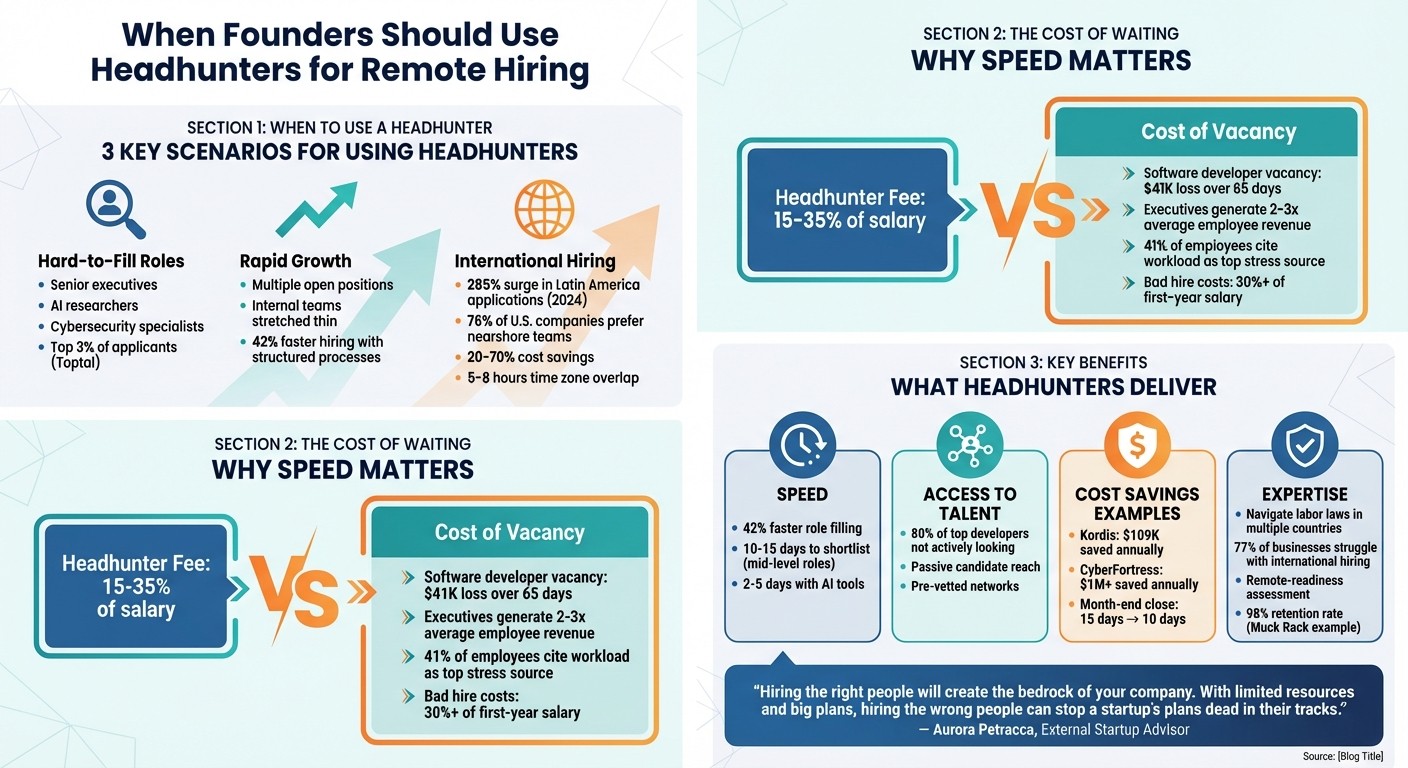
When Founders Should Use Headhunters for Remote Hiring: Key Scenarios and Benefits
A Founder's Hiring Guide: Gem's Strategy for Recruiting Early Talent #gemai

Common Remote Hiring Challenges for Founders
Hiring remotely comes with its own unique hurdles: navigating time zone differences, managing legal complexities across borders, and interpreting communication without the usual in-person cues. These factors highlight the importance of a recruitment approach tailored specifically for remote roles.
Finding Qualified Candidates Across Multiple Regions
Remote job listings often attract a flood of applications, but here’s the catch: only 20% of developers are actively searching for new opportunities. The top talent is usually already employed, meaning they’re not combing through job boards regularly.
To make things trickier, many job boards fail to account for critical factors like right-to-work laws or time zone compatibility, leading to a pile of applications that don’t fit your needs. On top of that, startups often find themselves competing with tech giants like Google and Facebook, which can offer bigger salaries and carry significant brand appeal. In fact, in 2023, 77% of businesses reported difficulties in finding the specific talent they needed.
Hiring across borders also comes with financial risks. For instance, employing someone in certain countries might trigger permanent establishment rules, creating unexpected corporate tax obligations - even if your company doesn’t have a physical office there.
Limited Time for Recruitment Activities
For founders, hiring is just one of many responsibilities competing for their attention. Between product development, fundraising, and customer acquisition, dedicating time to recruitment can feel impossible. Yet, the process - posting job ads, reviewing resumes, conducting interviews, and checking references - can take 20–30 hours per hire.
Delays in filling roles come with significant costs. Leadership positions, in particular, are expensive to leave vacant, as executives often generate 2 to 3 times the revenue of an average employee. Meanwhile, the longer a critical role stays open, the more pressure builds on the current team. In fact, 41% of employees cite workload as their top source of stress.
Companies that adopt structured kickoff meetings and maintain fast feedback loops tend to fill roles 42% faster than those with unorganized processes. These challenges emphasize the importance of efficient hiring strategies, which may include working with professional headhunters.
Evaluating Candidates Without In-Person Meetings
Relying solely on video interviews can sometimes lead to overemphasizing nonverbal cues. As Katie Wilde, author of The Holloway Guide to Remote Work, explains:
"The risk with an onsite or in-person only hiring process for remote workers is that you hire someone who comes across as a strong communicator on the basis of their body language... rather than the content of their communication."
This means candidates with confident body language might mask weaker written communication skills - an essential trait for remote teams. Beyond resumes, it’s also crucial to evaluate qualities like self-discipline, motivation, and the ability to address challenges proactively without waiting for direction.
Greg Caplan, CEO of Remote Year, puts it plainly:
"To remain productive, effective remote workers need to be able to give themselves structure without the crutch of a standard office environment."
Time zone differences only add to the complexity. A simple question can stretch into a day-long delay, especially for junior employees who may need more guidance. Poor hiring decisions can have lasting consequences - 80% of exit interviews point to a bad hire as the root cause of turnover. Financially, a mis-hire can cost over 30% of the new employee’s first-year salary. To navigate these challenges, many founders turn to headhunters for expert support.
When Founders Should Hire Headhunters for Remote Positions
There are specific scenarios where bringing in a headhunter makes sense. Knowing when to seek specialized recruitment help can save time, cut costs, and increase your chances of finding the perfect candidate.
Recruiting for Specialized or Hard-to-Fill Positions
When it comes to senior leadership roles or niche technical positions like CTO or VP of Engineering, the stakes are high. A bad hire at this level can be incredibly costly, making specialized headhunters a valuable asset. These recruiters excel in finding talent for roles requiring unique expertise - think prompt engineers for a Gen-AI startup or FP&A analysts for a SaaS company. They often have connections with passive candidates who might not be actively job hunting but are perfect for the role.
For positions like AI researchers, data scientists, and cybersecurity specialists, where internal teams might lack the expertise to evaluate candidates, headhunters step in with rigorous screening processes. For instance, Toptal's network includes only the top 3% of applicants, ensuring access to elite talent.
Growing Teams During Rapid Expansion
Headhunters are also critical during periods of rapid growth, where scaling quickly is non-negotiable. Unfilled roles can lead to significant losses in productivity and momentum, costing businesses tens of thousands of dollars. Whether you're looking to hire multiple mid-level sales reps for a new market or performance-marketing analysts to drive growth, headhunters bring the speed and reach that internal teams often lack.
Take Muck Rack as an example. Between 2023 and 2025, the PR platform successfully hired 35 remote engineers while maintaining a 98% retention rate. Co-founder and CEO Gregory Galant credited their success to standardized technical assessments, allowing candidates to demonstrate their skills without delaying the hiring process. For high-level roles like C-suite executives or VPs, retained search firms justify their fees (typically 25%–35% of the hire's salary) by offering in-depth market research and discreet candidate outreach. In these cases, headhunters act as strategic partners rather than just service providers.
Creating Teams Across Multiple Countries
Building distributed teams across borders is another scenario where headhunters shine. Hiring internationally often comes with added complexities, such as navigating regulatory and tax compliance. This is where nearshore headhunters, particularly those specializing in regions like Latin America, can make a big difference.
In 2024, applications from remote candidates in Latin America surged by 285%, and 76% of U.S. companies showed a preference for nearshore teams over offshore ones due to better time-zone alignment. With 5–8 hours of overlap with U.S. working hours, Latin American teams enable faster feedback cycles and smoother communication compared to offshore teams.
"Similar time zones across Latin America mean faster feedback cycles and smoother stand-ups." - Juli Brown, CEO, WOW Remote Teams
Global headhunters often work with Employer of Record (EOR) services to handle payroll, benefits, and compliance. They also assess candidates for remote-readiness, focusing on skills like communication, accountability, and asynchronous collaboration. This ensures you avoid hiring someone who might excel in a traditional office setting but struggle in a remote environment.
Additionally, hiring through nearshore agencies in Latin America can significantly cut labor costs - by as much as 20% to 70% compared to U.S.-based hires - while tapping into growing talent hubs often referred to as "Silicon Pueblos".
Advantages of Using Headhunters for Remote Hiring
Direct Access to Pre-Vetted Talent Networks
Headhunters have built extensive networks of pre-vetted, remote-ready professionals, enabling them to tap into both active job seekers and passive candidates - those high-performing professionals who aren’t actively seeking new roles but are open to the right opportunity. Unlike traditional job postings that primarily attract active applicants, headhunters proactively connect with skilled talent.
This targeted approach is especially helpful when you need niche expertise quickly. For example, in 2024, Kordis partnered with a remote recruitment agency and successfully hired a Latin American professional within just 14 days, saving $109,000 annually. Similarly, CyberFortress turned to a remote recruitment firm to build an entire accounting team from Latin America, cutting over $1,000,000 in annual costs and reducing their month-end close process from 15 days to just 10. These success stories highlight how headhunters can streamline the hiring process and deliver results fast.
Reduced Time to Fill Open Positions
Open positions can drain resources and stall progress. Companies that work closely with recruitment agencies and provide timely feedback fill roles 42% faster than those relying on traditional hiring methods. For mid-level roles, specialized agencies often deliver a shortlist of qualified candidates in just 10–15 business days.
"A software-developer vacancy saved $42k in payroll but bled $84k in lost product momentum, producing a net loss of $41k over 65 days." – Built In
Headhunters also cut down on inefficiencies by eliminating irrelevant applications. On average, businesses spend 9.24 days per role sorting through unsuitable or AI-generated resumes. By pre-screening candidates, headhunters ensure you only review top-tier talent, saving valuable time and resources.
Knowledge of Remote Work Requirements
Hiring for remote roles goes beyond technical skills - it requires evaluating traits like self-motivation, strong asynchronous communication, time management, and accountability. Headhunters specializing in remote hiring understand these nuances and assess candidates for their ability to thrive in distributed teams. They also factor in practical considerations like time-zone alignment and communication styles.
Additionally, these recruiters handle the more complex aspects of international hiring, such as navigating labor laws, tax regulations, and global payroll systems - areas where 77% of businesses face challenges when hiring internationally. With their expertise, headhunters can simplify the process, making them invaluable partners in remote recruitment.
How to Choose the Right Headhunter for Remote Roles
Experience in Your Industry
Specialized headhunters, whether in SaaS, AI, or fintech, bring more than just a network - they understand the technical and operational details that generalist recruiters might miss. They can interpret complex job requirements and evaluate whether a candidate's experience aligns with your expectations.
When assessing a headhunter, ask about their expertise in your industry. Speak directly with the recruiters who will manage your search, not just the sales representatives. Test their knowledge by requesting examples of how they’ve successfully filled difficult roles or managed challenging hiring situations. A good headhunter should also demonstrate familiarity with international labor laws, tax policies, and Employer of Record (EOR) systems for handling global payroll.
For U.S.-based startups, headhunters with experience in Latin America can be a game-changer. The shared time zones enable quicker collaboration, which explains why 76% of U.S. companies now favor nearshore over offshore teams.
"Similar time zones across Latin America mean faster feedback cycles and smoother stand-ups." – Juli Brown, CEO, Wow Remote Teams
Verified Success Stories and Client References
Industry expertise is one thing, but a proven track record is what truly sets top headhunters apart. Numbers speak louder than promises, so ask for measurable performance metrics like median time-to-shortlist, offer acceptance rates, and first-year retention statistics. Any reputable agency should be transparent about their results.
Look for firms that offer replacement guarantees in their contracts. These clauses ensure that if a hire leaves during the probationary period, the headhunter will find a replacement at no additional cost. This demonstrates their confidence in their vetting process. Also, verify their screening methods - top-tier headhunters rely on multi-stage evaluations, including resume reviews, technical tests, behavioral interviews, and reference checks.
Ask for concrete success stories. Agencies that can provide specific examples with clear timelines and financial outcomes are often better equipped to deliver results.
Use of Modern Recruitment Technology
Technology is a critical tool for remote recruitment, complementing industry expertise and proven processes. Advanced applicant tracking systems (ATS) like Greenhouse or Lever help streamline candidate management, reduce duplicate outreach, and provide real-time updates on the hiring pipeline. By 2025, more than half of surveyed organizations reported using AI-powered tools for recruitment. Headhunters leveraging these tools can connect you with qualified candidates in just two to five business days.
Before committing, ask for a demonstration of their tech-driven vetting process. Confirm that they use tools for assessing English proficiency, technical skills, and real-time salary benchmarking. They should also integrate with EOR platforms like Deel or Remote to handle international taxes and benefits seamlessly.
Top-performing remote headhunters also prioritize quick communication. Using platforms like Slack or Zoom, they aim for 24-hour feedback loops, which significantly reduce offer rejection rates. Companies with structured feedback processes can close roles 42% faster than those without.
Conclusion: Deciding If a Headhunter Is Right for Your Remote Hiring
When building a remote team, deciding whether to use a headhunter often comes down to understanding the true cost of leaving key roles unfilled. For instance, if a software developer vacancy costs your company $41,000 in lost progress over 65 days, a headhunter's contingency fee of 15–30% suddenly feels more like a strategic investment than an expense. To figure out your Cost of Vacancy (COV), calculate the daily revenue lost while the position remains open. For executive roles, you can estimate this by multiplying the average employee's revenue contribution by two or three times to account for the higher stakes involved.
Headhunters are especially valuable for filling specialized, senior, or hard-to-fill positions - roles where passive candidates might be the best fit. If your job board postings bring in unqualified applicants or your internal team is stretched thin trying to meet deadlines with regular overtime, it might be time to bring in outside help. While internal recruiters are great for handling high-volume hiring, headhunters shine when it comes to sourcing for C-suite roles, niche technical expertise, or deeply specialized positions.
This type of investment can be critical for establishing a strong team foundation.
"Hiring the right people will create the bedrock of your company. With limited resources and big plans, hiring the wrong people can stop a startup's plans dead in their tracks." – Aurora Petracca, External Startup Advisor
To ensure you're partnering with the right headhunter, evaluate their performance using measurable metrics like time-to-shortlist, offer acceptance rates, and first-year retention. Also, check if they use modern applicant tracking systems (ATS) to deliver shortlists quickly - ideally within two to five days. For U.S.-based startups, headhunters with nearshore networks in Latin America can offer significant cost advantages, with labor savings ranging from 20–70% while maintaining overlapping time zones for seamless collaboration.
For startups hiring fewer than 20 people annually or scaling rapidly, these factors can make a big difference. If you're only making a handful of hires each year, outsourcing to a headhunter or agency is often more efficient than maintaining an in-house recruiter. On the other hand, if you're in a phase of rapid growth, consider how a headhunter's fees compare to the savings from a faster time-to-hire. Companies with disciplined processes, such as structured kickoff meetings and 24-hour feedback loops, close roles 42% faster than their less organized peers.
The right headhunter can save time, reduce the risk of hiring mistakes, and secure the top-tier remote talent you need to drive your company forward.
FAQs
What are the main advantages of working with a headhunter for remote hiring?
Using a headhunter for remote hiring comes with several advantages. They can connect you with specialized or senior-level professionals worldwide, including those who aren't actively job hunting. This expands your talent pool significantly and gives you access to candidates you might not find through traditional methods.
Another major benefit? Headhunters simplify the hiring process. They take care of sourcing, vetting, and initial screenings, saving your team time and effort. This is especially helpful when you're dealing with hard-to-fill positions or need to quickly grow a remote team. Their expertise helps ensure you find the right match without unnecessary delays or costly hiring mistakes.
How can headhunters simplify international hiring for remote roles?
Headhunters play a crucial role in helping founders tackle the challenges of hiring talent across borders. With their extensive networks, they can tap into markets that are often difficult to access, connecting businesses with top-tier candidates - even those who aren’t actively seeking new opportunities. This approach not only speeds up the hiring process but also reduces the likelihood of costly hiring errors.
But their value doesn’t stop at sourcing talent. Headhunters handle the entire recruitment journey, from thoroughly vetting candidates to addressing logistical hurdles like time zone differences and virtual communication barriers. They also bring expertise in navigating immigration and compliance issues, ensuring companies meet visa requirements (like H-1B) and adhere to local labor laws. By working with a headhunter, founders can effectively scale their remote teams and tap into a global talent pool without the usual headaches.
When is it a smart choice for founders to hire a headhunter for remote roles?
Hiring a headhunter can be a game-changer when you're trying to fill specialized, senior, or hard-to-fill remote roles or if you're looking to quickly expand your remote team. These professionals have access to niche talent pools and can simplify the hiring process, saving you time and helping you avoid the expensive pitfalls of a bad hire.
This approach is especially helpful for roles requiring unique skills or when your internal team isn't equipped to efficiently source and assess candidates on a global scale. By relying on their expertise, you can stay focused on growing your business while they manage the challenging task of finding top-tier remote talent.