What’s the difference between a headhunter and a recruiter for executive roles?
Jan 17, 2026

Hiring for executive roles? Here’s the key difference: Headhunters specialize in finding passive, highly qualified leaders for top-tier positions, while recruiters focus on active job seekers and manage the entire hiring process across various levels.
Quick Summary:
Headhunters: Target executives not actively job hunting. Paid upfront (retainer) or through high-percentage fees (25–35%). Best for C-suite roles requiring discretion and precision.
Recruiters: Source active candidates via job boards and databases. Paid on contingency (only when a hire is made). Ideal for mid to senior roles with larger candidate pools.
Choosing between them depends on the role's complexity, timeline, and your budget. For a discreet, tailored approach to leadership hiring, headhunters are the way to go. Need speed and volume? Recruiters deliver faster results for less specialized roles.
Executive search headhunting versus recruitment

What Is a Headhunter for Executive Roles?
A headhunter is a recruitment specialist who zeroes in on finding and securing top-tier talent for senior leadership roles. Unlike traditional recruiters who often rely on job postings and applications, headhunters take a proactive approach. They seek out highly skilled executives who aren’t actively looking for new opportunities. As Investopedia puts it:
A headhunter is retained to fill jobs that require specific or high-level skills or offer high pay.
The major difference lies in their focus. Headhunters target passive candidates - those already employed in high-level roles and unlikely to respond to public job listings. By leveraging personal networks and industry connections, they tap into a talent pool that’s otherwise unreachable through standard hiring practices.
When companies need to discreetly replace a struggling executive or hire for a new leadership position, headhunters provide a confidential and strategic solution. Acting as intermediaries, they handle everything from the first outreach to negotiating terms, ensuring both the company’s and the candidate’s reputations remain intact. This level of confidentiality and precision sets headhunters apart from traditional recruitment methods.
Key Characteristics of Headhunters
For organizations filling C-suite roles like CEO, CFO, CTO, or board positions, headhunters offer a highly specialized and tailored approach. Instead of posting job openings publicly, they conduct thorough market research to pinpoint candidates with the necessary qualifications for these vital roles.
Headhunters go beyond evaluating technical expertise. They focus on leadership qualities, strategic vision, and how well a candidate aligns with the company’s values and goals. This process often involves close collaboration with boards and key stakeholders to define what success looks like before initiating the search.
Their allegiance is firmly with the hiring company. Typically working on an exclusive, retained basis, headhunters dedicate significant time and resources to finding the ideal fit for critical leadership positions.
Tools and Strategies Headhunters Use
Headhunters combine in-depth research with cutting-edge tools, such as AI-powered platforms like Caddie AI, to conduct global searches. These tools allow them to sift through extensive data and identify candidates across industries and regions. By analyzing competitors’ teams, exploring international organizations, and tapping into their extensive networks, headhunters find executives whose skills and experience align with their client’s needs. Advanced technology also helps minimize unconscious bias and speeds up the search process, while maintaining the personalized touch that executive recruitment demands.
However, technology is just one part of the equation. Long-standing professional relationships play a critical role. Headhunters rely on their deep industry connections to gain insights into top performers, identify executives open to new opportunities, and gauge competitive compensation trends. Many also use psychometric tests, 360-degree feedback, and other advanced assessment tools to thoroughly vet candidates. Interestingly, candidates hired through these methods are 8 times more likely to receive promotions within three years.
Next, we’ll explore how recruiters approach executive hiring with their own unique strategies.
What Is a Recruiter for Executive Roles?
A recruiter oversees the entire hiring process, from defining job roles to coordinating final offers. Unlike headhunters, who focus on finding passive candidates, recruiters typically target active job seekers through job boards and professional networks.
"Recruiters typically administer the entire hiring process to fill in the vacancies. They pre-screen candidates, facilitate the interviews, and generate reports on the hiring process." - Recruiter.com
Recruiters are responsible for filling positions across various levels and departments. Many organizations hire recruiters or staffing agencies to handle their hiring needs, with over 90% of companies relying on these services to fill open roles.
While headhunters often work on a retained basis, recruiters usually operate on a contingency model. This means they’re only paid once they successfully place a candidate. This structure drives them to work quickly and efficiently, often taking just 6–7 seconds to review a resume during the initial screening.
This efficiency-focused approach sets the stage for the unique qualities recruiters bring to executive hiring.
Key Characteristics of Recruiters
Recruiters differ from headhunters in their focus on managing high volumes of candidates and building large talent pipelines. This approach ensures a steady flow of qualified applicants to meet a variety of hiring needs. More than 75% of companies now use recruitment technologies, such as online career sites and social media platforms, to identify potential hires.
When it comes to executive roles, recruiters go beyond technical qualifications. They also assess candidates for how well they align with the company’s culture. Thanks to their long-term relationships with employers, recruiters gain insight into organizational values and dynamics, enabling them to evaluate how a candidate might integrate into the broader team - not just the specific role. As Randstad explains:
"Recruiting agencies are frequently contracted by companies to fulfill all the hiring needs across all their departments and divisions. Because of this, a recruiting company may be considered an extension of the company's internal human resources team."
This close collaboration often allows recruiters to offer additional services, such as salary negotiations, background checks, preparing hiring documentation, and even interview coaching. For executive roles, the recruiting process typically takes 30 to 40 days.
Tools and Strategies Recruiters Use
To streamline the hiring process, recruiters rely on a mix of tools and strategies, especially when filling executive positions. One of their primary tools is an Applicant Tracking System (ATS), which helps them manage and sort through the 200–250 resumes they receive for each job opening. These systems track candidates throughout the hiring process and keep records organized for compliance and reporting.
Beyond ATS platforms, recruiters use job boards, social media, and company career portals to connect with active candidates. Many have adopted recruitment marketing strategies, creating digital content to build employer brands and attract talent. Some recruitment teams even include dedicated researchers who compile data on talent pools, allowing lead recruiters to focus on interviews and negotiations.
For executive hiring, recruiters often incorporate advanced tools like psychometric tests and 360-degree feedback systems to evaluate leadership skills and ensure candidates align with the company’s values. Their expertise is further enhanced by proprietary databases, salary guides, and industry benchmarks, which provide the insights companies need to make informed hiring decisions.
Headhunter vs. Recruiter: Side-by-Side Comparison
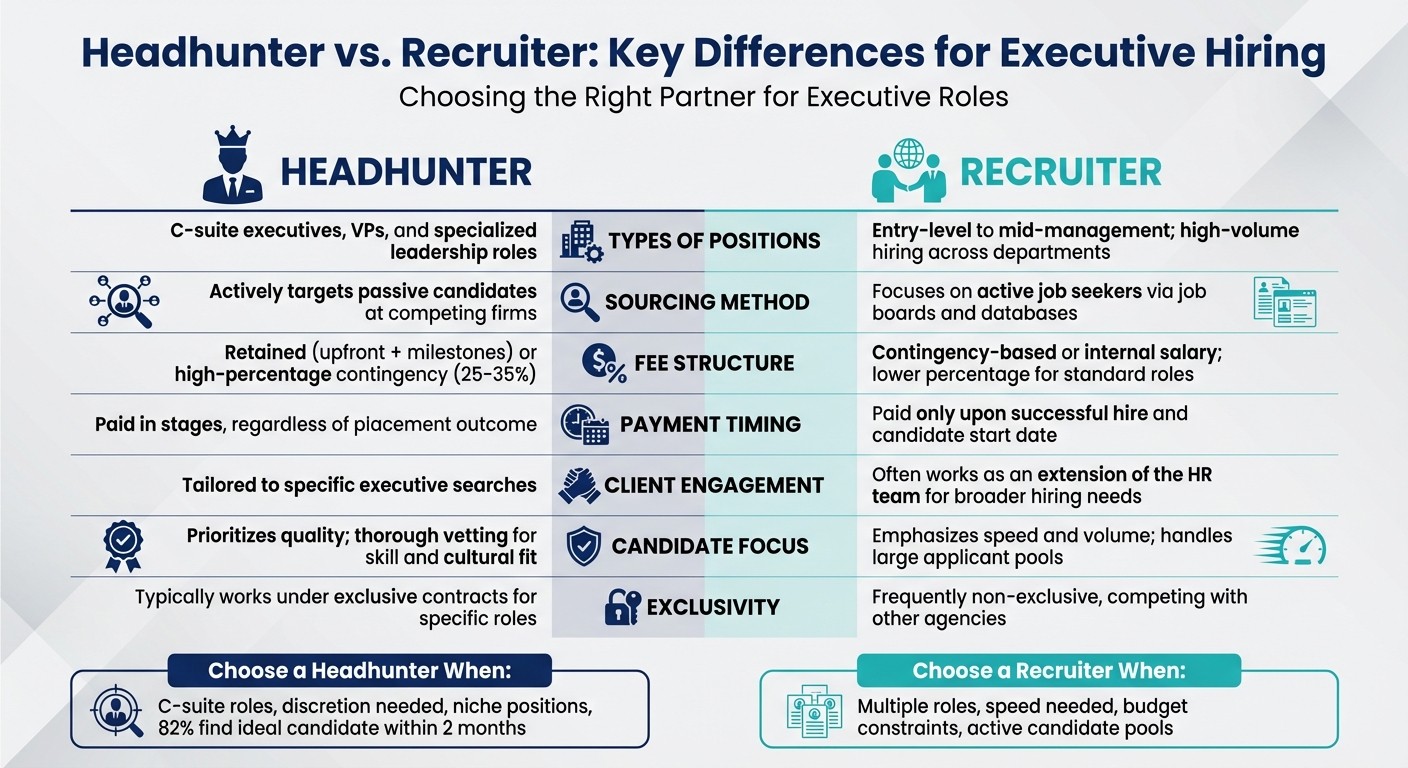
Headhunter vs Recruiter: Key Differences for Executive Hiring
When it comes to filling executive roles, knowing the differences between a headhunter and a recruiter can make hiring easier and more efficient. These differences show up in how they source candidates, their fee structures, and the overall hiring process.
Here’s a closer look at how their methods, payment models, and client interactions compare.
Sourcing candidates is where the distinction is most obvious. Headhunters actively seek out passive candidates - those who aren’t actively looking for new jobs. They often target executives at competing firms through private networks and referrals. On the other hand, recruiters focus on active job seekers - people who have posted their resumes on job boards or signed up with recruiting agencies.
Payment structures also highlight their different approaches. Headhunters usually work on a retained basis, meaning they’re paid upfront and in stages, regardless of whether the role is filled. Their fees typically range from 25% to 35% of the executive’s first-year salary. Recruiters, however, often work on contingency, meaning they only get paid when a candidate accepts the job and starts work. Their fees are generally lower than those of headhunters.
Scope and speed differ significantly as well. Headhunters often dedicate weeks or even months to filling one high-level position, carefully vetting a small number of top-tier candidates. Recruiters, by contrast, juggle multiple openings across various departments, working quickly through a high volume of applicants.
Here’s a breakdown to help you decide which professional is the better fit for your hiring needs:
Comparison Table
Feature | Headhunter (Executive Search) | Recruiter (General/Agency) |
|---|---|---|
Types of Positions | C-suite executives, VPs, and specialized leadership roles | Entry-level to mid-management; high-volume hiring across departments |
Sourcing Method | Actively targets passive candidates at competing firms | Focuses on active job seekers via job boards and databases |
Fee Structure | Retained (upfront + milestones) or high-percentage contingency (25-35%) | Contingency-based or internal salary; lower percentage for standard roles |
Payment Timing | Paid in stages, regardless of placement outcome | Paid only upon successful hire and candidate start date |
Client Engagement | Tailored to specific executive searches | Often works as an extension of the HR team for broader hiring needs |
Candidate Focus | Prioritizes quality; thorough vetting for skill and cultural fit | Emphasizes speed and volume; handles large applicant pools |
Exclusivity | Typically works under exclusive contracts for specific roles | Frequently non-exclusive, competing with other agencies |
When to Use a Headhunter vs. a Recruiter for Executive Roles
Choosing the right recruitment strategy for leadership positions is a crucial step toward organizational success. Deciding between a headhunter and a recruiter depends on the role's complexity, urgency, and the level of expertise required. It’s not just about the budget - it’s about aligning your hiring approach with your company’s unique needs. Here's when each option makes the most sense for executive hiring.
When to Choose a Headhunter
Headhunters are the go-to choice for high-stakes leadership roles. If you're hiring for C-suite positions like CEO, CFO, or CTO, an executive search firm can deliver the expertise and precision you need. Amit Ghodasara, CEO of iSmartRecruit, highlights the importance of this approach:
"A misalignment in leadership can result in costly mistakes, employee turnover, and lost market opportunities".
Headhunters shine in situations requiring discretion, such as sensitive leadership transitions. They specialize in reaching passive candidates - high-performing professionals who aren’t actively job hunting but might be open to the right opportunity. Impressively, 82% of employers using headhunting techniques find their ideal candidate within two months.
This approach is also ideal for niche or highly specialized roles where the talent pool is small and candidates must meet very specific qualifications. While the process can take three months or more, the thorough vetting - often including psychometric testing and in-depth assessments - helps minimize the risk of hiring the wrong person.
When to Choose a Recruiter
Recruiters, on the other hand, are better suited for scenarios where speed and volume are key. If you’re hiring for multiple mid-management roles or positions with a larger pool of active job seekers, recruiters can sift through candidates quickly and deliver results faster.
Recruiters are a practical choice for less specialized executive roles, where immediate availability and technical skills matter more than deep cultural alignment. If budget constraints are a concern, recruiters operating on a contingency model - where fees are only paid upon a successful hire - offer an efficient and cost-effective solution. They’re also a great option when you need to quickly expand operational teams to support an already established leadership structure.
These insights, paired with earlier comparisons, can guide you in selecting the recruitment strategy that best matches your executive hiring goals.
Conclusion
Understanding the distinction between headhunters and recruiters is crucial for making informed hiring decisions, especially when it comes to executive roles. Headhunters are experts in finding passive candidates for high-level positions like C-suite roles. They rely on personalized outreach and thorough vetting processes, which often take months to complete. On the other hand, recruiters focus on active job seekers and are skilled at quickly filling multiple roles by leveraging job boards and talent databases. The choice between the two depends entirely on your specific hiring needs - it's not about which is better, but about which aligns with your goals.
Your organization’s priorities and timeline should guide this decision. For example, if you're hiring a CEO and need a discreet process that ensures an excellent fit with your company’s values and leadership style, a headhunter is the way to go. However, if you're building a management team on a tighter budget and need quicker results, a recruiter’s high-volume approach is often more practical. Choosing the wrong option could cost your company valuable time, resources, and opportunities - making this decision one of strategic importance.
Adding to this, technology has become a game-changer in the recruitment process. Platforms like Caddie AI enhance executive hiring by connecting companies with expert headhunters who can deliver top-tier talent from around the world. This blend of technology and headhunting precision allows fast-growing businesses to fill critical roles more efficiently, without compromising on quality.
Ultimately, your recruitment strategy should reflect the complexity of the role, your timeline, and your budget. Whether you choose a headhunter, recruiter, or an AI-powered platform, the goal is the same: securing the right leader to drive your organization’s success.
FAQs
How do headhunters maintain confidentiality during executive searches?
Headhunters prioritize confidentiality by handling executive searches with the utmost discretion from the very beginning. To safeguard sensitive information, they often sign non-disclosure agreements (NDAs) with the hiring organization and craft anonymized job descriptions that exclude the company’s name and any critical details.
When reaching out to candidates, headhunters take a direct and personalized approach. They connect with pre-screened individuals using secure communication methods, ensuring privacy at every step. Only a select group of thoroughly vetted candidates receives the full details about the position. This careful process protects the company’s plans from competitors, employees, and the public while still drawing in highly qualified professionals.
How do I decide between hiring a headhunter or a recruiter for executive roles?
Choosing between a headhunter and a recruiter comes down to the type of role you need to fill. Headhunters are your go-to for senior-level or C-suite positions, especially when you're targeting passive candidates who aren’t actively job hunting. Their expertise lies in discreetly identifying and approaching top-tier talent. Recruiters, however, are better suited for mid-level roles, often working with a larger pool of active job seekers. This makes them a solid choice when you need to fill multiple positions more quickly.
Another factor to weigh is cost and timeline. Headhunters generally charge higher fees because of their in-depth research and highly personalized approach. Recruiters, on the other hand, often operate on a contingency basis, which can lead to faster results. If the role demands niche expertise or a very specific search, a headhunter may be worth the investment. But for broader hiring needs or quicker placements, a recruiter might be the better fit. Consider your budget, the urgency of the role, and how critical the position is to your overall strategy before making your decision.
Can recruiters find and engage passive candidates for executive positions?
Yes, recruiters can connect with passive candidates, especially when their expertise lies in executive-level searches. While many recruiters focus on active job seekers by posting job ads and sourcing applications, some have honed techniques to approach senior professionals who aren’t actively seeking new roles. These methods often involve tools like LinkedIn outreach and talent mapping to identify and engage top-tier talent.
That said, there’s an important difference between recruiters and headhunters. Headhunters, also known as executive search consultants, are specifically tasked with finding and approaching passive, high-level professionals. In contrast, general recruiters typically handle a broader range of positions. For senior or C-suite roles, companies frequently rely on headhunters or recruiters with executive search expertise to tap into the talent pool of individuals who may not be actively looking but are highly qualified for the role.