How do you hire a Chief Scientific Officer for a remote-first company?
Jan 16, 2026

Hiring a Chief Scientific Officer (CSO) for a remote-first company requires a different approach than for traditional, in-office roles. Here’s what you need to know:
Key Role of a CSO: A CSO oversees scientific strategy, aligns R&D with business goals, and leads globally distributed teams. They focus on deliverables, documentation, and managing remote workflows.
Remote Hiring Challenges: Candidates must have proven remote leadership skills, the ability to manage time zones, and strong written communication. Building trust is critical, as some candidates may view remote roles skeptically.
What to Look For: A Ph.D. or Master’s degree, 10+ years of experience, expertise in R&D, regulatory knowledge, and the ability to lead through digital platforms. Soft skills like self-motivation and resilience are essential.
Salary Expectations: U.S. salaries range from $157,000 to $325,000, with bonuses and equity often included. Remote-first companies may offer competitive, location-independent pay.
Effective Recruitment: Write clear job descriptions with transparent expectations, highlight remote-specific benefits, and use platforms like Caddie AI to streamline the process.
Onboarding and Retention: Provide structured onboarding, clear KPIs, and tools for remote work. Retain talent by involving the CSO in key decisions and ensuring work-life balance.
Hiring the right CSO can shape your company’s scientific vision and drive results, but success hinges on tailoring your recruitment and onboarding processes to the remote-first model.
What to Look for in a Remote CSO Candidate
Hiring a remote Chief Science Officer (CSO) is a high-stakes decision. This role requires not only scientific expertise but also the ability to lead effectively in a distributed work environment. A poor hire can derail your entire research and development strategy, so it’s crucial to focus on the right mix of qualifications, experience, and remote-specific skills.
By zeroing in on measurable credentials, proven remote work capabilities, and realistic compensation expectations, you can identify candidates who are well-suited to thrive in a remote leadership role. Let’s break down the essential qualifications and skills to look for.
Required Qualifications and Skills
A strong candidate should hold a Ph.D. or Master’s degree in fields like biochemistry, molecular biology, chemistry, or microbiology, paired with at least a decade of experience in scientific research and leadership. For context, 15.7% of Chief Science Officers hold a Doctorate, while 17.6% have a Master’s degree. Most successful candidates will have previously served as senior scientists, research directors, or principal scientists.
Expertise in R&D and clinical development is non-negotiable. Your CSO should be able to translate complex scientific research into actionable strategies that align with your company’s goals. Additionally, a deep understanding of regulatory and compliance standards - like FDA guidelines, clinical trial protocols, and ethical considerations - is essential to keep your company’s scientific progress on track, even from afar.
Remote leadership requires specific skills, including self-discipline, high task-relevant maturity, and intrinsic motivation. As Greg Caplan, CEO of Remote Year, puts it, remote leaders need to “give themselves structure without the crutch of a standard office environment”. For example, a Boston-based gene therapy startup recently hired a remote CSO who successfully filed an IND within four weeks and helped secure Series C funding. These results highlight the importance of finding someone who can deliver without constant oversight.
Skills That Matter for Remote Work Success
In a remote setting, strong written communication skills are critical. A CSO must be able to articulate complex ideas clearly and effectively across digital platforms. This skill can be evaluated through written assignments during the hiring process. The Holloway Guide to Remote Work emphasizes this point:
"The risk with an onsite or in-person only hiring process for remote workers is that you hire someone who comes across as a strong communicator on the basis of their body language... rather than the content of their communication".
Beyond technical expertise, soft skills like adaptability and resilience are key. Remote CSOs must navigate dynamic processes and manage hybrid teams across time zones while maintaining research quality. Candidates with a global perspective and the ability to adapt their communication style to different cultures and time zones are especially valuable.
Strategic foresight is another must-have. The ideal candidate will align long-term research goals with business objectives and market demands, even while working remotely. Look for someone who has experience managing large, diverse research teams through digital platforms, ensuring that innovation remains actionable and measurable.
Salary Ranges and Compensation Expectations
When budgeting for a remote CSO, it’s important to be competitive. In the U.S., annual salaries for CSOs typically range from $157,000 to $325,000, depending on the industry, company stage, and candidate experience. The median salary is around $152,000, with top-tier candidates earning over $275,000. Remote-first companies often pay at the higher end of this range, as 77% of executives report that flexible work arrangements are a key factor in attracting and retaining top leadership talent.
Compensation packages should also include bonuses and equity. High-caliber candidates expect competitive offers that reflect their pivotal role in driving innovation. Some companies are adopting location-independent salary models, offering high-market rates regardless of where employees live. This approach simplifies salary negotiations and demonstrates a commitment to fair pay across distributed teams.
Investing in the right CSO pays dividends. Executive search firms report a 98% success rate at the one-year mark for placed executives when using specialized recruitment processes. The right hire doesn’t just fill a vacancy - they provide the leadership that will shape your company’s scientific future.
How to Write a Job Description That Attracts Top CSO Candidates
Your job description is often the first impression potential candidates have of your organization. If it's poorly written, you risk losing out on highly qualified scientists. But if crafted thoughtfully, it can draw in exceptional talent from around the globe. The secret? Striking a balance between clearly outlining the role and showcasing your remote-first culture.
What to Include in Your Job Description
Start with a structure that makes the role easy to understand. Break it into sections like Impact/Intro, About the Role, About You (Qualifications), Who You'll Work With, Benefits, and About Us. Instead of diving into a list of duties, lead with the role's impact. For example, describe how the Chief Scientific Officer (CSO) will shape your company's scientific vision and contribute to long-term goals.
Be specific about geographic requirements. Whether the role is "Remote within USA", "Remote within EST", or "Remote – Global", clarity here saves time for both you and the candidates. Also, outline expectations for working hours. Will the CSO need to overlap with certain time zones or is the role fully asynchronous? For instance, you might specify, "Remote within EST to align with our EMEA-based research team".
Highlight the core responsibilities of the CSO, such as setting scientific strategy, overseeing R&D, mentoring multidisciplinary teams, securing research funding, and ensuring regulatory compliance. Additionally, emphasize remote-specific skills like strong written communication and the ability to lead via digital platforms.
Don’t shy away from discussing compensation. Include a salary range and clarify whether pay is location-based or a global flat rate. If the role involves travel, such as quarterly retreats or occasional lab visits, mention that upfront.
Finally, replace office perks with remote-friendly benefits. Instead of "catered lunch", consider offering a home office stipend, co-working space memberships, or a wellness allowance. These details help paint a clear picture of your remote-first culture.
How to Showcase Your Remote-First Culture
Be upfront about your remote work model. Are you "remote-first" (fully centered on remote work), "remote-friendly" (office-centric with remote options), or "remote-allowed" (offering remote work as a perk)?. Remote-first companies often demonstrate their commitment by ensuring equal perks and practices, such as "one human, one Zoom square" meetings where everyone joins video calls individually, regardless of location.
Highlight your emphasis on documentation. Candidates want to know that scientific progress, team decisions, and strategic plans are well-documented and accessible across time zones. Stress that your company operates asynchronously and prioritizes deep, focused work over constant meetings. As Andrew Gobran from Doist puts it:
"The company's mission and values, and how they are put into action, are the most important things to communicate when attracting talent. These provide a foundation for the relationship between company and candidate".
Make inclusivity a priority in your job description. Remote-first hiring creates opportunities for underrepresented groups, professionals with disabilities, and talent from regions often overlooked in traditional hiring. Avoid using terms like "rockstar" or "wizard", which can signal an exclusionary culture.
Include a "day in the life" section to help candidates visualize the role. Describe how the CSO will collaborate with distributed teams, manage research milestones, and use digital platforms to drive progress. This gives candidates a realistic sense of what to expect and helps them assess if the role is right for them.
By showcasing your remote culture and values, you’ll create a stronger connection with candidates and set the stage for attracting global talent.
Using AI and Digital Tools to Improve Job Postings
AI tools can take your job descriptions to the next level. Platforms like Jobed.ai can generate detailed postings, complete with visionary summaries, R&D responsibilities, and technical requirements like Ph.D. qualifications and leadership experience.
Optimize your job posting for search engines by including relevant keywords such as "Remote", "Distributed", "Work from anywhere", and "Time zone agnostic." Be specific in your job title, like "CSO, Remote (Global)" or "CSO, Remote within GMT+2".
Leverage AI to ensure your language is clear and inclusive. These tools can flag jargon or biased phrases that might discourage diverse applicants. Some companies are even moving beyond plain text descriptions and using tools like Pitch to create visually engaging job postings that reflect their brand and culture.
Lastly, post your opening on specialized remote job boards like We Work Remotely, Remotive, and Remote OK to reach a broader audience. With 83% of recruiters reporting higher-quality applicants for remote roles, these platforms can significantly boost your hiring efforts. Pair AI-driven sourcing with manual validation by reviewing candidates’ contributions on platforms like GitHub or Stack Overflow.
This blend of technology and strategy ensures your job posting is clear, inclusive, and far-reaching.
How Caddie AI Simplifies CSO Recruitment
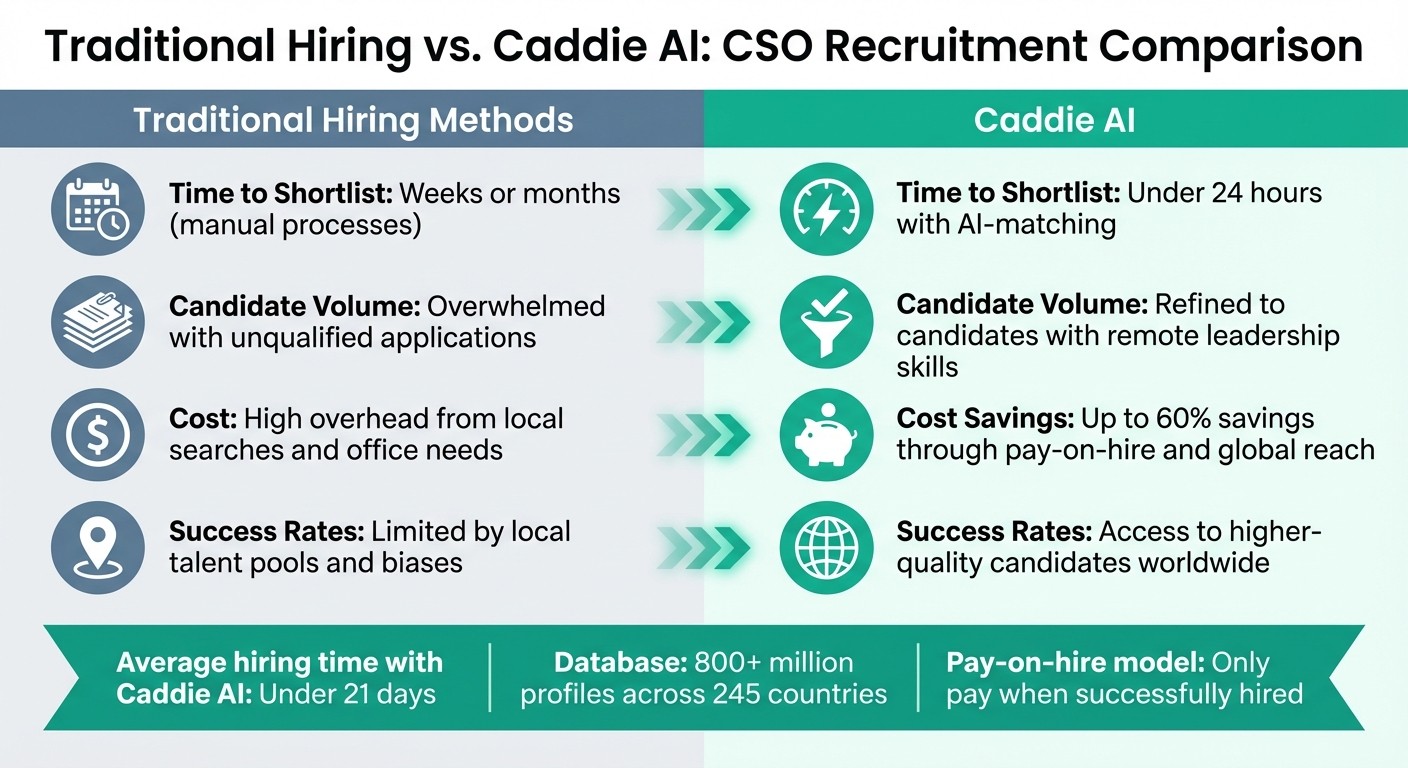
Traditional vs AI-Powered CSO Recruitment: Time, Cost & Quality Comparison
Hiring a Chief Scientific Officer (CSO) who can effectively lead a team remotely is no small feat - and it’s often an expensive and time-consuming process. Traditional recruitment methods can take weeks or even months, requiring extensive manual vetting. On top of that, companies often find themselves overwhelmed by an influx of unqualified applications. Enter Caddie AI, a platform that revolutionizes the hiring process. By connecting businesses with expert headhunters in major tech hubs, Caddie AI delivers pre-vetted shortlists in days, not weeks.
How Caddie AI Works for Global Recruitment
Caddie AI operates as an on-demand hiring solution, designed to simplify the global recruitment process. Once you post your CSO job opening, a network of expert headhunters immediately begins sourcing candidates from a database containing over 800 million profiles across 245 countries and regions. The platform’s AI goes beyond basic matching by analyzing key factors like candidate motivations, remote work preferences, eligibility, and scientific expertise to identify the best fit for your needs.
The process is built for speed and accuracy. Headhunters can provide shortlists in less than 24 hours, and the average hiring time is under 21 days. What’s more, the pay-on-hire model ensures you only incur costs when a hire is successfully made, cutting recruitment expenses by up to 60% compared to traditional methods. This AI-driven system doesn’t just save time and money - it also ensures that candidates presented have proven remote leadership skills, while addressing challenges like time zone differences and team compatibility. As Matt Moralo Langan, Head of People at TheyDo, puts it:
"Remote helps us unlock unlimited talent pools, and having the best talent gives us the greatest chance of business success".
This streamlined, precise approach offers a clear advantage over conventional hiring methods, as outlined below.
Comparing Caddie AI and Traditional Hiring
The gap between traditional hiring methods and Caddie AI’s approach is striking. Conventional recruitment often involves weeks or months of manual vetting, which typically limits searches to local talent pools. These methods also come with high overhead costs tied to office space and localized search efforts. By contrast, Caddie AI uses advanced AI-matching to deliver results in a fraction of the time, while focusing on critical skills like remote leadership and leveraging a global talent pool - all at significantly lower costs.
Feature | Standard Hiring Methods | Caddie AI |
|---|---|---|
Time to Shortlist | Weeks or months due to manual processes | Under 24 hours with AI-matching |
Candidate Volume | Overwhelmed with unqualified applications | Refined to candidates with remote leadership skills |
Cost Savings | High overhead from local searches and office needs | Up to 60% savings through pay-on-hire and global reach |
Success Rates | Limited by local talent pools and biases | Access to higher-quality candidates worldwide |
How to Screen and Evaluate Remote CSO Candidates
Once you've attracted a pool of qualified candidates, the next step is identifying those who can truly excel as remote leaders. For a remote CSO, strong communication skills aren't just a bonus - they're non-negotiable. The evaluation process should reflect the remote work model your CSO will oversee.
Steps in the Evaluation Process
Your screening process should mimic the way your CSO will operate in a remote-first environment. Start with AI-assisted resume reviews to narrow down candidates, then conduct interviews using a mix of video, audio, and text formats. Incorporate scenario-based questions to assess how candidates handle challenges like time zone differences or team burnout in a virtual setting.
For executive communication skills, consider asking candidates to record a short Loom video explaining a complex scientific concept. This will help you gauge their ability to inform and inspire without relying on face-to-face interaction. Additionally, conduct 360° back-channel referencing by reaching out to former colleagues. Ask about the candidate's experience managing virtual teams, resolving conflicts, and fostering cohesion despite physical distances.
What to Assess in CSO Candidates
In a remote-first role, certain competencies take on greater importance. While scientific expertise is critical, a candidate's ability to work independently - often referred to as task-relevant maturity (TRM) - is equally vital. High-TRM candidates thrive in environments with less structure, a hallmark of remote-first organizations. Be cautious of red flags, such as a strong preference for traditional office setups or unease with asynchronous tools like Notion or Loom.
Competency Category | Specific Skills to Assess | Assessment Method |
|---|---|---|
Scientific Expertise | Technical depth, task-relevant maturity, community contributions | Technical simulations, GitHub review, peer vetting |
Remote Leadership | Building psychological safety, async transparency, digital rituals | Scenario-based interviews, 360° back-channel referencing |
Strategic Vision | Risk mitigation, global roadmap alignment, financial/budgeting | Executive communication simulations, strategic case studies |
Remote Compatibility | Self-motivation, time management, written clarity | Trial periods, text-based interviews, rubric-based screening |
Testing these skills in practical, real-life scenarios is crucial to ensure a candidate's compatibility with remote work.
Using Trial Periods to Test Remote Fit
Even the most thorough interview process can leave gaps. Trial periods offer a way to see candidates in action before making a long-term hire. Assign a short, paid project - such as developing a scientific roadmap or creating technical documentation - to evaluate how they handle collaboration, deadlines, and communication in real-time.
Another effective option is a "Data Day", where candidates tackle a real-world challenge. This exercise not only tests technical skills but also reveals how well they align with your team's culture and their ability to manage the independence and isolation that often come with remote work. With 83% of recruiters reporting higher-quality candidates for remote roles, trial periods are a worthwhile investment to confirm a candidate's fit.
How to Onboard and Retain a Remote CSO
Hiring a Chief Scientific Officer (CSO) is just the beginning. The real challenge lies in ensuring they hit the ground running and stay engaged for the long haul. Onboarding someone remotely requires a thoughtful approach, structured processes, and ongoing support to build a strong foundation for success.
Remote Onboarding Best Practices
Preparation is key. Before your CSO’s first day, send them a virtual onboarding package that includes details about your company’s history, values, and vision, as well as any necessary hardware, software access, and login credentials. This proactive setup not only eases the transition but also reinforces the remote-first mindset introduced during recruitment.
Instead of overwhelming your CSO with back-to-back sessions on day one, spread out the onboarding process over the first week. Kelly Chuck, a Learning Partner at LinkedIn, shared their strategy:
"We didn't want to transition everything into a full day virtually. We felt we could best do that with shorter bursts spread over a week".
This approach helps prevent information overload and allows your CSO to gradually absorb essential details about their role, team dynamics, and strategic priorities.
Set clear KPIs and communication guidelines from the start. Your CSO should know which tools to use for various situations - whether it’s a video call, a Loom recording, or a Slack message. For international hires, consider using Employer of Record (EOR) services like Deel to manage legal and administrative tasks, such as local tax compliance and benefits.
To ease the transition, assign a local orientation partner who can help the CSO navigate company culture. Use HR automation tools to schedule brief virtual meet-and-greets with team members. These informal chats mimic the casual interactions that naturally happen in an office setting and help your CSO feel more connected.
Once the initial onboarding is complete, the focus shifts to keeping your CSO engaged and motivated over the long term.
How to Keep Your CSO Engaged Long-Term
Sustaining engagement requires a mix of strategic involvement, transparent communication, and a commitment to work-life balance. While competitive pay is important, flexibility is often a bigger factor in retention - 77% of executives cite flexible work arrangements as a top reason for staying with their organization.
Involve your CSO in key business activities, such as fundraising pitches, investor Q&A sessions, and board meetings. Martin Cooper, a Search Partner at Executive Recruit, highlights the evolving role of the CSO:
"The Chief Scientific Officer is no longer just the top scientist, they're a cornerstone of biotech leadership, with influence that reaches from the lab bench to the boardroom".
When your CSO sees how their decisions directly impact the company’s growth and value, they’re more likely to stay committed.
Prevent burnout by replacing daily status updates with asynchronous communication and focusing on high-impact weekly one-on-one check-ins. These sessions should emphasize strategic goals rather than micromanaging tasks. Encourage your CSO to set clear work-life boundaries - remote workers with flexible schedules report being 20% happier than their office-based counterparts. Support their well-being with stipends for home office setups and opportunities for professional development, such as attending conferences or publishing research.
Lastly, use performance management tools to align the company’s objectives with your CSO’s career aspirations. Regular reviews that go beyond quarterly metrics to focus on long-term growth demonstrate your investment in their success. With 54% of companies reporting higher retention rates due to remote work, the effort you put into onboarding and engagement will pay off in the form of a stable, motivated leader who drives innovation forward.
Conclusion
Bringing on a remote-first CSO means finding someone who not only has the scientific expertise to lead but also thrives in managing distributed teams and driving strategic progress. It’s a process that demands careful planning - evaluating technical skills, adaptability to remote work, and the ability to lead across different time zones and asynchronous workflows.
With executive searches taking an average of 130 days, the stakes of making a poor hire are high. Clearly defining your needs and using specialized tools to tap into global talent pools are essential steps that can save time and improve the quality of candidates.
That’s where Caddie AI steps in. The platform connects you with expert headhunters from around the world, delivering vetted candidate shortlists in just days instead of months. By using AI to match candidates based on the exact skills your position requires, you can focus on assessing leadership abilities and team alignment without wading through piles of unsuitable applications. Plus, with a pay-on-hire model and Deel’s global payroll management integration, you can hire confidently without worrying about compliance issues or upfront recruiting costs. This efficient process ensures you’re set up to secure a leader who can drive meaningful progress.
The numbers back the remote approach: 83% of recruiters say they see better-quality candidates for remote roles, and 77% of executives identify flexible work as a key factor in retention. By combining a well-thought-out hiring strategy with advanced tools and effective onboarding, you’ll be ready to bring in a CSO who not only shapes your scientific vision but also powers long-term growth.
FAQs
What skills are essential for a remote Chief Scientific Officer (CSO)?
A remote Chief Scientific Officer (CSO) must blend scientific expertise, leadership skills, and a strategic mindset to thrive in a remote-first work environment. Their role demands a strong foundation in fields like biotechnology or life sciences, paired with the ability to transform advanced research into practical business strategies.
Some essential skills for success include:
Leadership and Collaboration: Guiding distributed teams, encouraging innovation, and working seamlessly with departments like R&D, regulatory affairs, and executive leadership.
Strategic Thinking: Establishing research priorities that align with overarching business objectives while navigating the complexities of regulatory requirements.
Adaptability and Communication: Proficiency with virtual communication tools, sensitivity to cultural differences, and the discipline to manage global teams efficiently.
On top of these, a CSO must be proficient in data-driven decision-making, evaluating scientific risks, and nurturing a culture of ongoing innovation. These capabilities enable them to advance scientific initiatives and maintain momentum, even in the absence of a traditional office setting.
What are the best practices for onboarding a remote Chief Scientific Officer (CSO)?
To bring a remote Chief Scientific Officer (CSO) on board smoothly, start with a well-thought-out plan that sets them up for success from day one. This means equipping them with research-grade hardware, secure access to essential data and tools, and a detailed first-week schedule. The agenda should cover key meetings, initial deliverables, and important milestones.
Pair the CSO with a senior executive - like the CEO or head of R&D - who can serve as a mentor. This person will help them navigate company processes, regulatory requirements, and team dynamics. To immerse the CSO in the organization’s scientific environment, include virtual lab tours, recorded project summaries, and live Q&A sessions with research leaders. Regular check-ins - starting daily and gradually shifting to weekly or bi-weekly - can keep communication open and momentum strong.
Leverage AI-powered onboarding tools to handle routine tasks like paperwork and compliance training, freeing the CSO to focus on strategy and leadership. Set clear goals, such as shared OKRs (Objectives & Key Results), and schedule frequent feedback discussions. These steps will help the CSO align with the company’s mission, achieve early successes, and establish trust and accountability.
What are the best strategies to retain a remote Chief Scientific Officer (CSO) long-term?
Retaining a remote Chief Scientific Officer (CSO) starts with building a remote-first culture that prioritizes flexibility, independence, and effective communication. Give your CSO the freedom to manage their schedule while keeping them engaged through virtual strategy sessions and collaborative discussions. A competitive compensation package is key - think a base salary starting at $250,000, performance-based bonuses tied to R&D milestones, and equity options to align their success with the company’s growth.
Invest in their professional development by providing access to leadership training, mentorship programs, and cutting-edge tools to keep them at the forefront of their field. Strengthen their connection to the team with regular one-on-one check-ins, virtual onboarding for new projects, and company-wide science-focused town halls. A clear remote-work policy is also essential - one that emphasizes work-life balance, defines communication norms, and offers resources like telehealth and mental health support. When a CSO feels empowered, appreciated, and connected, they’re far more likely to stay committed for the long haul.