How to Hire Remote Developers in 5 Days or Less
Dec 18, 2025

Hiring remote developers quickly is challenging due to high demand, a global talent shortage, and slow traditional hiring processes. Here's how you can simplify and speed up the process:
Define Job Requirements: Write a clear job description with technical and soft skills, plus perks like flexible work or growth opportunities.
Post onCaddie AI: Use the platform to match your role with pre-vetted candidates worldwide. Get a shortlist in under 24 hours.
Evaluate Candidates Efficiently: Use targeted technical tests, live coding interviews, and portfolio reviews to confirm skills.
Offer Competitive Compensation: Research market rates and include benefits like equipment stipends or professional development.
Onboard in 5 Days: Complete background checks, sign contracts, and set up payroll using tools like Deel for international hires.
Key Benefits:
Save time with AI-driven matching and expert headhunter input.
Reduce costs with a pay-on-hire model.
Access top 1% global talent and hire in as little as 5 days.
Platforms like Caddie AI combine technology with human expertise to make hiring faster, efficient, and cost-effective.
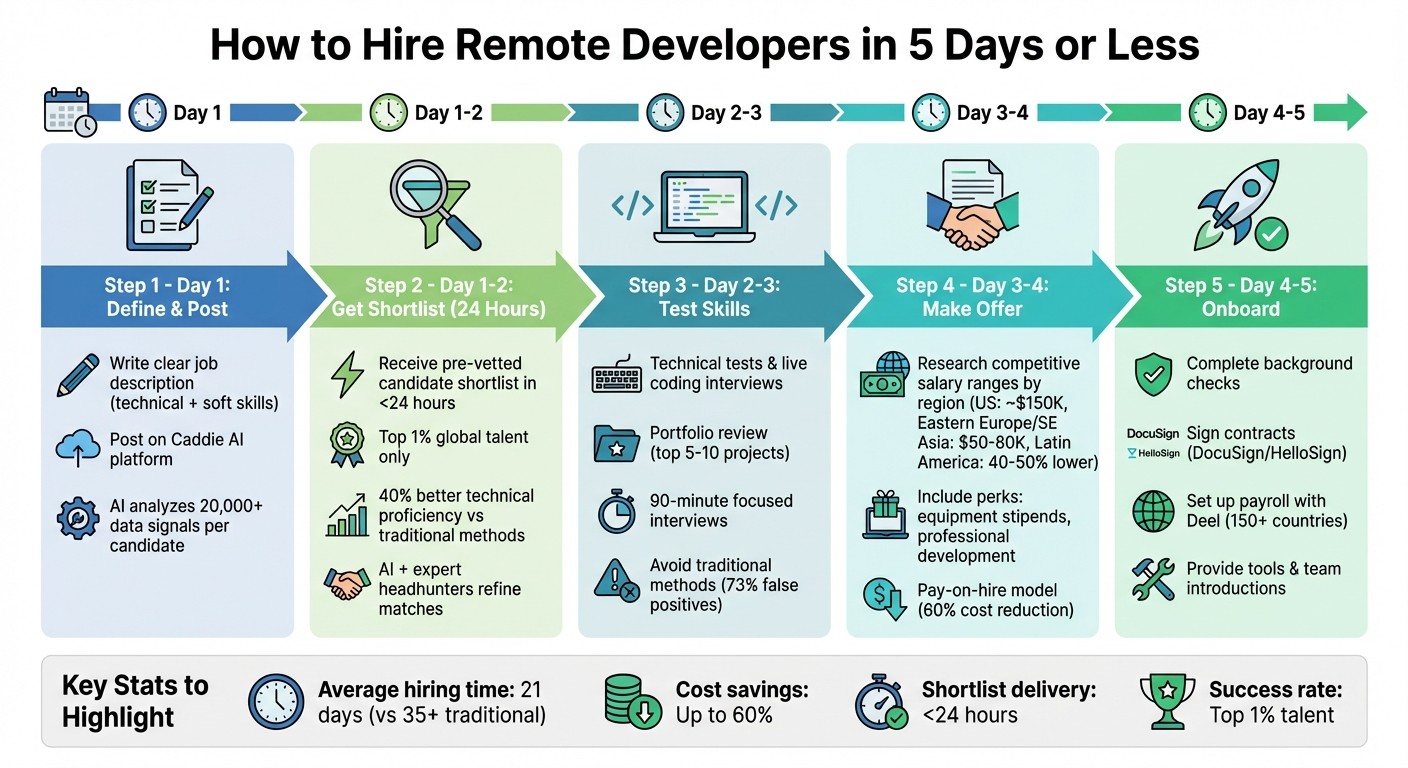
How to Hire Remote Developers in 5 Days: Step-by-Step Process
Step 1: Write Your Job Requirements and Post on Caddie AI
Write a Clear Job Description
Start by crafting a job description that highlights what makes the role appealing to skilled developers. Clearly outline the technical skills you’re looking for - whether it’s expertise in specific programming languages, frameworks, or tools. Be upfront about the level of experience required and the types of projects they’ll tackle. This precision helps the AI and headhunters find the perfect match for your needs.
Don’t forget to include soft skills like communication and the ability to work independently. It’s also a good idea to mention perks like professional growth opportunities, a strong team culture, or flexible work arrangements. These details not only attract the right candidates but also guide the AI and headhunters in narrowing down the best options. Keep the description clear and to the point - enough to inform without overwhelming. Once it’s ready, you can move on to posting your job on Caddie AI.
Post Your Job on Caddie AI
With your polished job description in hand, submit it to Caddie AI. The platform uses a combination of advanced AI and experienced headhunters to match your requirements with top-tier global talent. The AI digs into the details - technical skills, project experience, and even time zone compatibility - to deliver highly relevant candidates. Unlike traditional job boards, where you might drown in a sea of unfiltered applications, Caddie AI offers a curated shortlist that saves you time and effort.
The platform’s headhunters operate across multiple regions, giving you access to a broader talent pool than any single recruiter could provide. This global reach ensures you’re not limited by geography or time zones. Best of all, you’ll receive your first list of pre-vetted candidates in less than 24 hours. And with an average hiring timeline of under 21 days, the process is both fast and efficient. Plus, there’s no upfront cost - you only pay if you successfully hire, making it a risk-free way to tap into a world-class network of talent.
Step 2: Get Candidate Shortlists in 24 Hours
How AI-Matching Filters Candidates
As soon as your job is posted, Caddie AI gets to work, creating a top-notch candidate shortlist. The platform analyzes over 20,000 machine learning data signals for each candidate. It rigorously evaluates skills in programming languages, data structures, algorithms, system design, and frameworks. Each candidate undergoes more than five hours of testing and interviews, which include coding challenges and a detailed seniority assessment with 57 targeted questions. These questions cover five key areas: project impact, engineering expertise, communication, leadership, and strategic direction.
This process boosts technical proficiency evaluations by 40% compared to traditional hiring methods. The outcome? You’ll only see candidates from the top 1% of remote developers worldwide, tailored to your specific technical needs and project goals. This data-driven approach ensures that only the most qualified candidates make it to the next stage, where expert headhunters refine the selection.
How Expert Headhunters Refine Your Shortlist
After the AI-powered evaluation, expert headhunters step in to bring a human perspective. They conduct interviews to confirm problem-solving skills and domain-specific expertise - areas that algorithms might overlook. They also assess critical soft skills like English fluency, communication, teamwork, and readiness for remote work.
Headhunters dig deeper into factors like alignment with your company’s values, preferred working style (whether asynchronous or real-time), and compatibility with your time zone. By ensuring a strong fit in these areas, they help eliminate potential mismatches before you invest time in interviews. This blend of AI precision and human insight delivers a carefully curated shortlist in less than 24 hours - saving you from sifting through a mountain of unqualified applicants.
Step 3: Test Candidate Skills Quickly
Use Technical Tests and Coding Challenges
Once you’ve narrowed down your candidate pool, it’s time to confirm their technical skills without wasting any time. Automated pre-screenings are a great way to ensure consistent and objective evaluations. These tests can assess multiple aspects of a candidate’s abilities, like problem-solving and code quality, all while keeping the process efficient.
Live coding interviews are another powerful tool. They let you see how candidates approach problems in real-time, communicate their thought processes, and respond under pressure in scenarios similar to what they’d face on the job. To make these tests effective, keep them focused and relevant. The goal is to filter out unnecessary distractions and zero in on skills that directly impact job performance.
It’s worth noting that traditional algorithm puzzles are often poor predictors of success, with only a 15% accuracy rate for real-world performance. Meanwhile, conventional interviews can result in a staggering 73% false positives. Instead of abstract brain teasers, design assessments that reflect the actual challenges your team encounters. Once technical skills are confirmed, you can dive deeper into practical experience through portfolio reviews and targeted interviews.
Review Portfolios and Conduct Focused Interviews
A developer’s portfolio is like a window into their career. It showcases their coding expertise, the complexity of problems they’ve solved, and their overall growth. Concentrate on their top 5–10 projects that align with your team’s technical needs. Take a closer look at project descriptions and GitHub repositories to evaluate problem-solving approaches, their role in the project, tool usage, measurable results, code quality, commit patterns, and documentation.
When it’s time for interviews, skip drawn-out theoretical exercises. Instead, create a practical, hands-on experience. For example, you could have candidates participate in a screen-share session where they debug a broken feature from your actual codebase. Show them your architecture and ask for their input on improving workflows or refactoring components. You can even provide intentionally vague requirements to see how they handle ambiguity - do they ask the right questions? Do they push back professionally, as they would with real stakeholders?.
For remote positions, clear communication is a must. Pay close attention to both written and verbal skills throughout the process. On average, technical interviews last about 90 minutes, so focus on real-world tasks to make the most of the time and cover all the critical areas.
How to Hire Remote Developers

Step 4: Make Offers and Close Candidates
Once you've verified a candidate's skills, the next step is locking in top talent with an attractive offer.
Research Salary Ranges for Remote Developers
After identifying your ideal candidate, move quickly to offer a competitive compensation package. Start by researching salary benchmarks for the technical skills and regions you're targeting. For instance, a senior developer in the U.S. typically earns around $150,000 annually. In contrast, similar roles in Eastern Europe or Southeast Asia range from $50,000 to $80,000, while Latin America offers salaries that are 40–50% lower.
Remember, compensation isn't just about salary. Remote developers often value perks like professional development opportunities, home office stipends, and equipment allowances just as much as their paycheck. Use salary calculators to analyze industry standards in your target regions. For example, a full-stack developer in the U.S. earns between $92,000 and $155,000 on average, while in Latin America, the range is $54,000 to $110,000.
Paying at or above local market rates is a smart way to boost retention, especially in fast-moving tech fields. Be upfront about compensation from the start - this shows you respect the candidate's worth and understand global market trends. A well-researched salary strategy ensures a cost-effective hiring process while keeping you competitive.
Save Money with Caddie AI's Pay-on-Hire Model
Caddie AI takes cost efficiency to the next level with its pay-on-hire model. Instead of charging upfront, Caddie AI only requires payment when a hire is successfully made. This approach can cut recruitment costs by up to 60%, eliminating financial risks tied to traditional hiring methods.
The platform combines AI-powered matching with a network of expert headhunters to deliver qualified candidate shortlists in under 24 hours. This speed not only accelerates the hiring process but also reduces the downtime caused by unfilled positions, which can hurt productivity and delay projects. By leveraging global talent and the pay-on-hire system, you can offer competitive compensation while keeping recruitment expenses in check.
Step 5: Onboard Your Developer in 5 Days
Once your candidate has accepted the offer, a smooth and efficient onboarding process is essential to maintain momentum. The goal is to have everything - verification checks, contracts, payroll, and introductions - wrapped up within five days, so your developer can start contributing right away.
Complete Background Checks and Sign Contracts
Start by verifying your new hire’s credentials through background checks. These should be prompt to avoid delays while ensuring compliance. To simplify the process, use pre-written, legally reviewed contract templates. Digital platforms like DocuSign or HelloSign can make this step faster by setting "sign by" deadlines and using auto-complete features for fields .
For companies hiring across multiple countries, additional steps may be required. Coordinate with your internal teams to ensure the new hire is added to all relevant systems. If managing international compliance feels overwhelming, consider using an Employer of Record (EOR) to handle legal and regulatory requirements across borders.
Set Up Payroll with Caddie x Deel Integration (20% off Deel Discount)
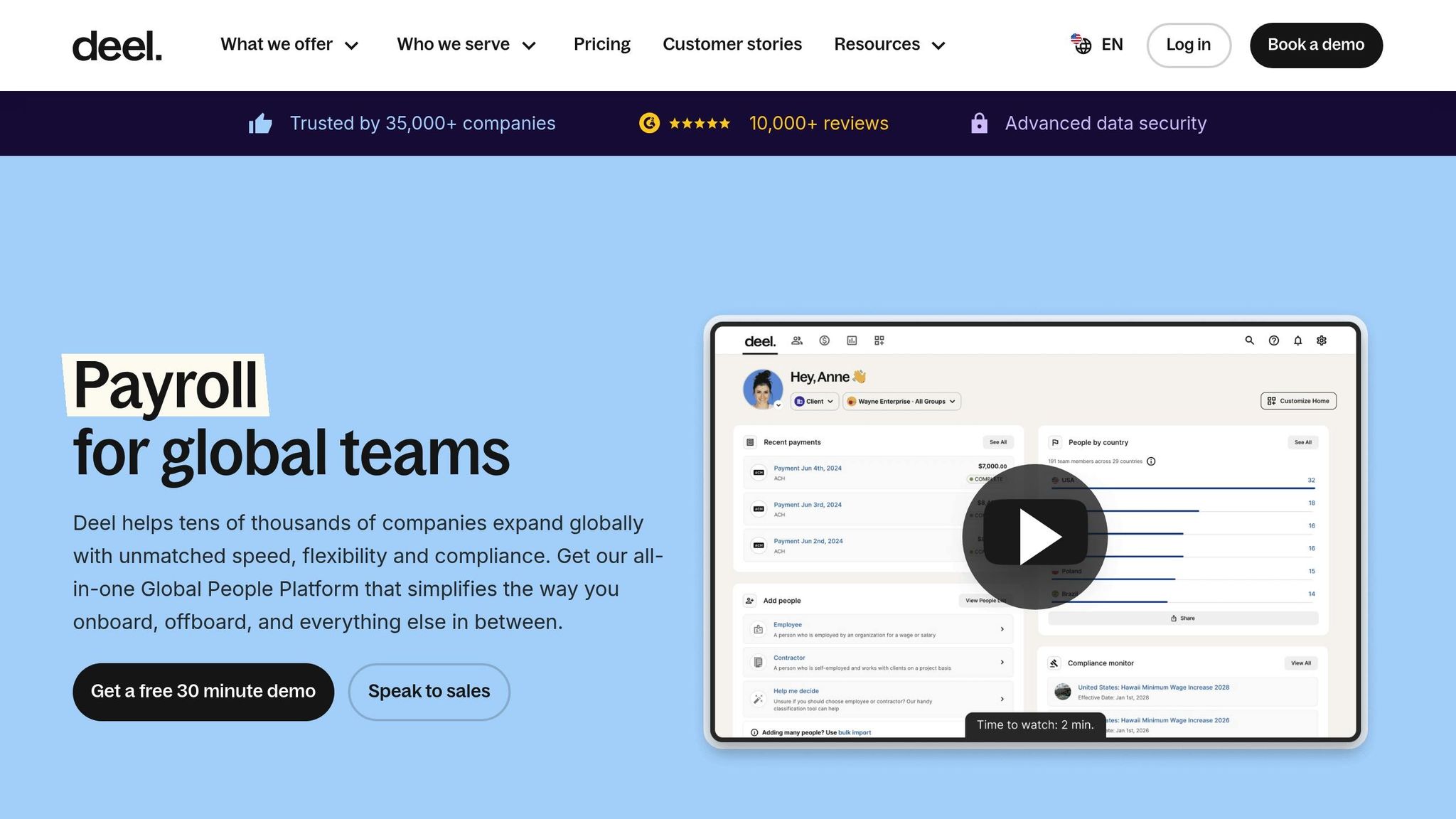
Managing payroll for remote developers in different countries can be tricky, but platforms like Deel simplify the process. Deel offers a comprehensive solution that combines payroll, HR, compliance, and performance management for both employees and contractors in over 150 countries.
By integrating Deel, you can process payments without creating a separate system for each country. For instance, Floship, a global logistics tech company, reduced its hiring and onboarding time from weeks or months to just two days by using Deel. Carmen Fan, Floship’s Head of Marketing, shared:
"Unrestricted talent search across borders allows us to hire and onboard in as little as two days, a process that used to take weeks or even months."
Once payroll is set, make sure your developer has access to all the tools they need to get started. Share an onboarding checklist to provide clarity and show professionalism. Wrap up by introducing your new hire to the team and ensuring they feel welcomed. With these steps, the entire onboarding process can be completed within five days.
Conclusion
Let’s wrap up by highlighting how a well-structured process, powered by Caddie AI, can transform the way remote hiring is done.
Fast-Track Your Remote Hiring Process
Imagine hiring remote developers in just five days. With a clear plan, it’s possible: define precise job requirements, post the role on Caddie AI, receive a pre-vetted shortlist within 24 hours, assess skills with targeted evaluations, make competitive offers, and onboard - all within the same week.
This streamlined process removes the delays that often make traditional hiring drag on for weeks or even months. By automating the sourcing and screening phases while keeping human expertise for final decisions, you can build a capable remote team quickly without compromising on quality. It’s a game-changer for companies aiming to scale efficiently.
Why Caddie AI Stands Out for Remote Hiring
Caddie AI combines advanced AI-driven matching with seasoned headhunters to deliver tailored candidate shortlists in under 24 hours. This approach slashes the average hiring time from over 35 days to just 21. And with a pay-on-hire model, you can cut hiring costs by up to 60%, avoiding the burden of upfront recruiting fees.
Cassy Aite, Founder & CEO, sums it up perfectly:
"Caddie saved us 40+ hours and helped us hire a CSM in Colombia in just 11 days - a top performer who's delivering incredible results at 50% lower cost".
When speed and quality are crucial, Caddie AI proves to be a reliable partner, making global talent hiring faster, more efficient, and budget-friendly.
FAQs
How does Caddie AI ensure the candidates it recommends are highly qualified?
Caddie AI leverages cutting-edge AI algorithms to match candidates with your specific requirements. By analyzing skills, experience, and qualifications, the platform ensures that only professionals with the right expertise and background make the cut.
What sets Caddie AI apart is its thorough vetting process. This includes detailed skill assessments and performance evaluations, guaranteeing that every recommended remote developer is well-equipped to deliver real value to your projects. With Caddie AI, you get a handpicked list of top talent ready to hit the ground running.
What are the advantages of Caddie AI's pay-on-hire model?
Caddie AI's pay-on-hire model brings a straightforward and no-risk method to hiring skilled remote developers. The best part? You only pay after successfully hiring a candidate, meaning your spending is tied directly to results.
This setup removes upfront expenses, lowers financial risks, and lets you evaluate candidates without feeling rushed or pressured. It’s a smart choice for businesses aiming to simplify their hiring process while keeping full control over their budget.
What’s the best way to evaluate a remote developer’s technical skills?
To evaluate a remote developer's technical skills effectively, it's essential to use a well-organized process that blends hands-on tests, practical scenarios, and detailed reviews. Begin with a coding assessment tailored to the role, focusing on tasks that closely resemble the actual work they’ll be doing. This ensures the evaluation is relevant and avoids relying on abstract puzzles that don't reflect real-world challenges.
Next, conduct a live, project-based interview. During this session, ask candidates to tackle practical tasks, such as debugging code or improving an existing project. This gives you a chance to see their problem-solving approach and coding standards in action.
You should also take the time to review their previous work, like GitHub repositories or code samples. This step helps you assess their coding habits, attention to detail, and documentation skills. Lastly, reach out for technical references to confirm their ability to collaborate and deliver results effectively in a remote work environment. Combining these strategies will help you make informed and confident hiring decisions.