In-House Recruiting vs Headhunters: Cost Comparison
Dec 22, 2025

When deciding between in-house recruiting and headhunters, the choice often boils down to cost, speed, and hiring needs. Here's the short version:
In-house recruiting has fixed costs, including recruiter salaries (around $85,000–$130,000 annually), benefits (20–30% extra), and tools like ATS systems ($15,000–$50,000/year). It’s more cost-effective for companies hiring in high volumes but slower in filling roles.
Headhunters charge 15–30% of a candidate's first-year salary (more for specialized roles). They’re faster, filling roles 20–45 days on average, and are effective for niche or urgent hires. However, fees can add up quickly, especially for senior or technical roles.
Key Takeaways:
Cost: In-house recruiting is cheaper for high-volume hiring, while headhunters are better for occasional, hard-to-fill roles.
Speed: Headhunters reduce vacancy time, saving $3,000–$7,000/day in lost productivity.
Specialization: Agencies excel at sourcing passive candidates and niche talent.
Quick Comparison:
Factor | In-House Recruiting | Headhunters/Agencies |
|---|---|---|
Cost Structure | Fixed (salaries, tools) | Variable (15–30% per hire) |
Speed | 42–68 days | 20–45 days |
Candidate Access | Active applicants | Passive/niche talent |
Best For | High-volume hiring | Specialized or urgent roles |
Your choice depends on hiring volume, urgency, and role complexity. For many, a hybrid approach - handling routine roles in-house and outsourcing specialized ones - offers the best balance.
In-House vs Recruitment Agency – Which is Best for Your Business? Pros and Cons explained

In-House Recruiting Costs
Setting up an internal recruiting team can lead to substantial fixed expenses, regardless of how many hires are made. This is especially true for tech companies competing for top-tier talent in competitive markets like San Francisco, Austin, or Seattle. Let’s break these costs down into three main categories: salaries, operational expenses, and hidden investments.
Salaries and Benefits
Recruiter salaries form a significant part of in-house recruiting expenses. Corporate recruiters typically earn between $85,000 and $130,000 annually. When you factor in employer taxes and benefits, the total cost can balloon to 1.25 to 2.5 times the base salary. For instance, a recruiter with a $100,000 base salary might actually cost the company somewhere between $125,000 and $250,000 per year. Senior positions come with even steeper price tags, further increasing the financial commitment.
Operational Expenses
Running an internal recruiting team involves more than just salaries - it requires investments in technology and tools. Here’s a snapshot of common operational costs:
Applicant Tracking Systems (ATS): $15,000 to $50,000 per year.
Skills assessment platforms: $20 to over $500 per seat per month.
Job board advertising: Costs vary, with per-click rates ranging from $0.10 to $5.00 and monthly post fees as high as $499.
Background checks: Between $10 and $2,800 per candidate, while federal contractor security clearances can cost $140 to $5,410.
Administrative costs: Internal HR teams spend an average of $2,524 per employee annually.
Some companies have managed to cut these costs significantly by optimizing their recruiting processes. For example, Nokia and Ericsson reportedly reduced their cost-per-hire by over 70% through better recruitment technology. Even so, the combination of salaries, tech tools, and advertising remains a hefty ongoing expense.
Hidden Costs and Time Investment
In-house recruiting also comes with less obvious costs that are easy to overlook but can have a big impact. One major factor is the time spent by internal teams on hiring instead of focusing on their core responsibilities. These "soft" costs can make up about 60% of total recruitment expenses, as noted by Edie Goldberg, Founder of E.L. Goldberg & Associates:
"Of those costs, I would say 30 percent to 40 percent are hard costs, and the other 60 percent are soft costs."
Other hidden expenses include training costs, which average $1,280 per employee annually, and the financial impact of unfilled roles, which can cost $8,000 to $15,000 per month. On top of that, new hires often take 8 to 26 weeks to reach full productivity, adding to the overall expense.
Interestingly, some companies have found ways to reduce these hidden costs. For instance, Nature's Pride saved about $1,100 per hire by transitioning from external agencies to an entirely internal recruitment team during a growth phase. However, these hidden costs still make the decision to rely on in-house recruiting a complex one, particularly for tech companies and startups navigating tight budgets.
Headhunter Costs and Fee Structures
Headhunters typically operate using a variety of pricing models. Their fees usually range from 15%–30% of a candidate's first-year salary, but this can climb depending on the role. For instance, tech positions often command rates of 25%–35%, specialized healthcare roles may reach 30%–40%, and high-stakes C-suite searches can go as high as 30%–50%. Let’s break down the main fee structures they use.
Headhunters generally work under two primary fee structures: contingency and retained search. In a contingency model, payment is made only when a successful placement is achieved. Retained search, on the other hand, involves an upfront fee - typically between $10,000 and $25,000 - followed by milestone payments. This approach is often reserved for C-suite or highly confidential searches, where dedicated resources are required. Retained fees are commonly split into three parts: one-third upfront, one-third when a shortlist is presented, and the final third upon the successful placement of the candidate.
Some agencies also offer alternative pricing models. For example, flat fees ranging from $5,000 to $20,000 per placement provide more predictable costs. Temporary positions often come with markups of 25%–100% on hourly wages. Entry-level hires might cost $2,000–$3,000, while C-suite placements can surpass $50,000.
Geography and industry also play a big role in pricing. In tech hubs like San Francisco, New York, and Boston, fees can be up to 40% higher. Tech roles generally attract fees of 25%–35%, compared to 18%–25% in industries like manufacturing. Executive searches may exceed $28,000, while the average cost-per-hire across industries is approximately $4,700.
Most headhunter agreements include a guarantee period, which ensures a free replacement if the new hire leaves within the first few months. This is an important safeguard, especially for senior roles, where the cost of a mis-hire can range from $17,000 to $240,000.
"The average cost of a mis-hire for a company can range anywhere from $17,000 to $240,000" - Michelle Han-Taylor, Hunt Club
This guarantee clause helps reduce financial risk, making headhunter fees more appealing when compared to the potential costs of in-house recruiting, which often lacks such protections.
Cost Comparison by Hiring Volume
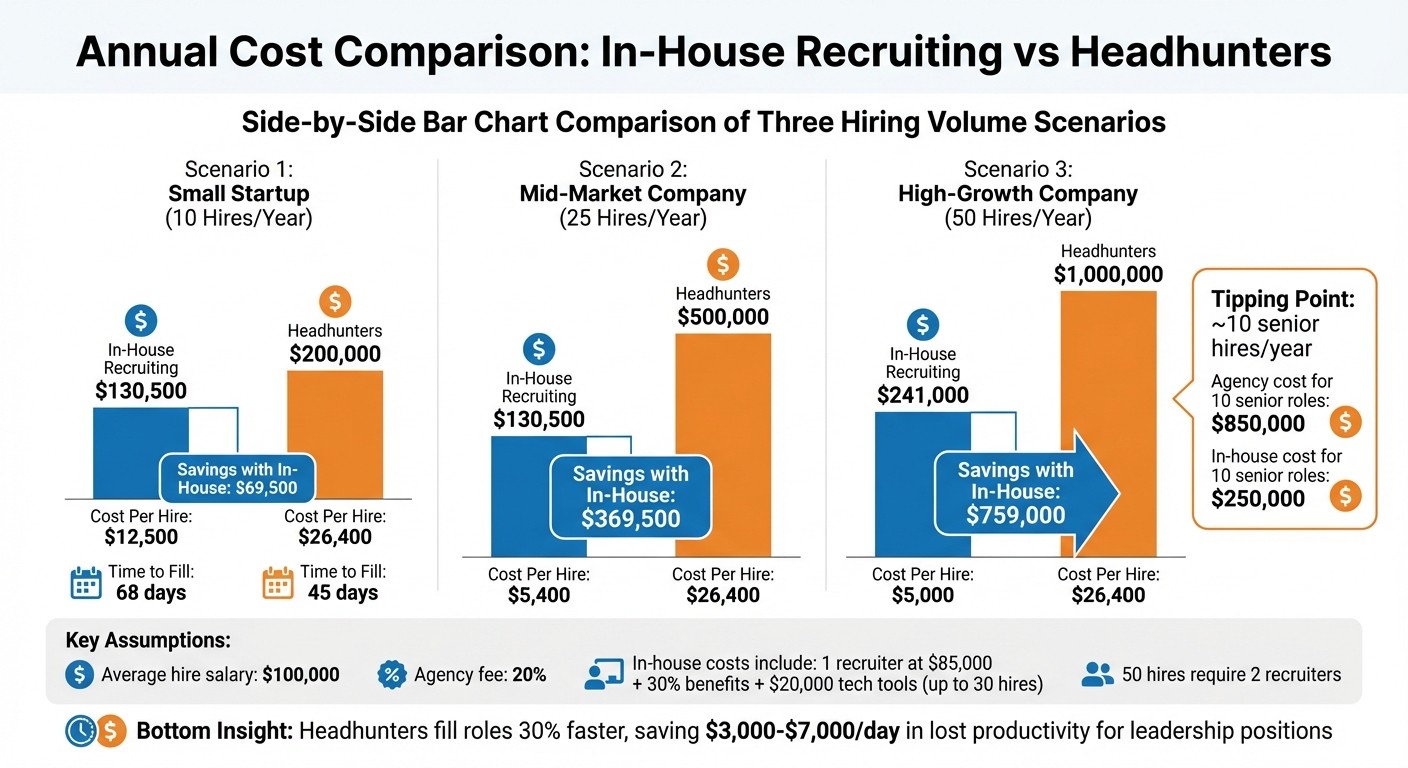
In-House Recruiting vs Headhunters Cost Comparison by Hiring Volume
When it comes to hiring, in-house recruiting comes with fixed costs like salaries, benefits, and subscriptions for recruitment tools, while headhunter fees vary depending on the number of placements made. The table below provides a clear breakdown of how costs compare at different hiring volumes.
Annual Cost Comparison Table
Here’s a look at the annual cost estimates based on varying hiring volumes. For this example, we’re assuming an average hire salary of $100,000 and a 20% agency fee. In-house costs include one recruiter earning $85,000, 30% for benefits, and $20,000 for recruitment technology for up to 30 hires annually. For 50 hires, you’d need two recruiters.
Hiring Volume | In-House Annual Cost | Headhunter Annual Cost | Cost Difference |
|---|---|---|---|
10 Hires/Year | $130,500 | $200,000 | $69,500 savings (In-house) |
25 Hires/Year | $130,500 | $500,000 | $369,500 savings (In-house) |
50 Hires/Year | $241,000 | $1,000,000 | $759,000 savings (In-house) |
The tipping point comes at around 10 senior hires per year. For instance, filling 10 senior roles through an agency could cost $850,000, while an in-house team would only require $250,000. Beyond this threshold, the financial benefits of in-house recruiting grow significantly.
Cost Per Hire Scenarios for Tech Companies
Let’s dive into how these costs play out in tech-specific hiring scenarios, using an average tech salary of $120,000 and a 22% agency fee.
Small Startup (10 hires/year):
For startups, in-house recruiting costs average $12,500 per hire, compared to $26,400 using headhunters. Over the course of a year, that’s $125,000 for in-house hiring versus $264,000 for agencies. However, agencies are faster, taking 45 days to fill a role compared to 68 days in-house. That 23-day gap could cost $3,000–$7,000 per day in lost productivity for leadership roles.
Mid-Market Company (25 hires/year):
At this level, the in-house cost per hire drops to $5,400, while agency fees remain $26,400 per placement. Annually, this translates to $135,000 for in-house recruiting versus $660,000 for agencies. With this volume, you’re nearing the capacity of one recruiter, which might require additional ad spend or part-time support.
High-Growth Company (50 hires/year):
For companies in rapid growth, the in-house cost per hire falls further to $5,000 with two recruiters and an expanded tech stack. In contrast, agencies still charge $26,400 per placement. Annual costs total around $250,000 for in-house recruiting versus $1,320,000 with headhunters - a difference of over $1 million.
While in-house recruiting saves money, agencies do offer speed. They fill positions about 30% faster, which can be critical when a vacant leadership role costs $5,000 per day in lost productivity. That 23-day speed advantage could save $115,000 in opportunity costs. Many high-growth tech companies find a middle ground: handling routine developer and support roles in-house while outsourcing specialized positions, like CTOs or AI engineers, to agencies.
This breakdown highlights the financial and strategic considerations that come into play when deciding between in-house recruiting and agency services.
Pros and Cons of Each Method
Expanding on the earlier cost breakdown, let's dive into the strengths and trade-offs of in-house recruiting versus headhunters. Both approaches offer distinct benefits but come with their own challenges.
In-house recruiting teams provide complete control over the hiring process and a strong alignment with company culture, which helps build a genuine, long-term employer brand. This method can be more economical when hiring consistently at high volumes. However, it has its limits. In-house recruiters often face challenges like limited access to passive candidates or niche talent pools. Additionally, this approach involves fixed costs such as salaries, benefits, and subscriptions to costly recruitment tools.
Headhunters, on the other hand, excel at quickly connecting companies with pre-vetted, high-quality passive candidates and offering specialized industry insights. They’re especially useful during hiring surges, as they help reduce the "cost of vacancy" by filling roles faster. On average, agencies fill positions 30% faster than in-house teams, which is critical when vacant leadership roles can cost businesses $3,000–$7,000 per day in lost productivity. However, this speed and expertise come at a price - placement fees can significantly increase per-hire costs. Additionally, companies may have less direct control over the candidate experience and employer branding.
"Every day that an Account Executive (AE) or Sales Development Representative (SDR) role remains vacant is a day of lost pipeline and missed opportunities." - Tyler Ritchie, Seattle Corporate Search
Interestingly, agency-recruited hires tend to stay longer in their roles. Turnover rates for agency hires are about 15%, compared to 25% for in-house hires, which helps minimize rehiring costs and productivity losses. In SaaS sales, the difference is even more pronounced: agency hires have a 1-year retention rate of 80–85%, compared to 60–65% for in-house hires.
Here’s a side-by-side comparison to make these differences clearer:
Comparison Table
Factor | In-House Recruiting | Headhunters / Agencies |
|---|---|---|
Scalability | Limited by internal team capacity | Easily adjusts for surges or multiple roles |
Speed | Slower (42–68 days average) | Faster (20–45 days average) |
Candidate Access | Primarily active applicants | Broad access to passive and niche talent |
Cost Structure | Fixed (salaries, tools, training) | Variable (fees per hire) |
Ongoing Expenses | High fixed costs regardless of volume | Scales with placements made |
Control | Full control over process and branding | Shared control; depends on agency quality |
When Headhunters Deliver Better ROI
Even with higher upfront costs, headhunters often provide a better return on investment by combining speed, expertise, and reduced opportunity costs.
Rapid scaling and urgent hiring needs are prime examples. Imagine a startup that just secured funding or a tech company rolling out a new product line. They need top talent - and they need it now. Waiting for an in-house team to complete the search could be costly. A vacant leadership position can rack up losses of $3,000 to $7,000 per day in lost productivity and revenue. If a headhunter can fill that role 23 days faster, the savings from reduced downtime alone can easily outweigh the standard 20–30% placement fee.
Reaching passive talent is another area where headhunters shine. Beyond just speed, they tap into a pool of candidates that in-house teams often miss. Around 70% of the global workforce consists of passive candidates - professionals who aren’t actively job hunting. Using consultative sourcing techniques and tools like LinkedIn Recruiter, headhunters can connect with these hard-to-reach individuals. This is especially valuable for specialized roles, like AI engineers or Chief Medical Officers, where in-house recruiters might lack the necessary contacts or industry insight.
"The right person for your role may not even be looking for another position – yet!" – Holt Engineering
Reducing mis-hire risks also contributes to better ROI. For executive roles, in particular, headhunters' thorough screening processes and 90-day replacement guarantees significantly lower the chances of costly hiring mistakes. Data shows that agency hires tend to have a 15% turnover rate, compared to 25% for in-house placements. This difference in retention can translate into substantial savings over time.
Expanding into competitive markets is yet another scenario where headhunters excel. In high-demand areas like Silicon Valley or New York, tech and healthcare firms often pay about 40% more for the same roles compared to companies in smaller markets. Headhunters bring established networks and strong negotiation skills to these high-stakes environments, enabling faster placements and higher offer acceptance rates. These advantages often offset their fees, making them a strategic choice for companies looking to secure top talent quickly.
Conclusion: Choosing the Right Recruitment Strategy
Deciding between in-house recruiting and headhunters isn’t about picking a universal solution - it’s about aligning the approach with your business’s specific needs. For example, if your company hires more than 10 senior positions annually, an in-house recruiter can save you from hefty agency fees. On the other hand, if you’re filling specialized roles on occasion or need to address urgent leadership gaps - where delays could cost $3,000 to $7,000 per day in lost productivity - a headhunter’s quicker turnaround might justify the upfront expense.
Your strategy should hinge on two key factors: hiring volume and the complexity of the roles. In-house teams are ideal for high-volume hiring that emphasizes cultural fit and predictable costs. Meanwhile, headhunters are better suited for accessing the 70% of professionals who aren’t actively job hunting or for niche technical roles that require deep industry connections.
"The choice between in-house hiring and working with a recruitment agency finally comes down to the hiring requirements and resources of your company." – Talentuch
Many companies find success with a hybrid approach, managing routine hires internally while outsourcing hard-to-fill roles. This method balances cost efficiency with the speed and specialized access that agencies offer. If the cost of a vacancy starts to outweigh agency fees, prioritizing faster placements becomes essential.
Don’t overlook internal promotions as an option. Promoting from within can cost up to 1.7 times less than external hiring and significantly shortens the time-to-productivity. Before deciding on in-house teams or headhunters, evaluate whether your current talent pool can meet the need. Ultimately, the best choice depends on your timeline, hiring volume, and the demand for specialized skills - not on industry trends or one-size-fits-all advice.
FAQs
What unexpected costs come with in-house recruiting?
While managing recruitment internally might seem like a budget-friendly option at first, there are plenty of hidden costs that can sneak up on you. Beyond the obvious expenses like paying salaries and benefits for your recruitment team, you’ll also need to account for office space, equipment, and recruitment tools such as applicant tracking systems, job board memberships, and scheduling software.
On top of that, investing in training and professional development for your team can push costs even higher. And don’t forget the time senior managers spend reviewing resumes, conducting interviews, and juggling schedules - time that could be better spent on their core responsibilities. These often-overlooked factors, combined with delays in filling open roles, can make in-house recruiting far pricier than it seems at first glance.
How do headhunters help prevent hiring mistakes?
Headhunters help companies avoid hiring missteps by taking a proactive and research-focused approach to finding the right talent. Instead of waiting for candidates to come to them, they actively search for top performers using well-established industry connections and in-depth market knowledge. This approach ensures they identify professionals who match both the technical demands of the role and the company's workplace dynamics.
To reduce risks even further, headhunters go beyond the basics by conducting comprehensive screenings. These often include multiple interview rounds, skill evaluations, and detailed reference checks. Many headhunters also focus on specialized or executive-level roles, leveraging their expertise to assess whether a candidate's experience aligns with your organization’s goals. On top of that, many firms offer guarantees or replacement policies, giving you added confidence that the hire will be a strong, long-term fit.
When is it best to use a hybrid recruiting approach?
A hybrid recruiting approach strikes the perfect balance for companies that need both control and flexibility in their hiring strategies. It blends the strengths of an internal team for routine recruitment with the expertise of external agencies for specialized or high-demand roles. For instance, an internal team can maintain brand consistency and oversee everyday hiring processes, while external agencies are ideal for tackling niche positions, executive-level searches, or scaling quickly - like when a tech startup expands from 50 to 200 employees in just a few months.
This model works particularly well in scenarios such as:
Fluctuating hiring demands: Internal teams manage regular hiring needs, while agencies step in during busy periods to prevent burnout or resource strain.
Specialized roles: Agencies bring extensive networks and expertise to fill senior or technical positions swiftly.
Cost-conscious hiring: Businesses can save on agency fees for routine recruitment while still tapping into external expertise for critical or complex roles.
By leveraging the strengths of both internal teams and external agencies, companies can stay in control of their core hiring processes while remaining flexible enough to adapt to shifting demands.