How do NYC headhunters help startups hire senior technical leaders?
Jan 18, 2026

NYC headhunters play a crucial role in helping startups hire senior technical leaders by addressing the unique challenges of the city’s competitive tech ecosystem. Here’s how they make a difference:
Access to Exclusive Networks: NYC headhunters tap into local talent pools, including professionals from finance, consulting, and media industries, as well as alumni networks and tech meetups.
Tailored Search Strategies: They customize their approach based on a startup’s growth stage, technical needs, and budget, often aligning recruitment efforts with financial bonus cycles to attract top talent.
Leveraging AI Tools: Advanced recruitment technologies help identify passive candidates, analyze resumes, and match profiles to specific startup needs.
Reducing Time to Hire: By streamlining interview processes and managing candidate engagement, headhunters cut the time-to-hire to an average of 21 days.
Minimizing Hiring Risks: Through in-depth evaluations and a 90-day replacement guarantee, they ensure startups make informed hiring decisions.
NYC’s diverse talent pool and competitive market make hiring senior leaders challenging, but experienced headhunters simplify the process by combining local expertise, advanced tools, and personalized strategies to secure the right candidates quickly and efficiently.
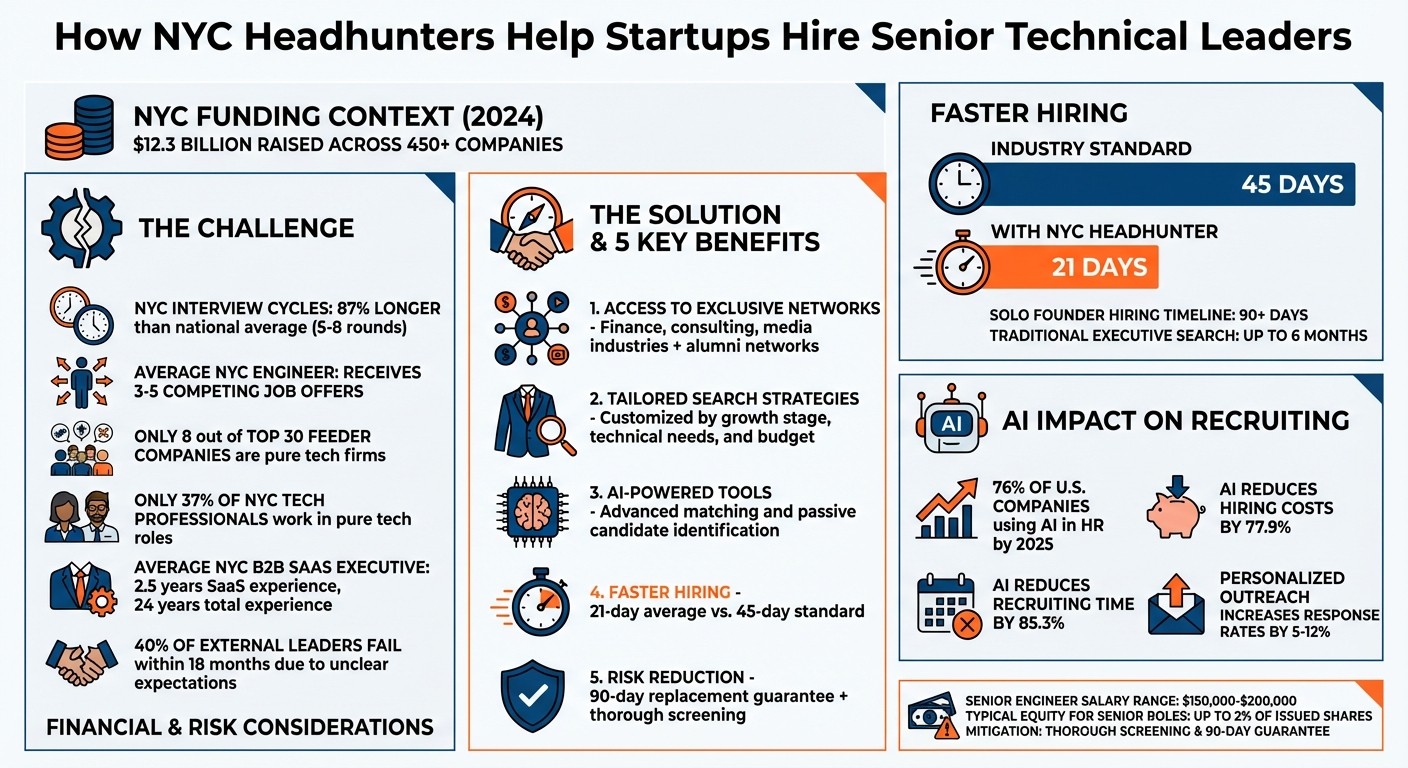
How NYC Headhunters Help Startups Hire Senior Technical Leaders: Key Statistics and Benefits
How NYC Headhunters Find Senior Technical Leaders
Tapping Into Local and Global Networks
NYC headhunters have access to exclusive local networks that most startups struggle to reach. They often collaborate with academic institutions like Cornell Tech and NYU, where up-and-coming technical talent tends to gather. But they don’t stop there - they look beyond the obvious tech hubs, focusing on industries that play a significant role in New York's talent ecosystem.
A study revealed that only 8 out of the top 30 feeder companies for senior tech executives in NYC are pure tech firms. This pushes headhunters to target industries like finance (e.g., Goldman Sachs, JPMorgan Chase), consulting (e.g., McKinsey, Deloitte), and legacy media (e.g., Bloomberg, Thomson Reuters). Interestingly, the average NYC-based B2B SaaS executive has just 2.5 years of experience in SaaS, despite having an average of 24 years of professional experience overall. This means headhunters often focus on identifying high-potential leaders - those ready to step into their first major leadership role - rather than solely chasing seasoned C-suite veterans.
"If you want to hire a chief product officer for a SaaS company with at least 10 years of experience in the role, you're going to have 20 candidates on the West Coast and maybe two in New York." – Alex Rinke, CEO and Co-Founder, Celonis
Timing also plays a big role. When recruiting from financial firms, headhunters often align their efforts with bonus cycles, particularly around March when candidates are waiting for their annual bonuses. Once they’ve tapped into these networks, headhunters use cutting-edge technology to fine-tune their search.
Using Recruitment Technology and AI Tools
NYC headhunters combine their traditional networking expertise with advanced AI-driven tools to find candidates who might not show up in conventional searches. By 2025, 76% of U.S. companies were using AI in HR. These tools allow recruiters to analyze massive datasets and predict which candidates are the best fit. AI platforms with natural language processing (NLP) extract skills from resumes, while semantic vector-based algorithms match candidates with a startup’s unique needs.
Some firms even apply investigative journalism techniques to uncover passive talent - candidates who aren’t actively looking but might be open to the right opportunity. They also use proprietary frameworks to assess candidates’ understanding of AI, ensuring they can bridge the gap between technical expertise and business strategy. The integration of AI has made a noticeable impact, cutting hiring costs by 77.9% and reducing the time spent recruiting by 85.3%. Personalized outreach efforts, supported by these tools, have also increased candidate response rates by 5–12%.
When pitching roles to candidates coming from high-paying financial firms, headhunters focus on what startups can offer beyond compensation. Instead of leading with the tech stack, they emphasize the startup’s business model and its path to profitability - an approach that resonates with candidates weighing offers against hedge fund salaries of around $400,000 in cash. These tech-driven methods complement the personalized strategies headhunters craft for each startup.
Customizing Search Methods for Each Startup
Every startup is different, and NYC headhunters tailor their approach based on a company’s growth stage, culture, and technical requirements. For early-stage companies with little name recognition, they lean on the reputations of venture capital backers like Accel or AlleyCorp to attract top-tier passive candidates. For startups targeting enterprise clients, they seek leaders experienced in navigating regulations and managing high-volume B2B products.
When sourcing talent from industries like consulting or finance, headhunters are particularly cautious. They prioritize candidates with a “startup mindset,” screening for qualities like adaptability and a willingness to thrive in less structured environments. Compensation strategies are also customized to NYC’s market, where senior engineers typically earn between $150,000 and $200,000.
For startups operating with a dual headquarters model - where R&D remains in regions like Europe or Israel while commercial leadership is built in NYC - headhunters expand their search globally. They tap into talent pools across EMEA, Latin America, and Asia. This approach helps startups benefit from NYC’s diverse talent base while keeping engineering costs manageable overseas.
Headhunter Secrets: How Top CTOs and VPs Get Picked– IT & Tech Recruitment Insights

Benefits of Working with NYC Headhunters
NYC headhunters bring tailored search strategies to the table, helping startups navigate the hiring process more efficiently while addressing the challenges of tight budgets and time constraints.
Reducing Time to Hire for Critical Positions
Startups don’t have the luxury of waiting months to fill senior technical roles. NYC headhunters cut the average time-to-hire to just 21 days, a significant improvement over the industry standard of 45 days. When founders handle hiring solo, the timeline often stretches past 90 days. Traditional executive searches can take even longer - up to six months.
These recruiters streamline the process by managing NYC’s notoriously lengthy interview cycles, which tend to be 87% longer than the national average and often involve 5–8 rounds. They also keep candidates engaged throughout to avoid drop-offs during key stages. For example, Bold Profiles helped a Series A fintech startup hire five senior engineers in only 30 days, achieving a 60% faster hiring time compared to the startup’s previous internal efforts:
"Bold Profiles helped us hire 5 senior engineers in just 30 days. Their NYC market knowledge was invaluable in competing with bigger companies." - Founder & CEO, Series A Fintech Startup
Reaching Passive and Top-Tier Candidates
The best technical leaders aren’t scrolling through job boards - they’re already thriving at companies like Goldman Sachs, McKinsey, or Bloomberg. NYC headhunters tap into these networks, recognizing that only 8 of the top 30 sources for senior tech executives come from pure tech firms. They also target high-potential directors and second-in-commands ready to step into leadership roles, even if they’re not actively seeking new opportunities.
Timing is another critical factor. Headhunters track financial industry bonus cycles, which typically wrap up in March, and may advise startups to wait until after payouts or offer bonus buy-outs to attract top talent. For candidates earning around $400,000 in cash at hedge funds, recruiters focus on the startup’s business model and profitability trajectory rather than just the tech stack. With the average NYC engineer receiving 3–5 competing job offers during their search, headhunters help startups stand out by highlighting the impact and growth opportunities that larger corporations often can’t provide.
Reducing Hiring Risks Through Thorough Screening
Making the wrong hire can be costly and time-consuming. NYC headhunters minimize this risk by conducting in-depth evaluations, including technical, psychometric, and cultural assessments, to ensure candidates align with a startup’s mission and leadership style. Some networks, such as the Recurse Center, build long-term relationships with candidates to gain a deeper understanding of their skills and motivations.
Roujia Wen, CTO of Seabound, shared her experience:
"The other recruiters sent like 50 CVs and we couldn't find anyone, and then RC sends a single candidate and we hired him."
Similarly, Dealops Co-Founder Fay Wu received just two candidate profiles from the Recurse Center and successfully hired one, significantly cutting down screening time. Many NYC headhunters also provide a 90-day replacement guarantee. If a hire leaves or underperforms within that period, they restart the search at no additional cost. This safety net reduces the impact of a potential mis-hire while ensuring recruiters remain invested in long-term placement success.
How Startups Can Work Effectively with NYC Headhunters
For startups, working with a headhunter can be a game-changer - if the relationship is built on clear, aligned communication. Treating headhunters as trusted advisors, rather than just resume providers, often leads to quicker results and better hires. The key? Set clear expectations and give them the tools they need to succeed.
Setting Clear Role Requirements and Expectations
To help headhunters find the right senior technical leader, startups need to paint a detailed picture of what success looks like. Instead of listing generic skills, focus on specific goals the hire should achieve in their first 12 to 24 months. For example, should the new CTO resolve a stalled sales pipeline, rebuild a disjointed product roadmap, or scale infrastructure to meet the company’s growth milestones?
Outline reporting structures, decision-making authority, and budget responsibilities while setting measurable first-year objectives. Keep in mind that about 40% of leaders hired from external firms each year fail within 18 months, often due to unclear expectations. Be upfront about whether you’re looking for someone who aligns with your company culture or someone who can drive disruptive change.
It’s also helpful to share the challenges your startup is facing - whether it’s technical debt, high turnover, or a shifting go-to-market strategy. Be transparent about your employer value proposition, including funding milestones, equity packages (typically up to 2% of issued shares for senior roles), vesting schedules, and what makes your engineering culture stand out.
Keeping Communication Consistent and Timely
Timely communication is critical when working with headhunters, especially in NYC, where senior engineers often juggle 3–5 competing offers. Acting quickly on candidate feedback can make the difference between landing a top choice or losing them to a competitor.
Start the process with a Strategic Calibration session to align on scope, key performance indicators, and stakeholder goals. Maintain regular check-ins with your headhunter and review real-time updates on their progress. Address logistical details early, like commute preferences - proximity to subway lines like the L or G can be a deciding factor - and consider how bonus cycles in industries like finance, which often conclude in March, might impact candidate availability.
Using Headhunters for Market Intelligence and Insights
NYC headhunters don’t just bring candidates - they bring insights. For instance, professionals from top-tier firms like Goldman Sachs, Two Sigma, or Jane Street often prioritize competitive cash compensation over equity due to the city’s high cost of living. They also value a startup’s business model and its path to profitability.
As Swaraj Banerjee, CTO of Sempre Health, shared:
"Honestly, you guys always come through. You understand what I want and send great candidates every time."
Swaraj Banerjee, CTO, Sempre Health
Leverage your headhunter’s expertise to refine your strategy. Ask for advice on aligning your timing with bonus cycles, streamlining your interview process (aim for under 25 days rather than the 45-day industry average), and positioning your startup as a place where candidates can make a real impact and grow. By integrating these insights, you can sharpen your pitch and stand out against larger competitors.
Conclusion
Key Takeaways for Startup Founders and Recruiters
Hiring senior technical leaders in NYC is no small feat. With only 37% of tech professionals working in pure tech roles and much of the talent pool rooted in industries like finance, media, and professional services, the hiring process often requires more than just a job posting. Top headhunters in NYC rely on exclusive networks - think Goldman Sachs, Bloomberg, and McKinsey - to connect with candidates who aren’t actively job hunting.
These headhunters also bring efficiency to the process, cutting the average time-to-hire down to just 21 days compared to the standard 45-day timeline. They navigate challenges like competing offers, bonus cycles, and even the practicalities of location and transit accessibility. It’s clear why their expertise is essential in NYC’s competitive hiring environment.
Why Expert Headhunters Are a Game-Changer
The benefits of working with expert headhunters go beyond just filling roles. In 2024, NYC startups raised an impressive $12.3 billion in venture capital across more than 450 companies, making the race for senior talent fiercer than ever. By partnering with experienced headhunters, founders can stay focused on scaling their businesses while leaving the complexities of recruitment to the experts.
Beyond streamlining the hiring process, seasoned headhunters provide invaluable market insights that can reshape your recruitment strategy. For instance, candidates from firms like Jane Street often prioritize competitive cash compensation and a clear roadmap to profitability over equity-heavy packages. Headhunters use this knowledge to help startups position their growth potential in a way that resonates with top-tier candidates, even when competing with lucrative offers from finance giants.
In NYC’s fast-paced startup ecosystem, expert headhunters aren’t just recruiters - they’re strategic allies who help you secure the talent you need to grow smarter and faster.
FAQs
How do NYC headhunters tailor their hiring strategies for startups?
NYC headhunters tailor their hiring strategies to align with the specific needs of each startup, considering factors like growth stage, team dynamics, and technical priorities. Their process starts with gaining a clear understanding of the startup’s mission, leadership style, and product objectives. This insight helps them craft the ideal candidate profile for senior technical roles.
These recruiters rely on data-driven tools and tap into their vast local talent networks to pinpoint professionals with the right skill set, whether it’s expertise in AI, cloud computing, or cybersecurity. They also adjust their outreach methods, compensation packages, and interview processes to keep pace with the fast-moving startup environment, ensuring the right match for both the company and the candidate.
By blending industry expertise, personalized strategies, and modern recruitment techniques, NYC headhunters help startups secure the technical leaders they need to push boundaries and achieve growth.
How do NYC headhunters use AI to help startups hire senior technical leaders?
AI is transforming the way NYC headhunters help startups hire senior technical leaders. With the power of AI-driven algorithms, recruiters can sift through vast talent pools in no time, identifying candidates with the right mix of technical skills and team compatibility. These tools even make it possible to spot passive candidates - those who aren’t actively job hunting but might be the perfect fit.
Beyond matching candidates, AI takes care of tedious tasks like screening resumes, sending initial outreach messages, and scheduling interviews. This frees up recruiters to focus on what truly matters: building connections and carefully assessing top talent. On top of that, many headhunters rely on AI-based behavioral analytics to gauge how likely a candidate is to thrive in a leadership role. This data-driven approach helps startups make faster, smarter hiring decisions.
How do NYC headhunters help startups avoid bad hires for senior technical roles?
NYC headhunters play a crucial role in reducing the chances of a bad hire by combining deep industry insight with rigorous evaluation methods. Many of these recruiters come from technical backgrounds, equipping them to effectively assess candidates' skills and how well they align with the fast-paced demands of startups. They also tap into extensive talent networks, often uncovering top-tier professionals, including those who aren’t actively job hunting.
To create the perfect match, headhunters rely on structured tools such as behavioral analytics, technical case studies, and personality assessments. These methods help confirm a candidate’s expertise, leadership abilities, and compatibility with a company’s environment early in the hiring process. On top of that, they offer advice on crafting competitive compensation packages, using market data to benchmark salaries and equity offers. This well-rounded approach ensures startups invest in leaders who can genuinely drive results, safeguarding both time and resources.