Remote Hiring Checklist: 12 Steps to Find Top Talent
Dec 17, 2025
Remote hiring opens up access to a global talent pool but comes with unique challenges like navigating labor laws, ensuring compliance, and assessing candidates without face-to-face interaction. This 12-step checklist helps you streamline the process, from defining roles and selecting markets to onboarding and measuring success. Key takeaways:
Define roles clearly: Focus on measurable outcomes and required skills for remote success.
Choose hiring markets wisely: Align time zones, skills availability, and compensation.
Create remote-friendly job postings: Be transparent about pay, time zones, and expectations.
Use structured interviews and assessments: Evaluate skills and remote readiness objectively.
Plan onboarding and measure success: Ensure smooth integration and track key metrics.
With remote work growing, this process helps you find qualified candidates, reduce risks, and build a productive team from anywhere in the world.
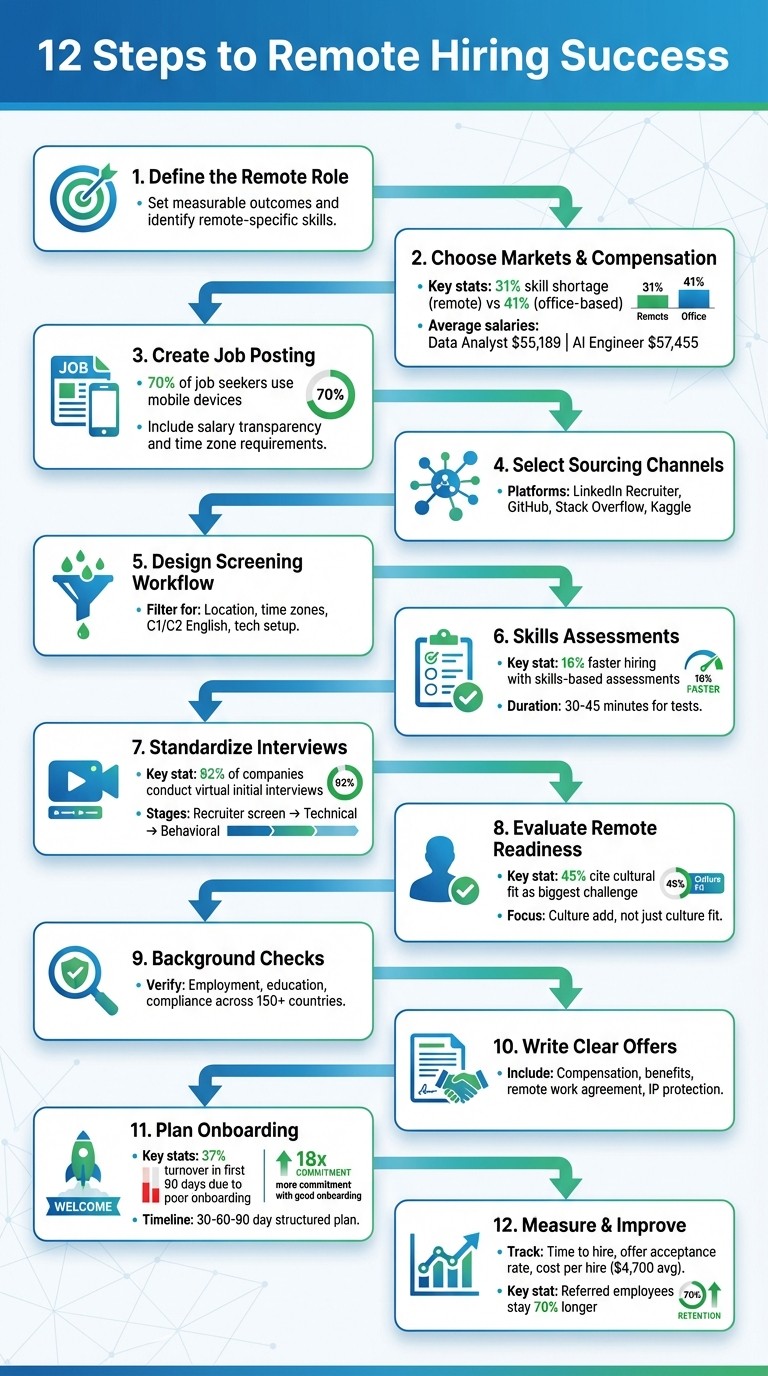
12-Step Remote Hiring Process Checklist for Global Talent Acquisition
How to Hire Remote Employees
Step 1: Define the Remote Role and Success Profile
Before you start recruiting, take the time to clearly define what success looks like for the remote role. This goes beyond a typical job description - it's about pinpointing the specific skills and behaviors that lead to success in a remote work environment.
Start by tying measurable outcomes to your business goals. For instance, a remote sales team in Latin America might need to generate $500,000 in quarterly revenue or onboard 10 new clients within six months. For engineering roles, you could track metrics like code quality, while marketing roles might focus on lead conversion rates. These benchmarks not only provide a clear way to assess performance but also help you determine the skills and expertise needed to meet these goals.
Remote work calls for a unique set of abilities. Self-management is key - candidates should demonstrate self-discipline and the ability to work independently. Strong communication skills are equally important, especially for roles requiring collaboration with US-based teams, where C1 or C2 level English proficiency is often essential. Ideal candidates should thrive in asynchronous workflows, understand time zone differences, and proactively communicate rather than waiting for direction.
"The objective is to identify if they have the communication skills required to collaborate from afar, as well as the organizational skills, self-discipline, and time management skills to work from home." – Monster.com
To streamline the hiring process, categorize skills into "must-have" and "nice-to-have" buckets. For example, technical expertise like Python proficiency or experience with cloud platforms might be non-negotiable, while other skills can be learned on the job. Also, set clear expectations from the start about availability, work styles, and team dynamics. This is crucial - 35% of US job seekers would turn down an otherwise ideal job if the company culture felt like a poor match. Make sure to document key details such as deliverables, reporting structures, and the tools candidates will need to succeed.
Step 2: Choose Hiring Markets and Compensation Ranges
The next step in building your remote team is selecting hiring markets and establishing competitive compensation. These choices are key to aligning global talent with your business goals.
Start by identifying regions where the skills you need are abundant. For example, only 31% of remote workplaces report skill shortages, compared to 41% for office-based teams. If you're hiring a Data Analyst, you’ll find a global pool of approximately 2.7 million candidates vying for 98,275 positions, with an average salary of $55,189.93. Similarly, for an AI Engineer, there are 586,130 candidates competing for 44,386 openings, with an average salary of $57,455.50.
Time zone compatibility often plays a big role in remote hiring, especially for US-based teams. Ideally, candidates should be available to overlap with your working hours by at least 4–6 hours. Latin America, for instance, offers excellent time zone alignment with the US, along with strong English proficiency. A senior software engineer in this region typically earns between $30,000 and $50,000 annually while delivering work comparable to a US-based engineer earning over $120,000. This allows you to stretch your budget while maintaining quality. In fact, remote operations can cut talent costs by 23% without compromising on performance.
When setting compensation, factor in local market conditions, cost of living, and benefits. For example, a Finance Manager role averages a global salary of $53,848.30 and carries a difficulty-to-hire score of 8/10, emphasizing the importance of competitive offers. With digital job opportunities expected to grow by 25% to over 90 million roles by 2030, understanding these dynamics gives you a clear advantage.
Additionally, ensure candidates meet your English proficiency requirements and evaluate this during the screening process. Ask about their experience working across time zones, and test their written and verbal communication skills with practical exercises. In remote work, proactive and clear communication isn’t just helpful - it’s non-negotiable.
Step 3: Create a Remote-Friendly Job Posting
Crafting a remote-friendly job posting is your chance to make a strong first impression. Be upfront about the role's remote structure - whether it’s fully remote, hybrid, or tied to a specific location. Clearly state if the position is Work From Home (WFH) or Work From Anywhere (WFA). If the role requires availability during specific time zones, like Pacific Time business hours, make sure to highlight that as well. This clarity not only helps candidates understand the role but also reflects an organized and efficient hiring process.
In the U.S., pay transparency is now a legal requirement. Employers must include salary ranges in job postings. Research shows that unclear or misaligned pay can lead to declined offers and higher turnover within the first year, especially in remote teams. Including a clear salary range in U.S. dollars builds trust and speeds up offer acceptance. If you use geo-adjusted pay, explain how it works so candidates know what to expect.
Shift your focus from generic requirements to outcome-driven expectations. For example, instead of writing “2+ years of PHP experience,” try something like, “Develop scalable web applications to enhance user experience by 30%”. Clearly separate must-have qualifications from nice-to-have skills. If the role requires specific tools or equipment, mention whether the company provides them. This approach sets clear expectations and helps attract the right candidates.
Time zone requirements are especially important for remote roles. Clearly specify how much overlap you need with your team’s working hours. For instance, if you require three hours of overlap with Eastern Time, state that explicitly. This helps candidates self-assess and saves time during the screening process.
Additionally, format your job posting with mobile users in mind - 70% of job seekers browse job listings on their phones. Use concise, scannable sections, simple language, and bullet points to make the post easy to read. Avoid unnecessary jargon. Highlight remote-specific skills like strong communication, self-discipline, and time management, as these are critical for success in distributed teams. By focusing on clarity and accessibility, you’ll attract qualified candidates who are well-suited for remote work.
Step 4: Select Sourcing Channels and Platforms
When it comes to hiring remote tech talent, using the right sourcing strategies is crucial. Many top-tier candidates steer clear of generic job boards or templated outreach because these spaces are flooded with recruiter messages. In fact, many skilled professionals intentionally limit their visibility or ignore generic approaches due to the sheer volume of contacts they receive. To connect with these candidates, you need to meet them where they are and use a more tailored approach.
Start by exploring professional networking platforms like LinkedIn Recruiter, which offers AI-powered filters to help you find candidates with the right skills and experience. For developers, GitHub is invaluable - not only for finding talent but also for evaluating their technical expertise through their code contributions. Other platforms like Stack Overflow Jobs and Kaggle are excellent for targeting niche tech communities.
Don’t underestimate the power of employee referrals. These often lead to faster hires and candidates who are a strong fit for your team. Encourage participation by offering referral bonuses, which can motivate employees to recommend high-quality candidates.
If you’re looking to simplify the process, consider tools like Caddie AI. This platform connects you with expert headhunters in major tech hubs and delivers AI-matched, pre-vetted candidate shortlists in under 24 hours. With Caddie AI, you can tap into the top 1% of global talent while cutting hiring times to under 21 days and saving up to 60% on costs. Plus, you only pay when you make a successful hire, making it a low-risk option for speeding up your remote recruitment.
The secret to success lies in matching your sourcing channels to the specific skills you’re looking for. For instance, a data scientist might be more active on Kaggle, while a full-stack developer could have a strong presence on GitHub. Experiment with and refine your strategies to ensure they align with the unique requirements of each role.
Step 5: Design an Application and Screening Workflow
Creating an efficient application and screening process is key to identifying the right candidates for remote work. A well-thought-out workflow ensures you’re advancing only those who meet the necessary qualifications, saving time and resources.
Start by filtering for non-negotiable criteria upfront. These include factors like location (important for tax and legal compliance), time zone compatibility, salary expectations, and language proficiency. For roles requiring close collaboration with US-based teams, candidates should have C1 or C2 English proficiency. Additionally, confirm that applicants are technologically prepared - this means reliable internet, a functioning computer, and a proper home office setup. These initial filters set the stage for a consistent and effective resume screening process.
"A structured remote hiring process is essential to minimize miscommunication, delays, and mismatched hires while building a productive workforce." - Scale Army
To streamline this process, consider integrating an applicant tracking system (ATS). A US-compliant ATS can help standardize resume reviews by defining benchmarks for technical expertise, communication skills, and alignment with company values across various roles and regions. You can configure the ATS to automatically filter candidates based on critical criteria like location, time zone availability, minimum qualifications, and relevant experience. This automation ensures every applicant is assessed uniformly, reducing bias and improving the quality of hiring decisions.
Incorporate structured assessments to evaluate candidates objectively. These could include coding challenges, scenario-based tasks, or language proficiency tests. Make sure expectations are clearly outlined and the entire application process is finalized before engaging with candidates.
"A successful virtual onboarding experience begins during the recruitment process itself. Laying out the parameters beforehand will ease the process for both the company and the candidate." - Prachi Goradia, peopleHum
Step 6: Use Structured Skills Assessments
After setting up a structured screening process, it's time to add skills assessments to the mix. These assessments help you move beyond resumes, providing measurable insights into a candidate's abilities. This approach is especially helpful for remote roles, where you can't observe daily work habits. In fact, research shows that skills-based assessments can cut remote hiring time by 16% and improve the quality of candidates you bring on board.
The trick lies in designing assessments that reflect the actual responsibilities of the job. For technical roles, this might mean coding challenges tailored to your specific tech stack. For project management positions, scenario-based tasks that test prioritization and communication skills work well. These assessments should evaluate both hard skills - like coding, data analysis, or writing - and soft skills that are essential for remote work, such as problem-solving, self-motivation, and adaptability.
Keep the assessments short and focused. Aim for tests that take 30–45 minutes to complete, or limit take-home projects to 3–4 hours. Longer assessments can lead to candidate drop-off, especially for those juggling other commitments. Since you're hiring globally, asynchronous testing is crucial. It allows candidates in different time zones to complete their assessments at a time that suits them.
Once you've nailed the timing, the next step is to standardize how you evaluate results. Define clear scoring criteria that outline exactly what you're looking for - whether it's the quality of code, problem-solving strategies, communication clarity, or technical design thinking. This helps eliminate subjective biases. You might even consider group evaluations, where your team reviews the same sample work together to align expectations and reduce individual bias.
Of course, assessment scores shouldn't stand alone. Combine them with interviews, reference checks, and portfolio reviews for a well-rounded evaluation. Over time, track how assessment results correlate with job performance to fine-tune your process. By integrating these insights into your overall hiring strategy, you'll make remote hiring more efficient and effective.
Step 7: Standardize Remote Interview Stages
Creating a consistent structure for remote interviews ensures candidates are evaluated fairly, no matter where they are or what time zone they’re in. With 92% of companies conducting initial interviews virtually, it’s crucial to have a process that works seamlessly across digital platforms.
A standard remote interview process typically involves three main stages: recruiter screens, technical evaluations, and behavioral assessments. Start with a 30-minute recruiter screen to confirm basic qualifications, discuss salary expectations, and gauge the candidate’s interest. Next, move qualified applicants to technical evaluations, which may include live coding sessions, system design discussions, or other tasks specific to the role. Finally, conduct behavioral interviews to evaluate communication skills, problem-solving methods, and readiness for remote work. Many remote-first companies have found initial video screens to be highly effective.
To ensure the process runs smoothly, use reliable video platforms like Zoom, which are familiar to most candidates and minimize technical hurdles. Share interview details at least 24 hours in advance, including platform instructions, technical requirements, and a clear agenda. Test your equipment beforehand and have a backup plan, such as a phone number, in case of technical issues.
Time zones can complicate remote hiring, but setting a primary time zone for scheduling and communication helps streamline the process. For live interviews, aim to schedule during overlapping working hours. Companies like TriSearch achieve a 98% interview attendance rate for international placements by using advanced scheduling tools that identify the best time slots for everyone involved.
Finally, document each interview using role-specific scoring rubrics. After panel interviews, hold a quick debrief while impressions are still fresh, allowing the team to share feedback and make decisions collectively. This structured approach not only reduces unconscious bias but also helps refine your hiring process over time.
Step 8: Evaluate for Remote Readiness and Culture Add
After completing structured interviews, it’s time to assess candidates for their ability to thrive in remote roles and their potential to bring new perspectives to your team. Remote positions come with unique challenges, and 45% of companies identify evaluating cultural fit as their biggest hiring obstacle. Sharon Koifman, Founder and Remote CEO at DistantJob, emphasizes the importance of this step:
"The key is to nail your vetting process. We're talking about thorough technical assessments, yes, but more importantly, evaluating how candidates handle real-world remote scenarios. Do they communicate proactively? Can they work asynchronously? Are they problem-solvers who take initiative?"
Remote readiness goes beyond technical skills. It’s about understanding how candidates manage remote-specific challenges, like maintaining clear communication and working asynchronously. You can test this by incorporating practical writing exercises that reflect real work situations. For roles involving heavy collaboration, standardized language tests can simulate everyday interactions. During interviews, ask candidates to describe their home office setup, how they structure their workday, and how they’ve tackled obstacles while working remotely. These questions can uncover their self-management abilities and problem-solving mindset.
When it comes to team dynamics, shift your focus from "culture fit" to "culture add." Instead of seeking candidates who simply align with your current team, look for those who bring fresh ideas and varied experiences that can enrich your workplace. Hiring solely for culture fit can unintentionally perpetuate sameness and introduce biases. Use behavioral interview techniques and group exercises to see how candidates handle feedback, navigate virtual collaboration, and contribute innovative ideas in asynchronous environments.
Additionally, evaluate candidates’ proficiency with the tools your team relies on, like Slack or Zoom. Job simulations and work samples can provide a clearer picture of how candidates perform under real-world conditions. These assessments often reveal more about their remote readiness than a polished resume ever could.
Key traits for remote success include independent work habits, effective asynchronous communication, and the ability to coordinate across time zones. By focusing on these qualities and prioritizing culture add, you can assemble a diverse, high-performing remote team that brings fresh perspectives and drives innovation in your organization.
Step 9: Conduct Compliant Background and Reference Checks
Once you've narrowed down your top candidates, the next step is conducting background and reference checks. This step isn't just about ticking boxes - it's about making sure your hiring process aligns with the legal and regional standards of each candidate's location. Background screening laws can differ widely from one country to another, so adapting your approach is crucial. Failing to comply with these laws could lead to fines, legal trouble, or even damage to your company's reputation.
Start by focusing on checks that are directly relevant to the job and always get the candidate’s informed consent before proceeding. For candidates in the U.S., this might involve verifying past employment, confirming educational qualifications, and - where legally allowed - running criminal background checks. For international hires, it’s a good idea to consult local legal experts or use Employer of Record (EOR) platforms like Deel or Remote.com. These platforms can help you navigate the complexities of payroll, taxes, and legal compliance in over 150 countries. To maintain fairness, apply the same criteria consistently for candidates in similar roles.
Beyond legal requirements, reference checks give you valuable insight into how a candidate might perform in a remote work environment. They help validate a candidate’s ability to work effectively in a remote setting. Reach out to previous supervisors to confirm employment history, evaluate performance, and verify technical skills. Ask targeted questions about their ability to meet deadlines, collaborate across time zones, and adapt to remote work dynamics. For roles in fields like development or marketing, focus on specific project outcomes and measurable contributions.
To save time, consider streamlining the process with asynchronous methods. Written questionnaires can be particularly useful for reference checks when dealing with different time zones. You can also use automated tools like HiPeople, HR Avatar, or Spark Hire, which standardize evaluations and provide detailed reports. When speaking with references, make sure to ask about communication skills, self-management, and tech proficiency. These insights can help you make more confident hiring decisions while keeping the process efficient.
Step 10: Write Competitive and Clear Remote Offers
When hiring remotely, being thorough and clear in your documentation is crucial to avoid potential misunderstandings down the road. Once you've chosen your top candidate, craft an offer that is both competitive and easy to understand. The offer letter should include a detailed remote work agreement that outlines compensation, benefits, and job expectations. Be specific about the base salary, payroll schedule (e.g., bi-weekly, semi-monthly, or monthly), and benefits such as health insurance, retirement plans, paid time off, and any performance-based bonuses. For US-based hires, make sure to address the at-will employment status and include the requirement to complete the I-9 Form, which verifies employment eligibility and identity.
It’s equally important to set clear expectations for remote work to avoid any ambiguity. Define collaboration hours for team communication. If the role involves working across time zones, specify whether overlapping hours with the main office or team are required. Clarify whether the position follows a fixed schedule or operates on deadlines, and outline the frequency of virtual meetings. If travel or in-office attendance is necessary, explain how often and who will cover the associated costs.
Make sure your agreement explains how time tracking and compensation will be managed, as well as who is responsible for providing equipment and handling expenses. For example, in states like California, employers may be required to reimburse remote employees for internet and phone bills under the California Labor Code. Additionally, confirm that the offer complies with federal labor laws, such as the Fair Labor Standards Act, and the specific employment laws of the state where the employee will be working.
Lastly, address intellectual property (IP) protection and privacy practices in the agreement. Clearly define the responsibilities and rights of both parties, including how productivity will be monitored and the privacy measures in place to comply with laws like the Electronic Communication Privacy Act. While not mandatory, providing an employee handbook can be a helpful addition. It can outline responsibilities, benefits, company policies, and contact information, setting clear expectations from the start. A well-structured offer paves the way for a smooth working relationship.
Step 11: Plan Remote Onboarding for Global Hires
Once you've chosen your top candidate, the next crucial step is crafting a detailed onboarding plan to help them smoothly transition into your remote team. Why is this so important? Because a well-thought-out onboarding process can significantly reduce early turnover and improve productivity. Consider this: 37% of employee turnover happens within the first 90 days, often due to poor onboarding. On the other hand, employees who experience a positive onboarding process are 18 times more committed to their employer - yet only 12% of workers report having a good onboarding experience.
Preparation is key. Before their first day, make sure everything is set up. This includes preparing IT systems, delivering necessary equipment ahead of time, and setting up all required accounts. Automating tasks like account creation can save your HR team valuable time, allowing them to focus on providing personalized support.
A structured 30-60-90 day plan works particularly well for global remote hires. Here’s a breakdown:
First 30 days: Focus on orientation, company overview, and initial training. The first week should cover the basics, while the following weeks dive into job-specific training, virtual shadowing, and setting goals.
Days 31–60: Continue training, hold regular check-ins, and introduce performance feedback discussions.
Days 61–90: Gradually increase their autonomy by involving them in team projects and career development sessions.
Providing this roadmap on day one helps new hires understand their responsibilities and what lies ahead.
A solid onboarding plan can dramatically improve productivity during the first six months. To make it even more effective, ensure flexibility by offering centralized resources and scheduling regular 90-day check-ins to address any issues promptly. By taking this structured approach, you’ll set the stage for seamless integration and long-term success.
Step 12: Measure and Improve Remote Hiring
Once you've established a solid hiring and onboarding process, the next step is to make sure it's working as intended. Continuous measurement is key to refining your remote recruitment strategy. By tracking and analyzing the results of steps 1–11, you can ensure your efforts deliver long-term value.
Start by keeping an eye on critical metrics like time to hire, offer acceptance rate, and cost per hire. In the United States, the average cost per hire is around $4,700, although filling specialized or senior positions can cost three to four times the employee's annual salary.
But numbers alone don’t tell the whole story. You also need to evaluate the quality of hires. Look at how new employees perform and whether they stay with the company beyond the first 90 days. Keep track of where your most successful hires are coming from - referrals, for instance, are often a goldmine. Research shows that referred employees stick around 70% longer and deliver the best return on investment for sourcing talent. On average, it takes three to eight months for new hires to reach full productivity, so monitoring their progress during this period is essential.
The candidate experience is another area that deserves attention. Nearly 80% of candidates believe the hiring process reflects how much a company values its people, and half of all job seekers have turned down offers due to a poor experience. To find out how candidates feel about your process, send out short surveys after key stages like the application, interview, and offer. A simple question, such as, "How likely are you to recommend our hiring process to others?" can uncover areas for improvement.
Don’t forget to gather feedback from hiring managers as well. Their input on candidate quality, process efficiency, and HR support can highlight whether job descriptions match the actual role and if your screening methods are effective. These insights can help fine-tune your approach.
If you notice red flags - like a time-to-fill metric exceeding 60 days or an offer acceptance rate dropping below 84% - it’s time to act. Set clear, measurable goals, such as cutting time to hire by 15% or increasing applications from underrepresented groups by 20%. Review your progress monthly to stay on track. Using tools like an Applicant Tracking System can simplify data collection, allowing your team to focus on making strategic improvements rather than getting bogged down in manual tasks.
Conclusion
Building a successful remote team starts with having a clear, repeatable process. The 12 steps in this checklist offer a practical framework to find, evaluate, and hire top talent from anywhere in the world. From defining role requirements and identifying the best hiring markets to standardizing interviews and crafting a thorough onboarding plan, each step is designed to address the unique challenges of remote recruitment. This approach not only streamlines your hiring process but also prepares you to handle the complexities of managing a virtual workforce.
As remote work continues to grow, these steps ensure your company stays ahead. With 98% of employees preferring some form of remote work and 82% of employers planning to offer remote options, mastering this process can give your business a real advantage. By tapping into a global talent pool, cutting overhead costs, and building teams that are both productive and satisfied, you position your company for long-term success. In fact, two-thirds of companies report higher productivity among their remote employees compared to those in traditional office settings.
The key is to set clear, measurable expectations at every stage. Whether it’s defining success metrics, creating consistent screening methods, or planning a structured onboarding experience, having precise guidelines from the start helps you avoid mismatched hires and reduces early turnover. Considering that one in five employees leaves within the first 45 days, getting this right early on can save significant time and resources.
Use this checklist to secure top remote talent. Keep track of your results, gather feedback from candidates and hiring managers, and fine-tune your strategy based on the insights you gain. Companies that excel in remote hiring are those that follow disciplined, data-driven approaches. By implementing these steps, you can build a remote team that thrives.
FAQs
What skills are essential for thriving in a remote position?
Success in a remote role hinges on a mix of effective communication, self-discipline, and the ability to manage tasks independently. Comfort with technology, a knack for solving problems, and adaptability to shifting circumstances are also essential qualities that set remote workers up for success.
Equally important is the ability to collaborate seamlessly and align with the team's values and goals. These elements play a big role in staying productive and creating a positive, cohesive work environment, even when team members are scattered across various locations.
How can companies stay compliant with labor laws when hiring remote international employees?
To comply with U.S. labor laws when hiring remote international employees, companies need to follow a few critical steps. First, make sure to list all work locations on the required labor condition applications (LCAs) and petitions. If an employee moves, it's important to update HR and immigration teams right away and file amended petitions for relocations outside the original metropolitan statistical area (MSA).
Employers should also keep detailed records of worksite locations, meet prevailing wage requirements, and provide employees with digital access to legal notices, such as workplace posters. Beyond that, it’s crucial to follow federal, state, and local regulations related to employment, taxes, and workplace safety, tailored to each specific jurisdiction. Staying organized and ahead of these requirements can help reduce compliance risks and streamline the remote hiring process.
How can I assess if a candidate is ready for remote work?
When assessing a candidate's suitability for remote work, pay close attention to their communication abilities, time management skills, and comfort with virtual tools. Using structured interviews and asynchronous tasks can provide valuable insights into how effectively they navigate remote workflows.
You should also explore their past experience working across time zones, their capacity to work independently, and their reasons for pursuing remote work. Don't forget to check references and ask about their home office setup to confirm they have a workspace that supports productivity.