Tech Talent Acquisition: Complete Guide for Startups
Dec 23, 2025

Finding top tech talent in 2025 is challenging, especially for startups with limited budgets and resources. With tech roles taking an average of 52 days to fill, startups face steep competition from industry giants like Meta, which offer lucrative incentives to attract AI experts. Here’s a quick summary of how startups can overcome these hurdles and hire effectively:
Skills-Based Hiring: Focus on practical experience over degrees to broaden your talent pool. Clear job descriptions with specific challenges attract qualified candidates.
AI-Powered Tools: Use platforms like Caddie AI to automate resume screening, interviews, and candidate matching, reducing hiring time to under 21 days.
Remote Hiring: Access global talent pools, cut costs by hiring in lower-cost regions, and streamline compliance with Employer of Record (EOR) services.
Automated Assessments: Evaluate candidates’ skills efficiently with tools offering real-world tests and AI-driven proctoring.
Employer Branding: Showcase your company’s mission, team values, and impact to attract top talent. Use social media, employee testimonials, and engineering blogs to stand out.
Data-Driven Metrics: Track time-to-hire, cost-per-hire, quality of hire, and retention rates to refine your hiring strategy.
Secrets to Recruiting Startup Talent (vs. Big Tech)

Writing Clear Job Descriptions That Focus on Skills
Your job description is often the first interaction a candidate has with your company, so it needs to stand out. In 2024, a surprising 52% of U.S. job postings on Indeed didn’t require formal education, signaling a shift toward skills-based hiring. For startups competing with larger, well-funded companies, this approach can unlock access to a broader pool of talented candidates.
Instead of listing vague responsibilities, focus on specific challenges. For example, replace something like “improve system performance” with “refactor a payment processing system to handle 10x scale”. This clarity not only helps candidates understand the role but also allows them to assess if they’re the right fit.
Prioritizing Skills Over Degrees
Requiring a degree can exclude a huge portion of the workforce - 60% of U.S. workers don’t hold a college degree, while only 36% do. Additionally, many traditional degree programs struggle to keep up with the rapid pace of the tech industry. It’s no wonder that 62% of hiring managers now favor coding bootcamp graduates for junior roles over candidates with Computer Science degrees.
"People have more to offer than paper credentials. By assessing the full range of each candidate's experience, companies are providing opportunities to a wider pool of talent than ever before."
– Blaise Radley, Workday
Skills-based hiring also helps build diverse teams. Gender-diverse engineering teams, for instance, generate 28% higher revenue. However, research shows women are less likely to apply for a job unless they meet 100% of the qualifications, while men typically apply when they meet only 60%. By removing strict degree requirements and focusing on practical experience, companies can create a more inclusive hiring process. This approach is especially valuable for startups looking to scale quickly without spending heavily on recruitment.
Writing Clear, Direct Job Descriptions
Keep your list of non-negotiable requirements short - ideally, just 1–3 core skills - and limit the total number of requirements to seven or fewer. Overloading the description with excessive qualifications can deter strong candidates. Clearly differentiate between “must-have” skills (e.g., Python, SQL) and “nice-to-have” extras (e.g., Kubernetes, machine learning frameworks).
Be upfront about your tech stack. Developers want specifics, so instead of saying “experience with cloud platforms,” write “AWS, React, and Sentry for error tracking”. Use inclusive, gender-neutral language and avoid terms like “rockstar” or “ninja,” which can alienate potential applicants.
"Ditch corporate jargon and focus on clarity... Devs are motivated by compelling problems more than free snacks."
– Promap.ai
Choose job titles that are both clear and searchable. For example, “Senior Backend Engineer” works better than a creative but vague title. Adding details like “Build AI tools for 10M users” can help candidates connect with the role’s impact. Well-written job descriptions not only attract the right talent but also improve the performance of AI recruitment tools by providing precise criteria. Clear and concise descriptions set the foundation for effective, tech-driven hiring.
Using AI-Powered Hiring Platforms
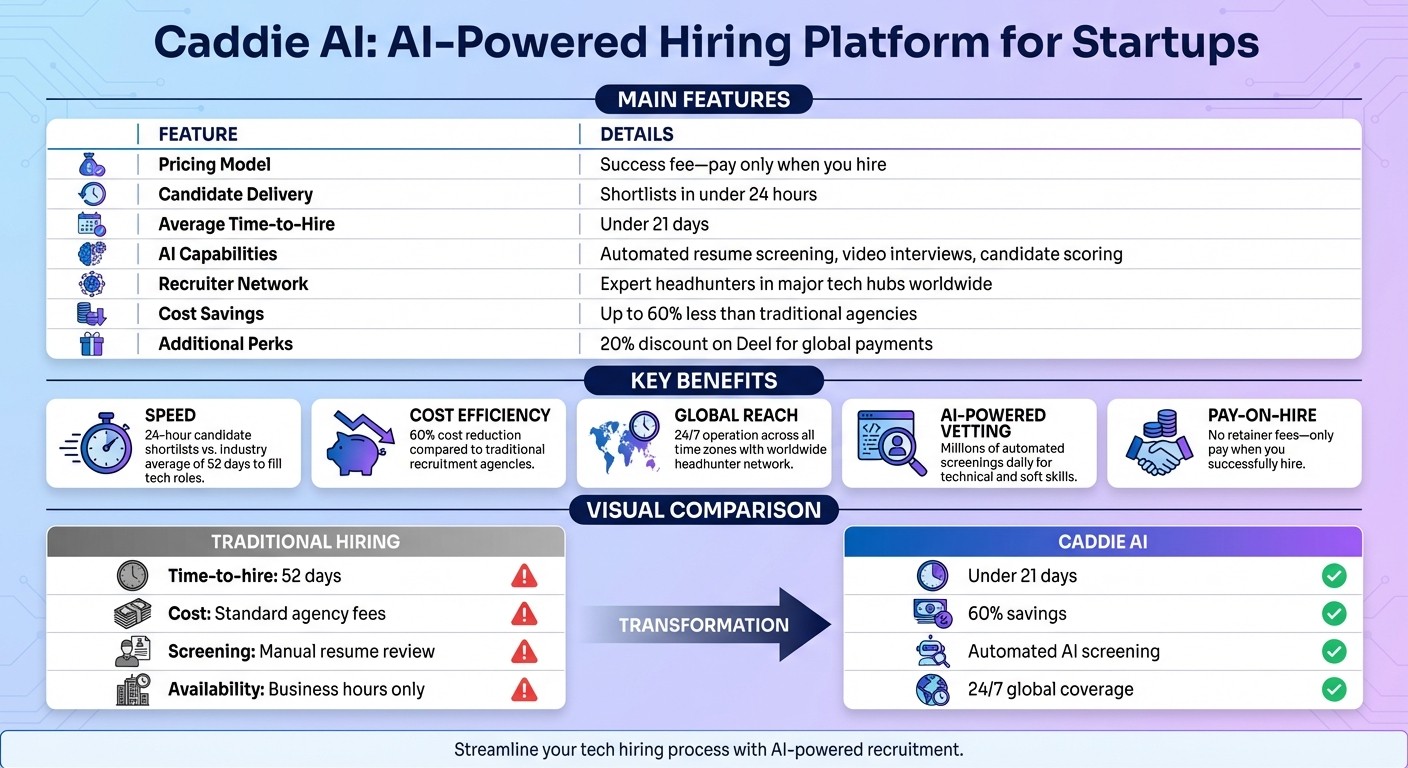
Caddie AI Features and Pricing Comparison for Startup Tech Hiring
Hiring in the traditional sense can be a major drain on resources, especially for startups. Weeks of manually screening resumes, juggling endless scheduling calls, and navigating time-zone challenges can slow things down. AI-powered hiring platforms are changing the game by automating these tedious tasks while still maintaining high standards.
These platforms use advanced tools to handle everything from crafting job descriptions to posting openings across multiple channels and pre-screening candidates with just a few prompts. AI-driven interviews take it a step further by conducting initial screenings, scoring candidate responses, and summarizing the results. This means your team can focus on evaluating top-tier candidates instead of wading through a mountain of applications.
Let’s take a closer look at how Caddie AI uses these technologies to make hiring faster and more efficient.
How Caddie AI Works
Caddie AI combines advanced AI-matching technology with a global network of expert headhunters located in key tech hubs. When you post a job, multiple headhunters simultaneously search for candidates. The platform’s AI-powered vetting system ensures only qualified applicants make it to your inbox by filtering out those who don’t meet your criteria.
Speed is a major strength here. Caddie AI delivers candidate shortlists in less than 24 hours and achieves an average hiring time of under 21 days. Operating around the clock across all time zones, it also conducts automated video and voice interviews that assess both technical expertise and soft skills - processing millions of screenings daily without needing human involvement.
Saving Time and Money with Caddie AI
Caddie AI’s pricing model is straightforward: you only pay when you successfully hire someone. This pay-on-hire approach can slash recruitment costs by up to 60% compared to traditional agencies that charge retainers regardless of results.
The platform’s automated screening and scoring system reduces the need for manual evaluations, allowing your team to focus on interviewing pre-vetted candidates and making quicker, more informed decisions. For budget-conscious startups, this efficiency can be a game changer. On top of that, Caddie AI customers get a 20% discount on Deel, simplifying global payments and streamlining the hire-to-pay process for remote teams.
Caddie AI Features and Pricing
Feature | Details |
|---|---|
Pricing Model | Success fee - pay only when you hire |
Candidate Delivery | Shortlists in under 24 hours |
Average Time-to-Hire | Under 21 days |
AI Capabilities | Automated resume screening, video interviews, candidate scoring |
Recruiter Network | Expert headhunters in major tech hubs worldwide |
Cost Savings | Up to 60% less than traditional agencies |
Additional Perks | 20% discount on Deel for global payments |
One of the standout features of Caddie AI is its global recruiter collaboration. You’re not limited to a single network, which is especially useful for specialized roles. For instance, if you’re hiring a senior machine learning engineer with a background in healthcare AI, multiple experts can work together to find the perfect match quickly and efficiently.
Building a Remote Hiring Process
For startups, remote hiring has become more than a trend - it's a necessity. With remote jobs expected to increase by 25% to reach 92 million by 2030, and 74% of professionals viewing remote work as the "new normal", embracing this shift opens up a world of opportunities. By hiring remotely, startups are no longer restricted to local talent pools, giving them access to a global workforce.
The financial benefits are hard to ignore. Startups hiring from lower-cost regions can save up to 80% compared to U.S. rates. On top of that, 83% of full-time workers report maintaining or even increasing their productivity while working from home. All of this makes building an efficient remote hiring process a smart move for startups aiming to balance cost savings with access to top talent.
Why Remote Hiring Expands Your Talent Pool
Remote hiring breaks down the geographic limitations that have traditionally tethered startups to pricey tech hubs. Instead of battling for talent in competitive cities like San Francisco or New York, startups can now tap into emerging talent across the U.S. and globally.
This approach also fosters diversity. Remote work creates opportunities for groups like parents, caregivers, and individuals with disabilities. For example, 33% of employees would accept a 5% pay cut in exchange for the flexibility of remote work, highlighting how much this option is valued.
"Talent is equally distributed, opportunity is not."
– Leila Janah
When determining compensation, startups face a key decision: pay based on local market rates or adopt a global rate. Local market rates can save costs but might lead to pay disparities among employees in similar roles. On the other hand, global rates provide transparency and attract high-caliber talent but can increase overall expenses. Many startups begin by using location-based pay and transition to standardized rates as they grow. Once you've tapped into this expanded talent pool, the next step is designing a remote interview process that ensures you find the best candidates.
Conducting Effective Remote Interviews
Your remote interview process should reflect how your team operates day-to-day. For example, if your team primarily uses tools like Slack and Zoom, evaluate candidates' ability to communicate effectively across these channels. For roles that require strong written communication, consider including a messaging-based segment to assess clarity and tone.
Take a page from Muck Rack's playbook. Between 2020 and 2022, the company hired 35 engineers with a 98% retention rate by adopting a structured remote hiring strategy. Co-founder and CEO Gregory Galant emphasized the importance of standardization to reduce bias. Their process included 2–3 hour technical assessments, during which candidates could interact with the team via Slack for real-time support.
"The clarity we gain from those deep dives informs our sourcing strategy and helps us proactively target the candidates with the specific skills and experience we need for the roles."
– Gregory Galant, Co-founder and CEO, Muck Rack
Respecting time zones is another critical element. Use scheduling tools that account for multiple time zones to avoid arranging interviews at inconvenient hours. Grouping panel interviews on the same day can also help speed up the hiring process, reducing the risk of losing top candidates to competitors.
For technical assessments, aim to keep them under four hours and ensure they resemble tasks candidates would handle in the role. Providing direct access to a hiring manager during these assessments not only values candidates' time but also enhances their experience. Offering compensation for time spent on technical projects can further strengthen your employer brand.
Beyond interviews, streamlining compliance and administrative processes is critical for a smooth remote hiring experience. Employer of Record (EOR) services can simplify international hiring by managing payroll, taxes, and labor laws without requiring you to set up local entities. These services typically charge 20–30% of an employee's salary and allow you to hire in over 190 countries. If you reach 10 or more hires in a single country, it might be worth establishing a local entity.
Using Automated Assessments to Screen Candidates
Automated assessments are reshaping how companies evaluate technical candidates, cutting engineering recruitment time by more than 60%. These tools handle the initial screening process, allowing your team to focus on building and improving your product.
What makes these platforms stand out is their ability to identify candidates with practical skills, regardless of their formal education or credentials. With 63% of senior executives worried about talent shortages, automated assessments help expand the talent pool by focusing on what candidates can actually do, not just what’s on their résumé.
These platforms also come equipped with advanced features like AI-driven proctoring, ID verification, and plagiarism detection to ensure the integrity of results. For instance, window proctoring tracks whether candidates remain on the test screen, while machine learning algorithms flag suspicious behavior. Some platforms even offer blind reviews, removing identifying details from submissions to promote fair, merit-based evaluations.
That said, automation works best when paired with human judgment. While automated tests are great for high-volume screening - especially for junior roles or university recruitment - they shouldn’t replace live interviews for senior positions. Interestingly, only 11% of new hires fail within their first 18 months due to technical skill gaps. The majority - 89% - fail because of issues like lack of motivation, poor temperament, or inability to adapt. By saving time with automated screening, you can focus on more in-depth interviews that assess soft skills and alignment with your team’s values.
Adding Technical Tests to Your Hiring Process
The most effective technical assessments mimic real-world work environments rather than relying on abstract puzzles. Look for platforms that offer cloud-based IDEs with tools like build systems, package managers, and terminals. These features give candidates a chance to demonstrate their skills in a setting that mirrors their day-to-day work.
Timing is crucial. For live coding sessions, aim for 45 minutes to 2 hours, while take-home projects should allow 4–8 hours of work spread over 2–5 days. Tailor the tasks to the role - if you’re hiring a backend developer, for example, test their ability to build APIs or optimize database queries rather than focusing on rarely-used algorithms.
To keep the process smooth, establish clear Service Level Agreements (SLAs) for providing feedback. Commit to reviewing and responding to candidate tests within 24 hours. Speed is key - top candidates often juggle multiple offers, and delays could mean losing out on great talent. Additionally, consider having a preliminary conversation with candidates before assigning a coding challenge. This small gesture shows respect for their time and builds goodwill.
Whenever possible, use pre-built, research-backed assessments. Many platforms offer certified question banks, saving your team the hassle of creating and maintaining custom tests. These standardized assessments also make it easier to objectively compare candidates across your talent pool. Focus on testing for the "must-have" skills listed in the job description, and don’t eliminate candidates who lack "nice-to-have" skills - they can often learn these on the job.
Building Your Employer Brand to Attract Tech Talent
Your employer brand is essentially how tech professionals view your startup as a workplace. And it’s not just a nice-to-have - it can make a huge difference. A strong employer brand can cut your hiring costs in half and bring in 50% more applicants. For startups competing with big, well-funded companies, this is a game-changer. In fact, 86% of job seekers check out company reviews and ratings before applying, which means your reputation is a serious competitive edge. By sharing a genuine and compelling story about your company culture, you can stand out in a crowded market.
But here’s the thing: authenticity is key. Tech professionals are quick to spot canned corporate messaging. Instead of relying on overly polished marketing, show the real side of your work environment. Share photos of team milestones, behind-the-scenes projects, or examples of how your engineers solve tricky problems. This kind of content feels more relatable and leaves a lasting impression.
Take Clover Network as an example. Back in 2017, their Head of Recruiting, John Vormbaum, led an Employee Value Proposition exercise to define what made the startup attractive to engineers. By clearly communicating their culture and screening for the right fit, they hired 135 engineers in a single year at just $7,000 per hire. The result? They grew to handle transaction volumes that rivaled Square.
"Employer brand is where you can differentiate yourself in a crowded marketplace. You'll know you're improving your employer brand when cost per hire drops as your inbound applicant volume, staff retention, and profitability grows."
– Crystal Guerrero and Josh Constine, SignalFire
Highlighting Your Startup Culture and Mission
To build a strong employer brand, focus on the "4 P's": People (team values), Purpose (mission), Place (work environment), and Product (the impact of the work). Many tech professionals, especially Millennials and Gen Z, value meaningful work over just a high salary. Make sure you clearly communicate the "why" behind your product and how it contributes to something bigger - like sustainability, financial empowerment, or innovation.
Startups have unique advantages over larger companies, and it’s important to emphasize them. Highlight the opportunity for employees to make a real impact, take ownership of projects, and work at a faster pace. Engineers at startups often get to wear multiple hats, ship features quickly, and see the direct results of their work. On top of that, showcasing your tech stack - whether it’s cutting-edge infrastructure, modern frameworks, or opportunities to learn new skills - can be a big draw for STEM talent.
Encourage your employees to become brand ambassadors. Provide them with pre-formatted monthly posts they can share about their work. Authentic testimonials from your team carry much more weight than generic corporate messaging, helping prospective candidates imagine themselves as part of your company.
Using Social Media and Professional Networks
Did you know that half of all professionals follow companies on social media for job updates? To make the most of your efforts, focus on the platforms where your target audience already spends time. For engineers, that might mean GitHub, while professionals might be more active on LinkedIn. If certain channels aren’t performing, don’t be afraid to drop them and save your resources.
Social media is a great way to amplify your company’s culture and reach the right talent. But don’t limit yourself to LinkedIn. For specialized tech talent, explore platforms like GitHub or Stack Overflow. On GitHub, you can review candidates’ contributions, while on Stack Overflow, you can engage with experts based on their activity in specific coding languages. When reaching out, personalize your message by referencing the candidate’s achievements or open-source contributions. This tailored approach is far more effective than generic outreach.
Another way to connect with tech professionals is through an engineering blog. Platforms like Medium or LinkedIn are perfect for sharing posts about technical challenges your team has tackled, while also highlighting your company’s mission. You can also create a recruiting dossier - a shareable document that summarizes your company’s story, culture, and the technical challenges you’re solving. This is easy to link in social posts or direct messages to candidates.
Finally, help your team shine professionally by offering workshops or tutorials on keeping their LinkedIn and GitHub profiles up-to-date. You can also curate a monthly list of company news or recent articles and share it with your team to make it easier for them to spread the word through their own networks.
Tracking Key Hiring Metrics
Once you've fine-tuned your hiring process, keeping track of key metrics is essential for ongoing improvement. Measuring these metrics not only helps you refine your strategy but also gives you an edge in the competitive race for tech talent. As Kofi Group aptly puts it:
"What gets measured gets managed. In the competitive startup hiring landscape, having data on your side gives you a serious edge".
For pre-Series A startups, tracking these metrics doesn’t require fancy tools - a simple spreadsheet can do the job. Focus on metrics like time-to-hire, cost-per-hire, quality of hire, and retention rates. Companies that rely on data-driven hiring practices are three times more likely to achieve better team performance and retention.
Tracking these indicators can help you avoid costly errors. For instance, a single bad hire could cost anywhere from 30% to 50% of their annual salary. By monitoring these metrics, you can identify issues early on - like if your time-to-fill exceeds 60 days or your offer acceptance rate dips below 65%. Let’s take a closer look at two critical metrics: time-to-hire and cost-per-hire.
Measuring Time-to-Hire and Cost-per-Hire
Time-to-hire measures the number of days between when a candidate applies and when they accept your offer. For tech roles, the average is about 33 days. Engineering positions typically take 30 to 45 days to fill, while sales roles are faster, averaging 20 to 30 days. If your timeline exceeds these averages, it could indicate bottlenecks like slow interview scheduling or delayed feedback.
Cost-per-hire reflects your total hiring investment. To calculate it, combine internal costs (recruiter salaries, applicant tracking system software, referral bonuses) with external expenses (job board fees, agency commissions, background checks), then divide by the number of hires. In the U.S., the average cost-per-hire is around $4,700. Early-stage startups typically aim for $3,000 to $5,000. Keep in mind, unfilled roles can be expensive; for a 50-person startup with $5M in revenue, an unfilled position can cost approximately $16,735 over 41 days.
It’s also helpful to assess which sourcing channels deliver the best results. For example, referral hires are 40% more likely to stay beyond their first year. Additionally, monitoring your funnel conversion rates - like aiming for 15% to 20% of applicants advancing to the screening stage and 70% to 80% of offers being accepted - can help fine-tune your hiring process.
Evaluating Candidate Quality and Retention
If there’s one metric to prioritize, it’s quality of hire. This metric answers the core question: Are you bringing in the right talent? As Megan Alpine explains:
"Quality of hire is surely one of the most important [metrics]. It answers the fundamental question, 'is recruiting bringing in the right talent?'".
Assess candidate quality at key intervals. A 90-day review can offer early insights into performance and alignment with your team’s culture. A more comprehensive review at six months - factoring in performance ratings, cultural fit, and achievement of key goals - provides a clearer picture of long-term potential. If you notice consistently low scores, it might be time to refine your job descriptions or screening process.
Retention rates are another vital metric. For startups, an annual employee turnover rate under 5% is considered excellent. Pay close attention to first-year attrition. If employees are leaving within their first year, it could mean your job descriptions aren’t setting clear expectations. Separating voluntary turnover (employees choosing to leave) from involuntary turnover (employees being let go) can provide deeper insights. High voluntary turnover often points to cultural or compensation issues, while high involuntary turnover may signal problems with your initial screening process.
The financial cost of poor retention is steep. Replacing an employee can cost anywhere from 50% to 200% of their annual salary. To address potential issues early, consider conducting stay interviews - one-on-one meetings where employees can share feedback on burnout or team dynamics. These conversations can help you retain top talent by addressing problems before they escalate.
Conclusion
Building a strong tech team doesn’t have to be a drawn-out or expensive process. The strategies outlined in this guide - skills-based hiring, remote recruitment, AI-powered screening, and data-driven metrics - provide a clear path for startups to compete for top talent, even when resources are limited.
AI tools are transforming recruitment, making the process up to 10 times faster. With 96% of HR leaders already using AI in hiring, the technology is becoming essential. The market for AI recruitment tools is expected to grow from $661.56 million to $1.12 billion by 2030. Startups that embrace these tools can gain a critical edge, speeding up hiring while improving decision-making.
Platforms like Caddie AI showcase how AI can make a real difference. By connecting startups with global headhunters, Caddie AI delivers pre-vetted candidate shortlists in just 24 hours, slashing hiring timelines to under 21 days and reducing costs by up to 60%.
The key is finding the right balance - using AI to handle repetitive tasks while keeping human oversight for the decisions that matter most. As Nadia Alaee, Senior Director at Deel, puts it:
"If you're just using the technology to do all of the work, it can be a detriment... but AI-powered people platforms help your people teams move faster and hire faster - without sacrificing the human touch".
Pinpoint your biggest hiring challenges - whether it’s too many applicants, time-consuming screening, or bottlenecks in interviews - and apply targeted, data-driven tools to address them. Track your progress, refine your approach, and remember: a poorly composed team is a factor in 23% of startup failures. Streamlining your hiring process isn’t just about efficiency - it’s a critical step toward building a successful business.
FAQs
How can startups use skills-based hiring to attract top tech talent and compete with larger companies?
Startups often face tough competition when it comes to hiring, especially against larger companies with established brands and deeper pockets. One way to stand out? Focus on skills-based hiring. Instead of relying on traditional credentials like degrees or past job titles, this approach zeroes in on what truly matters: a candidate's abilities. For example, if a role requires proficiency in Python or strong problem-solving in team environments, startups can craft job postings that attract individuals driven by the chance to do meaningful, impactful work.
To bring this strategy to life, startups can tap into AI-powered tools to evaluate candidates. Automated assessments, coding challenges, and data-driven evaluations can help screen applicants based on their actual skills. During interviews, focus on real-world tasks - like live coding sessions or portfolio reviews - to gauge performance in practical scenarios. Offering clear and competitive salary ranges, such as $120,000–$150,000 for senior engineers, tied directly to skill levels, can also motivate candidates while encouraging ongoing growth and learning.
By prioritizing skills over traditional markers, startups can level the playing field, building teams that thrive on merit and are fueled by a shared commitment to making an impact.
What are the advantages of using AI tools for hiring in startups?
AI-driven hiring tools are a game-changer for startups, offering a faster, more precise, and streamlined recruitment process. By automating tasks like résumé screening, skill matching, and background checks, these tools can slash the time it takes to find the right candidate. Plus, they go beyond surface-level qualifications, evaluating real skills like coding proficiency instead of just focusing on keywords or degrees.
These tools don’t just help companies - they also enhance the experience for job seekers. Through personalized communication and simplified scheduling, candidates enjoy a smoother, more engaging process. On top of that, AI delivers actionable insights, enabling teams to make smarter, data-backed decisions, reduce unconscious bias, and focus their energy where it counts most. For startups looking to grow efficiently, these benefits can be a real game-changer.
How can startups create a strong employer brand to attract top tech talent?
Building a strong employer brand starts with defining how people see your startup as a workplace. This involves highlighting your mission, values, and workplace environment, as well as the benefits of being part of your team. A well-defined employee value proposition (EVP) is crucial - focus on elements like your mission, career development opportunities, pay, equity, work-life balance, and dedication to diversity. Share this EVP consistently across your careers page, job postings, and social media platforms. Use engaging formats like videos or team testimonials to bring it to life.
But remember, actions matter more than words. Build trust by being transparent and focusing on candidates throughout the hiring process. Platforms like LinkedIn and tech forums are great for sharing achievements, showcasing what makes your company stand out, and connecting with potential hires. Make sure your hiring process is efficient, respectful, and tailored to the individual. On top of that, offer initiatives like mentorship programs, skill-building workshops, and flexible work options to show that your startup genuinely supports growth and balance. When your actions reflect your EVP, top tech talent will see your company as a place where they can grow, contribute, and succeed.