Why Traditional Recruiting Takes Too Long: 7 Solutions
Dec 21, 2025

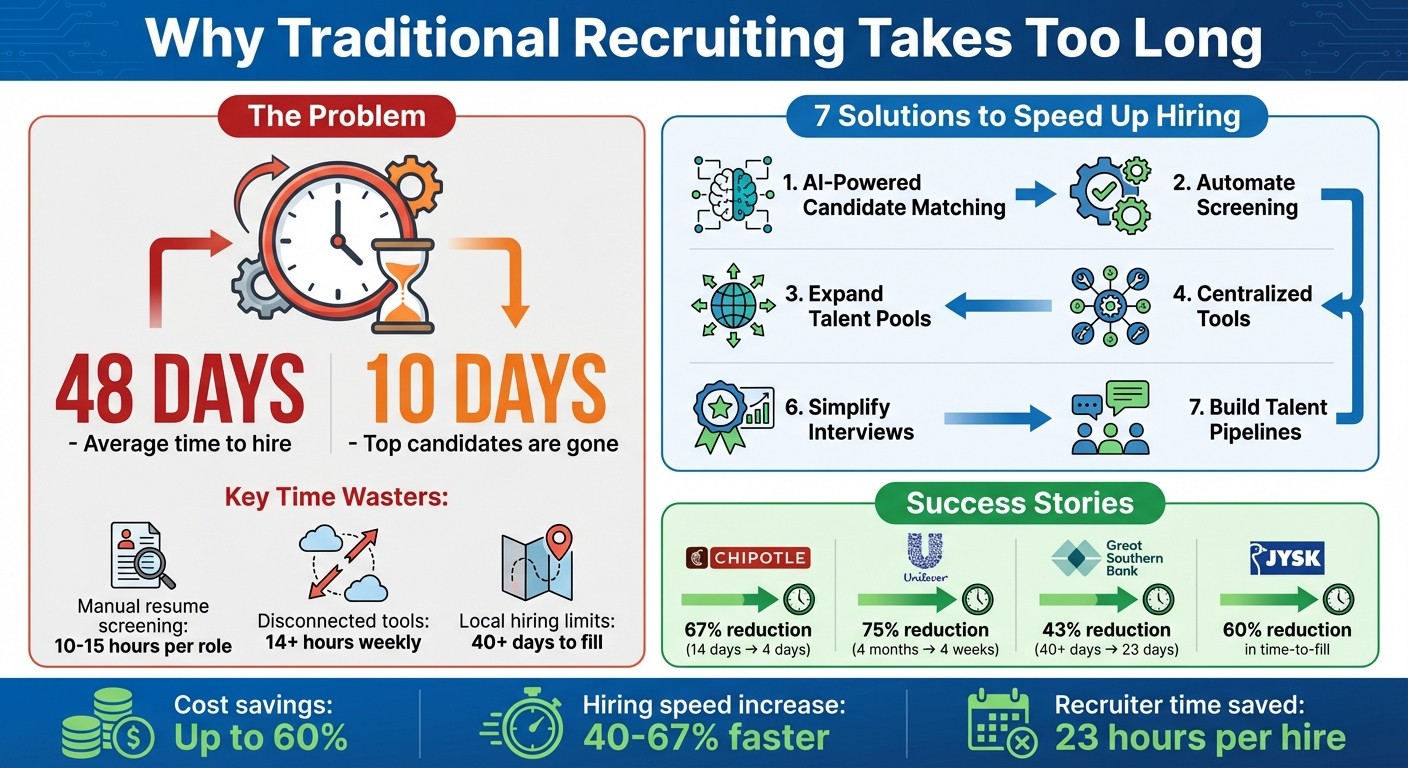
Recruiting is slow because outdated methods like manual resume reviews, fragmented tools, and long approval steps dominate the process. The result? It takes an average of 48 days to hire, while top candidates are gone in just 10 days. This mismatch leads to missed opportunities, overworked teams, and costly delays.
Key Problems:
Manual resume screening wastes 10–15 hours per role.
Disconnected tools create inefficiencies, adding 14+ hours weekly.
Local hiring limits talent pools, stretching timelines beyond 40 days.
7 Solutions to Fix This:
AI-Powered Candidate Matching: Quickly find top talent using AI tools.
Automate Screening: Save hours with standardized assessments and chatbots.
Expand Talent Pools: Tap into global marketplaces for faster hiring.
Centralized Tools: Use one platform to track and manage hiring.
Skills-Based Evaluation: Focus on abilities over resumes.
Simplify Interviews: Reduce rounds and set strict deadlines.
Build Talent Pipelines: Maintain a pool of pre-qualified candidates.
Companies like Unilever, Chipotle, and Quora have cut hiring times by 40–67% using these methods. Modern tools not only speed up hiring but also reduce costs by up to 60%. If your process is slow, it's time to rethink your approach.
Traditional Recruiting Timeline Problems and Solutions Statistics
The AI Recruitment Blueprint: Automating Hiring from Prospecting to Payroll

Why Traditional Recruiting Is So Slow
Recruitment often feels like a drawn-out process, with several roadblocks that eat up time and, unfortunately, cost companies access to top-tier talent. Let’s break down the main reasons behind these delays.
Manual Resume Screening Drains Time
Sorting through resumes by hand is a massive time sink for recruiters - taking up to 10 to 15 hours per position. With hundreds of applications flooding in for each role, it’s no surprise recruiters only spend about seven seconds skimming each resume. That’s barely enough time to gauge whether a candidate is a good fit.
Adding to the challenge, about one in three Americans embellishes their resumes. Specifically, 46% exaggerate their experience, and 40% inflate their skills. Verifying these claims manually slows things down even more. To combat this, Unilever turned to AI for initial resume screening and introduced gaming-based assessments for its graduate program in 2024. The results? Unilever slashed its hiring timeline from 4 months to just 4 weeks, saving over 50,000 hours of recruiter time annually.
Disconnected Tools Cause Workflow Headaches
Recruiters often juggle between email, spreadsheets, and calendars, which means manually transferring data across platforms. This inefficiency eats up about 14 hours per week. On top of that, the lack of a centralized system increases the chances of losing important candidate information, leaving hiring managers without a reliable way to track progress.
Scheduling interviews is another major pain point, often adding weeks to the process. Quora tackled this issue by using Metaview’s AI tool to automate interview note-taking and feedback collection. This change reduced their candidate feedback cycle from two days to just 10 minutes.
Limited Local Talent Pools Stretch Timelines
Sticking to local candidates can be a big disadvantage. While top candidates usually accept offers within 10 days, local hiring often drags on for more than 40 days. This mismatch forces companies to compete for a smaller pool of talent, sometimes resulting in settling for less-qualified hires simply due to availability.
Great Southern Bank faced this exact issue, seeing a 60% drop in applications and delays caused by manual processes. By widening its reach with video interviews and digital assessments, the bank managed to cut its average time-to-hire from over 40 days to 23 days - a 43% improvement - while doubling the number of roles filled.
7 Solutions to Speed Up Your Hiring Process
These strategies tackle common hurdles in hiring, helping you shave weeks - sometimes months - off your recruitment timeline. By addressing bottlenecks directly, these methods streamline the process for faster and more efficient outcomes.
1. Use AI-Powered Candidate Matching
AI can revolutionize candidate matching by quickly identifying suitable applicants from internal databases, LinkedIn, and public profiles. Using semantic search, AI tools analyze context, skills, and experience to find the best fits.
Take Chipotle Mexican Grill as an example. They implemented a conversational AI assistant, "Ava Cado", to handle applications and screening for high-volume hiring. This reduced their average time-to-hire from 14 days to just 4 - a 67% improvement. AI tools also rank candidates based on job requirements, allowing recruiters to focus on a pre-qualified shortlist instead of sifting through hundreds of resumes.
Interestingly, 70% of the workforce consists of passive talent - individuals not actively job hunting but open to the right opportunity. AI tools can uncover these candidates and use predictive analytics to identify those most likely to accept an offer.
To maximize the benefits, ensure your AI tools integrate seamlessly with your Applicant Tracking System (ATS). This allows access to historical candidate data while keeping human recruiters involved in final decisions to assess fit.
Once AI matching is in place, you can further speed things up by automating screening and assessments.
2. Automate Screening and Early Assessment
Automation drastically reduces screening time by using standardized assessments that rank candidates objectively and reduce bias.
For instance, JYSK equipped 3,500 hiring managers with mobile tools to speed up candidate reviews, cutting time-to-fill by over 60%. Similarly, Great Southern Bank reduced screening time by 60% with video interviews and role-specific assessments. This is crucial, as 62% of candidates drop out of hiring processes lasting more than three weeks.
AI chatbots add another layer of efficiency by providing 24/7 interaction, answering FAQs, and updating candidates instantly. This is critical since top talent is typically available for only about 10 days. Automating repetitive tasks can also free up 5 to 10 hours per week for recruiters to focus on strategic work.
Start small by automating one bottleneck, like high-volume screening for a specific department. Set a strict 48-hour feedback deadline after automated screening to keep the process moving.
3. Access Global Talent Marketplaces
Restricting your search to local candidates can limit your options and lead to compromises. Global talent marketplaces expand your reach, offering pre-vetted candidates from various regions and delivering shortlists in days instead of weeks.
Unlike traditional job boards that cater to active job seekers, global marketplaces tap into the broader pool of passive candidates, who make up a significant portion of the talent market. Considering top-tier candidates are often off the market within 10 days, this approach is essential.
Platforms like Caddie AI connect companies with expert headhunters in major tech hubs, using AI to ensure only qualified candidates are presented. This approach delivers shortlists in under 24 hours, reduces average hiring time to less than 21 days, and cuts costs by up to 60%. For context, the global median time-to-hire is 38 days, varying by country - from 32 days in Australia to 55 days in Germany.
Maintain a database of strong candidates who didn’t make the final cut and those flagged for future opportunities. This creates a warm pipeline, ready when a role opens up.
4. Centralize Your Hiring Workflow
Using fragmented tools like email, spreadsheets, and calendars can slow down your hiring process. A centralized platform simplifies everything by consolidating tasks into one system. Disconnected tools not only waste time but also risk losing critical candidate information. Even scheduling interviews can add weeks to the timeline.
For example, Quora used Metaview’s AI tool to automate note-taking and feedback collection during interviews, reducing the feedback cycle from two days to just 10 minutes.
Automated scheduling tools can also make a big difference. Allow candidates to book directly into interviewers’ calendars, cutting out back-and-forth emails and shortening the interview phase by over 50%.
5. Focus on Skills-Based Evaluation
Shifting from resume-based assessments to skills-based evaluations can speed up hiring decisions while improving hire quality. Instead of relying on academic credentials or big-name employers, focus on candidates’ actual skills and potential.
Methods like virtual job tryouts, coding challenges, and structured assessments provide objective insights into a candidate’s abilities. Companies using interview scorecards report a 99% adoption rate among teams, leading to more consistent evaluations. Additionally, 86% of employers believe that structured questions and scorecards help reduce bias.
For high-volume roles, create repeatable workflows with pre-set interview guides and evaluation criteria to standardize and accelerate decisions.
6. Redesign Your Interview Process
A lengthy interview process can cost you top candidates. If your timeline exceeds the 10-day window that top talent typically remains active, you risk losing them. Filling technical roles can take 40 to 60 days, while executive searches often exceed 90 days - delays that today’s competitive market can’t afford.
Streamline your process by reducing the number of interview rounds. Panel interviews, for instance, allow multiple perspectives to be gathered in one session. Set clear deadlines for decisions at each stage to avoid unnecessary delays.
Conduct a one-week audit of your last five closed roles to identify where delays occur - whether it’s scheduling, feedback collection, or decision-making - and address those bottlenecks immediately.
7. Build a Continuous Talent Pipeline
Waiting for a role to open before sourcing candidates puts you perpetually behind. A continuous talent pipeline of pre-qualified candidates eliminates this lag, cutting sourcing time drastically when vacancies arise.
Keep relationships alive with candidates who performed well in previous cycles, nurture industry contacts, and engage passive talent. Partnering with expert headhunters can also ensure you’re always connected to top-tier candidates.
"AI transforms this process from artisanal hunting into strategic, data-driven farming." - The Talent Lab
With AI sourcing agents, generating a quality longlist for hard-to-fill roles takes minutes rather than days. Use predictive analytics to monitor your hiring funnel in real time, identify drop-off points, and adjust your strategy to keep the pipeline flowing.
How Caddie AI Speeds Up Tech Hiring
Caddie AI combines cutting-edge AI-powered candidate matching with a network of expert headhunters spread across major tech hubs worldwide. By using semantic search technology that understands context, skills, and experience, the platform delivers a pre-qualified, AI-ranked shortlist in less than 24 hours. This approach not only speeds up candidate screening but also expands your reach to include both active and passive talent globally.
With its focus on global talent, Caddie AI breaks through local hiring limitations, delivering shortlists faster and reducing the average hiring time to under 21 days - well below the global median of 38 days.
Unlike traditional recruitment models that often involve hefty upfront fees, Caddie AI operates on a pay-only-when-you-hire basis. This eliminates upfront costs while ensuring candidates align with both job requirements and company culture. This unique pricing approach can reduce hiring expenses by as much as 60%.
By centralizing workflows and automating tasks like screening and ranking, Caddie AI allows recruiters to focus on final evaluations. Companies using AI-driven recruitment processes report hiring talent 26% faster, with recruiters saving an average of 23 hours per hire. Additionally, the platform enables multi-region collaboration, allowing multiple expert headhunters to work on the same role simultaneously. This expands your talent pool without adding to your internal workload, further enhancing both speed and quality in the hiring process.
Caddie AI's combination of AI efficiency, global talent access, and cost-effective pricing tackles common recruitment challenges head-on. It delivers faster hiring without compromising quality or exceeding budget limits, offering a smarter way to meet your tech hiring needs.
How to Measure Faster Recruiting Results
Once you've streamlined your hiring processes, the next step is to measure their impact. Tracking the right metrics ensures your efforts are paying off. For instance, time-to-fill tracks the total days from when a job is posted to when a candidate accepts the offer, while time-to-hire zeroes in on the time a candidate spends in your pipeline after applying. Globally, the median time to hire is 38 days. However, the average time to fill has increased to 66 days in 2025, up from 52 days in 2021. If your process takes 45 days but top candidates are off the market in just 10 days, you risk losing out on the best talent. These metrics are critical for gauging the efficiency gains from AI-powered hiring.
To ensure your faster processes maintain quality, track metrics like the offer acceptance rate, which reflects whether candidates are satisfied with your process. The current benchmark sits at 82%. Another key metric is cost-per-hire, which includes internal costs like recruiter salaries and external costs such as job board fees. Modern recruitment technology can reduce hiring costs by 37%, saving about $2,800 per hire.
Break down your hiring funnel - application, screening, interview, and offer stages - to identify bottlenecks. For example, in 2024, Australian healthcare provider KinCare cut its average time to fill from 40 days to just 18 days while maintaining a candidate approval rating above 90%.
Another essential metric is quality of hire, which you can monitor by assessing employee performance at intervals like 90 days, 6 months, and 1 year. This ensures that speed doesn’t come at the expense of finding the right fit. Additionally, tracking candidate response times and drop-off rates at each stage can help you address issues that might cause you to lose qualified applicants. Companies using AI in recruitment report hiring 26% faster, saving an average of 11 days per hire.
Lastly, evaluate recruiter productivity by calculating the hours saved per hire. Modern tools have reduced recruiter time from 28.5 hours to 11.2 hours per hire - a 60.7% improvement. In the U.S., recruiters handle an average of 54 hires per month, which is 85% higher than the global average, thanks to automation. These metrics not only validate your technology investments but also highlight areas for further improvement.
Conclusion
The traditional recruiting process is outdated. With prolonged time-to-fill and quick candidate turnovers, manual methods just don’t cut it anymore. The seven strategies discussed in this article aren’t just ideas - they’re proven methods that companies like Chipotle, Unilever, and Great Southern Bank have used to slash hiring times by 40% to 67%, all while maintaining or even boosting candidate quality.
Modern challenges demand modern solutions. By integrating AI into recruitment, you can streamline the process and focus on what matters most. Think about it: recruiters often spend 10–15 hours screening resumes for a single role or waste days juggling schedules with candidates. These tasks don’t require human intuition - they require efficiency. AI can handle them in minutes, allowing your team to dedicate time to building relationships and evaluating cultural fit, areas where human expertise truly shines.
The cost of doing nothing is steep. Every day a position stays vacant can cost 1.5–3× the role’s salary in lost productivity. On top of that, 93% of managers say hiring takes longer now than it did two years ago, and 42% link employee burnout directly to understaffed teams. These numbers highlight why change is no longer optional - it’s essential.
Case studies and metrics make it clear: modernizing recruitment is a must. As Glen Cathey from Randstad puts it, "AI is a tool to augment human judgment, not replace it. Successful organizations will find the right balance - using AI to handle routine tasks while preserving meaningful human interaction where it matters most". This balance is the key to better, faster hiring.
To get started, review your last five closed roles and identify the biggest delays. Then, pilot an AI solution in that area - whether it’s automated screening, intelligent scheduling, or accessing global talent through platforms like Caddie AI. This targeted approach sets the foundation for smarter, quicker hiring. The real question isn’t whether you should modernize your recruiting process - it’s whether you can afford not to.
FAQs
How does AI make the hiring process faster and more efficient?
AI has transformed the hiring process by taking over repetitive tasks and offering quicker, data-backed insights. It can sift through resumes, match candidates to specific job criteria, and rank applicants, cutting down the time to fill roles. In fact, some companies have reported reducing their hiring timelines by as much as 40%, which translates to saving both time and money.
Some standout features include AI-powered tools for finding candidates, predictive screening to evaluate skills and compatibility, and automated scheduling that eliminates endless email exchanges. AI also improves the candidate experience with 24/7 chatbots and helps craft job descriptions that attract the right talent. These innovations free up recruiters to focus on more strategic tasks, creating a smoother and faster hiring process overall.
What are the advantages of accessing a global talent pool?
Expanding your hiring efforts to include a global talent pool opens up access to a broader and more varied group of qualified professionals. This not only helps fill positions faster but also does so more efficiently. By tapping into international candidates, companies can reduce the time it takes to hire, avoid productivity gaps caused by unfilled roles, and even cut recruitment costs. For instance, hiring offshore talent can often be more cost-effective on a daily basis compared to relying solely on domestic candidates.
A global hiring strategy also boosts flexibility and efficiency, especially with the help of technology like AI-powered recruiting tools. These tools simplify the screening process, making it easier to address local talent shortages, diversify skill sets, and enhance employer branding by showcasing a commitment to inclusive hiring. Moreover, sourcing talent from around the world increases the chances of discovering fresh perspectives and niche expertise, which can be particularly valuable for tech companies and startups looking to innovate.
Why should companies prioritize skills-based evaluations over traditional resume reviews?
Focusing on skills-based evaluations allows employers to see what candidates can actually do rather than just what they say they can do on a resume. Traditional resumes often emphasize job titles, years of experience, or education - none of which necessarily guarantee someone has the skills needed for the job. By testing practical abilities like coding, technical know-how, or problem-solving, companies can make smarter hiring choices and avoid mismatches.
This method also helps reduce unconscious bias tied to factors like where someone went to school or their previous employers. As a result, businesses can access a broader and more diverse pool of talent. In fast-paced fields like tech and startups, where staying current and being adaptable are crucial, skills-based hiring ensures candidates are ready to tackle challenges and start contributing right away.