What is a contractor non-disclosure agreement and when do you need one?
Dec 16, 2025

A contractor non-disclosure agreement (NDA) is a legal document that ensures independent contractors keep your sensitive business information private. Unlike employee NDAs, these agreements are specifically designed for non-employees who may work with multiple companies. Contractor NDAs protect details like trade secrets, client lists, financial data, and intellectual property from being shared or misused.
Key Points:
Why You Need It: Contractors often work with multiple clients, increasing the risk of leaks or misuse of your information. NDAs help secure your competitive edge and protect your business.
What It Covers: Confidential information, contractor obligations, permissible disclosures, duration of confidentiality, and breach consequences.
When to Use It: Anytime you share sensitive information with freelancers, consultants, vendors, or during product development, partnerships, and investor presentations.
Drafting Tips: Be specific about what’s confidential, outline obligations, and ensure compliance with federal and state laws. Use a unilateral NDA when only your business shares information or a mutual NDA when both parties exchange sensitive details.
What Should Be Included in a Contractor NDA
How to Define Confidential Information
A solid contractor NDA starts with a clear definition of what counts as confidential information. This eliminates potential loopholes and ensures everyone is on the same page. Be specific - list categories like trade secrets, business strategies, client contact lists, product specs, financial forecasts, HR data, patents, computer code, research, inventions, processes, designs, engineering plans, marketing strategies, and proprietary know-how.
For example, if you're working with developers, include details like source code, API documentation, and technical diagrams. For marketers, you might specify campaign strategies or pricing models. The agreement should also clearly outline the contractor's responsibilities and any permissible disclosures.
Contractor Obligations and Permitted Disclosures
The NDA must spell out the contractor's obligations. These typically include keeping information confidential, using it only for the project, limiting access, and implementing security measures like encryption. It should also make it clear that contractors can't share this information with other clients or use it to benefit their own business ventures.
At the same time, the agreement should define exceptions to confidentiality. These might include situations where the information is already public (as long as the contractor didn't cause it to become public), was known to the contractor beforehand, was independently developed, or needs to be disclosed due to legal requirements - with prior notice, of course.
"A well-crafted NDA is only as good as how a recipient and individuals with access to confidential information comply with it." - Catherine M Bragg
After covering these obligations, the NDA should move on to define how long confidentiality lasts and what happens in case of a breach.
Agreement Duration and Breach Consequences
The confidentiality period should align with the nature of the information. For trade secrets - information that holds value because it's secret - these obligations can last indefinitely, as long as the information remains a trade secret. For other types of confidential information, perpetual terms often aren't enforceable, so most businesses stick to a duration of two to five years.
The NDA should also detail the consequences of a breach. This might include injunctive relief (court orders to stop further disclosure), monetary damages to cover losses and legal fees, or liquidated damages clauses that set a predefined compensation amount, provided it's reasonable under U.S. law.
When Should You Use a Contractor NDA?
Hiring Remote Contractors and Outsourcing Work
When you bring freelancers, consultants, subcontractors, or vendors on board and they need access to sensitive business information, an NDA becomes a must-have. This is particularly true when working with remote tech talent through platforms like Caddie AI or outsourcing tasks globally. Remote contractors often juggle multiple clients at once, which increases the potential for information leaks.
"When you hire contractors or remote workers, they often need access to proprietary information to fulfill their duties. They may need to see client lists, access financial information, and stumble across trade secrets and intellectual property (IP) not yet available to the public." - Ellen Sutton
The challenge with remote work lies in monitoring - it’s naturally harder to oversee contractors compared to in-house employees. Combine that with typically shorter working relationships, and the risk of confidential information being shared with competitors rises. Whether it's a vendor preparing a proposal, a developer working with proprietary code, or a service provider quoting a project, make sure the NDA is signed before any sensitive data is shared. This aligns with the broader need for confidentiality measures discussed earlier.
Working on Product Development Projects
NDAs are equally critical when collaborating on product-specific projects. For startups, protecting unpatented inventions, technology, or new ideas from being disclosed too early is vital. Designers, manufacturers, developers, and beta testers often require access to technical specifications, financial details, and other proprietary information during these projects.
Product development usually involves multiple third parties, each exposed to different aspects of your intellectual property. Without an NDA in place, there’s a risk that your ideas, prototypes, or technical specs could be repurposed for other clients - or even for the contractor’s own ventures. This is especially crucial in software development, where proprietary code could unintentionally (or intentionally) end up being reused in other projects.
Mergers, Acquisitions, and Investor Presentations
NDAs are just as important during high-stakes strategic discussions. Whether you're exploring joint ventures, mergers, acquisitions, or partnerships, these conversations often involve sharing highly sensitive details - financial data, customer lists, trade secrets, business strategies, and proprietary technology. If the deal falls through, any exposed information could harm your competitive position.
For entrepreneurs pitching to potential investors, NDAs help protect business plans and proprietary technology during presentations. Similarly, they’re essential when discussing asset purchases or exploring new business relationships. These agreements establish clear boundaries and create a legally binding obligation to maintain confidentiality. If sensitive information is misused, the NDA provides the legal grounds to seek damages or injunctions, reinforcing the importance of safeguarding your data in both operational and strategic contexts.
What Is a Non-Disclosure Agreement for Contractors?

How to Create and Enforce a Contractor NDA
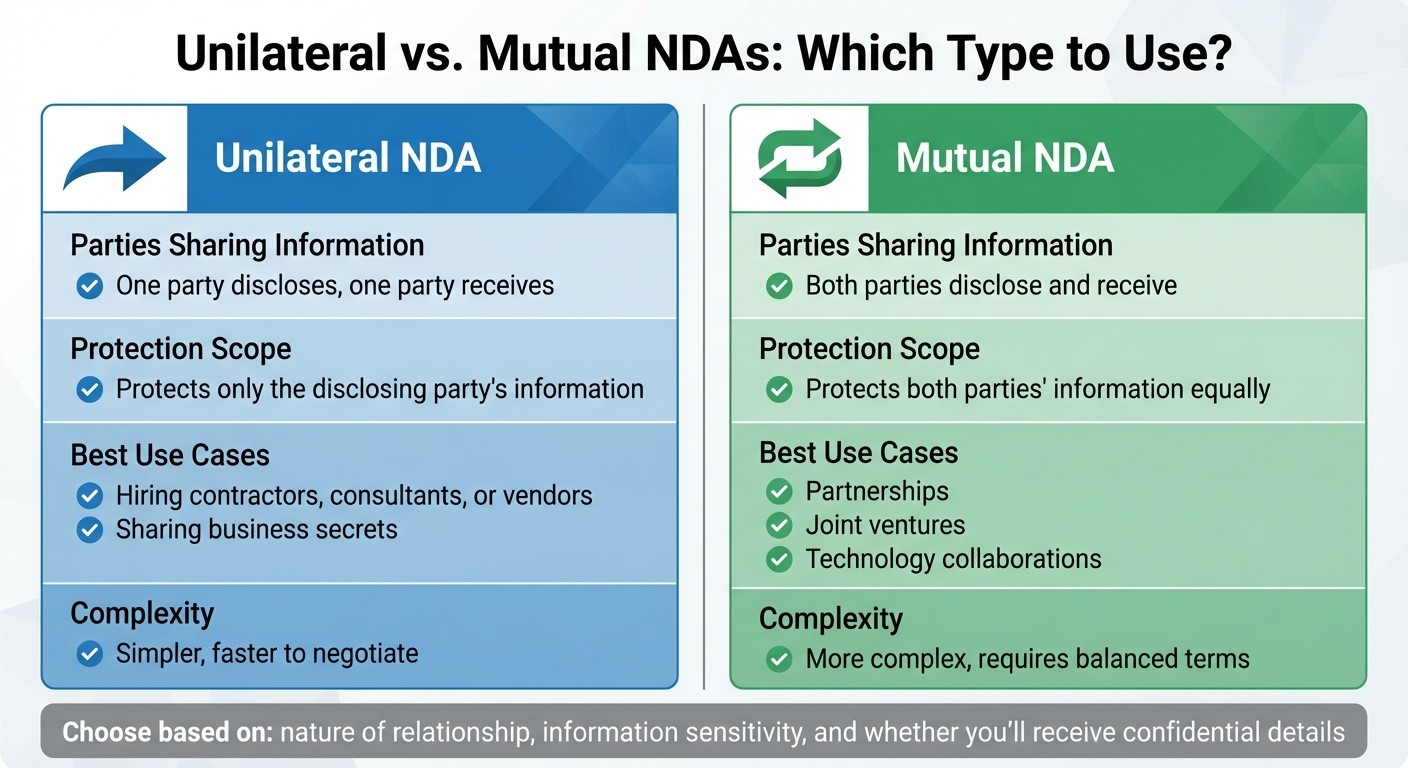
Unilateral vs Mutual NDA Comparison Chart
How to Draft a Contractor NDA
When drafting a contractor NDA, it’s crucial to customize it to meet both state and federal legal requirements, such as the Defend Trade Secrets Act of 2016. Start by clearly defining what qualifies as confidential information, using specific categories and examples. Include exclusions, like publicly accessible data or information already known to the contractor before the agreement. Consistency is key - make sure the definitions in your NDA align with those in other related documents.
Avoid using vague terms like "proprietary information", as courts often find these too broad. Instead, be specific. For example, list categories such as trade secrets, customer lists, business strategies, financial records, or intellectual property.
The document should clearly identify all parties involved, including their full legal names and addresses. If subcontractors will have access to the information, they must also be named. Outline the scope and duration of confidentiality obligations, specifying how the information can be used. For trade secrets, confidentiality may need to remain in place indefinitely. Include instructions for returning or securely destroying sensitive data when the contract ends. Additionally, specify which state's laws govern the agreement, as regulations can vary widely depending on the jurisdiction.
Make sure the NDA is signed before any sensitive information is shared. An NDA cannot retroactively protect information already disclosed. Be aware of specific legal limitations - states like California, with its "Silenced No More Act", and federal laws like the U.S. Speak Out Act of 2022, restrict the use of NDAs in cases involving sexual harassment or assault. Also, NDAs cannot prevent someone from reporting misconduct to government authorities.
A well-prepared NDA ensures your business information stays secure. Once your document is finalized, decide on the type of NDA that best fits your needs.
Unilateral vs. Mutual NDAs: Which Type to Use
Choosing the right type of NDA depends on the flow of sensitive information. A unilateral NDA is ideal when only one party - your business - is sharing confidential details with a contractor. This is common when disclosing proprietary processes, internal strategies, or trade secrets to an independent contractor, consultant, or vendor.
On the other hand, a mutual NDA is more appropriate when both parties will exchange sensitive information. This often occurs in collaborations like joint ventures, partnerships, or technology projects where both sides share proprietary materials.
Here’s a quick comparison:
Aspect | Unilateral NDA | Mutual NDA |
|---|---|---|
Parties Sharing Information | One party discloses, one party receives | Both parties disclose and receive |
Protection Scope | Protects only the disclosing party's information | Protects both parties' information equally |
Best Use Cases | Hiring contractors, consultants, or vendors; sharing business secrets | Partnerships, joint ventures, technology collaborations |
Complexity | Simpler, faster to negotiate | More complex, requires balanced terms |
Think about the nature of your relationship, the sensitivity of the information being shared, and whether you expect to receive confidential details from the contractor. If you’re unsure, consult legal counsel to ensure the NDA type aligns with your needs and legal requirements. Once the appropriate NDA is in place, you’ll be better positioned to handle any potential breaches.
What to Do When an NDA is Violated
If a contractor violates an NDA, it’s important to act quickly and systematically. Start by collecting evidence of the breach - document what information was disclosed, when it happened, and who received it. Keeping detailed records of all information exchanges can make a big difference.
Next, send a formal written notice to the contractor. This should outline the breach, reference the specific NDA clauses that were violated, and demand they stop any unauthorized disclosure immediately. You should also request the return or destruction of all confidential materials. In many cases, addressing the issue directly can resolve the situation.
If the contractor doesn’t comply or the breach causes significant harm, legal action may be necessary. Your NDA should outline remedies for violations, such as contract termination, monetary damages, or obtaining a court order to prevent further disclosure. Enforcement is critical - inefficient contract management can cost organizations 5% to 9% of their annual revenue. However, keep in mind that an NDA might be challenged in court if its terms are overly broad, lack proper consideration, or if you didn’t take reasonable steps to protect the information in the first place.
Conclusion: Protecting Your Business with Contractor NDAs
Contractor NDAs are a cornerstone of safeguarding your business when bringing in outside expertise. By granting contractors access to sensitive information, you open the door to potential risks if that information is mishandled. Consider this: over one-third of employees in the U.S. are bound by some form of written non-disclosure agreement. This statistic highlights how vital it is to establish clear legal boundaries, especially when working with contractors.
Unlike full-time employees, contractors often juggle projects for multiple companies, sometimes even competitors. Without proper agreements in place, they could inadvertently - or intentionally - share proprietary strategies, customer lists, or other sensitive details. NDAs create enforceable boundaries to protect your business, ensuring that vital information remains secure.
A thoughtfully drafted NDA not only prevents leaks but also fosters trust, enabling you to collaborate effectively. Whether you're innovating new products, negotiating partnerships, or working with remote professionals, NDAs provide the framework for secure and productive relationships.
Key Takeaways
Here’s a quick recap of how NDAs can secure your business:
Clearly define confidential information.
Be specific about what’s protected - trade secrets, customer data, financial records, and business strategies. Avoid vague language, which may not hold up in court. Exclude publicly available information or details the contractor already knows.
Get NDAs signed before sharing sensitive information.
Contractors should sign the agreement before gaining access to any confidential materials. Once information is disclosed, it’s too late to retroactively protect it.
Choose the right type of NDA.
Use a unilateral NDA if only your business is disclosing information. Opt for a mutual NDA when both parties are sharing sensitive details, such as in joint ventures or technology collaborations.
Outline obligations and consequences.
Specify how contractors can use the information, the duration of confidentiality, and what happens if the agreement is breached. For trade secrets, confidentiality might need to last indefinitely. Include provisions for returning or destroying materials at the end of the contract.
Follow legal requirements.
Be aware of laws like the U.S. Speak Out Act of 2022 and California’s "Silenced No More Act", which restrict the use of NDAs in cases involving workplace misconduct. NDAs cannot prevent individuals from reporting illegal activities to authorities.
Act quickly on breaches.
If an NDA is violated, document everything, issue a formal notice, and prepare to take legal action. Delays in enforcement can be costly - inefficient contract management can drain 5% to 9% of annual revenue.
When properly executed, contractor NDAs safeguard your business’s competitive edge, set clear expectations, and provide a legal safety net. They’re a must-have for any company working with external talent.
FAQs
What’s the difference between a unilateral NDA and a mutual NDA?
When only one party is sharing confidential information, a unilateral NDA is typically used. This agreement ensures the receiving party agrees to keep the shared details private. On the other hand, a mutual NDA is ideal when both parties are exchanging sensitive information and commit to safeguarding each other's confidentiality.
The type of NDA you need depends on your specific situation. For instance, unilateral NDAs are often used when hiring contractors who will access proprietary information. Meanwhile, mutual NDAs are more common in partnerships or collaborations where both sides share valuable or sensitive data.
How can I make sure my contractor NDA follows state and federal laws?
When drafting a contractor NDA, it’s crucial to ensure it complies with both state and federal laws. Start by clearly defining what counts as confidential information and specifying the scope and duration of the agreement. Avoid vague or overly broad terms that could lead to legal challenges, and make sure the NDA reflects the laws in the contractor's jurisdiction.
Regularly consulting a legal professional to review and update your NDA is a smart move. This helps ensure the agreement stays current and respects legal rights, such as the ability to report unlawful activities or engage in whistleblowing without facing retaliation. By tailoring the NDA to meet legal requirements at both levels, you can protect your business while staying on the right side of the law.
What should I do if a contractor violates the NDA?
If a contractor violates a non-disclosure agreement (NDA), the first step is to gather solid evidence of the breach. This could include emails, documents, or other communications that clearly show the violation. Once you have this, review the NDA carefully to understand the contractor's obligations and the remedies specified in the agreement.
Next, consult with a qualified attorney to explore your options. Depending on the situation, you might consider sending a cease-and-desist letter, seeking financial compensation, or filing for an injunction to stop any further misuse of your confidential information. Acting quickly and following legal guidance is crucial to safeguarding your business.